
Loading, please wait...
LOT 0595
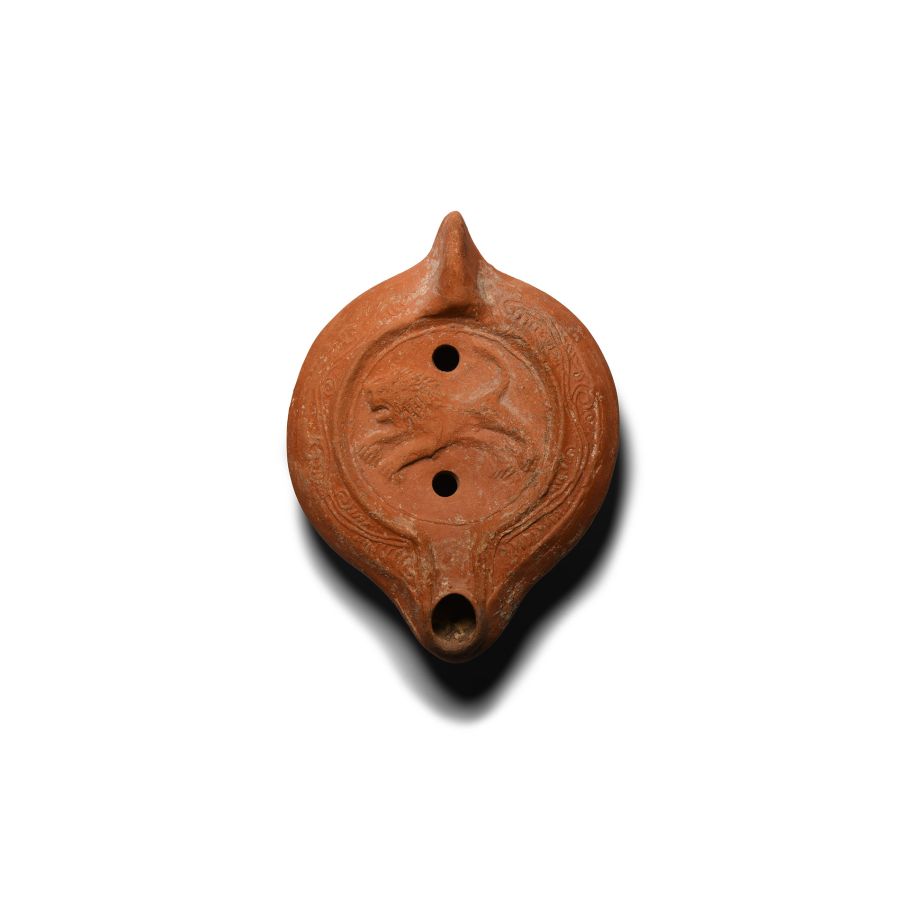
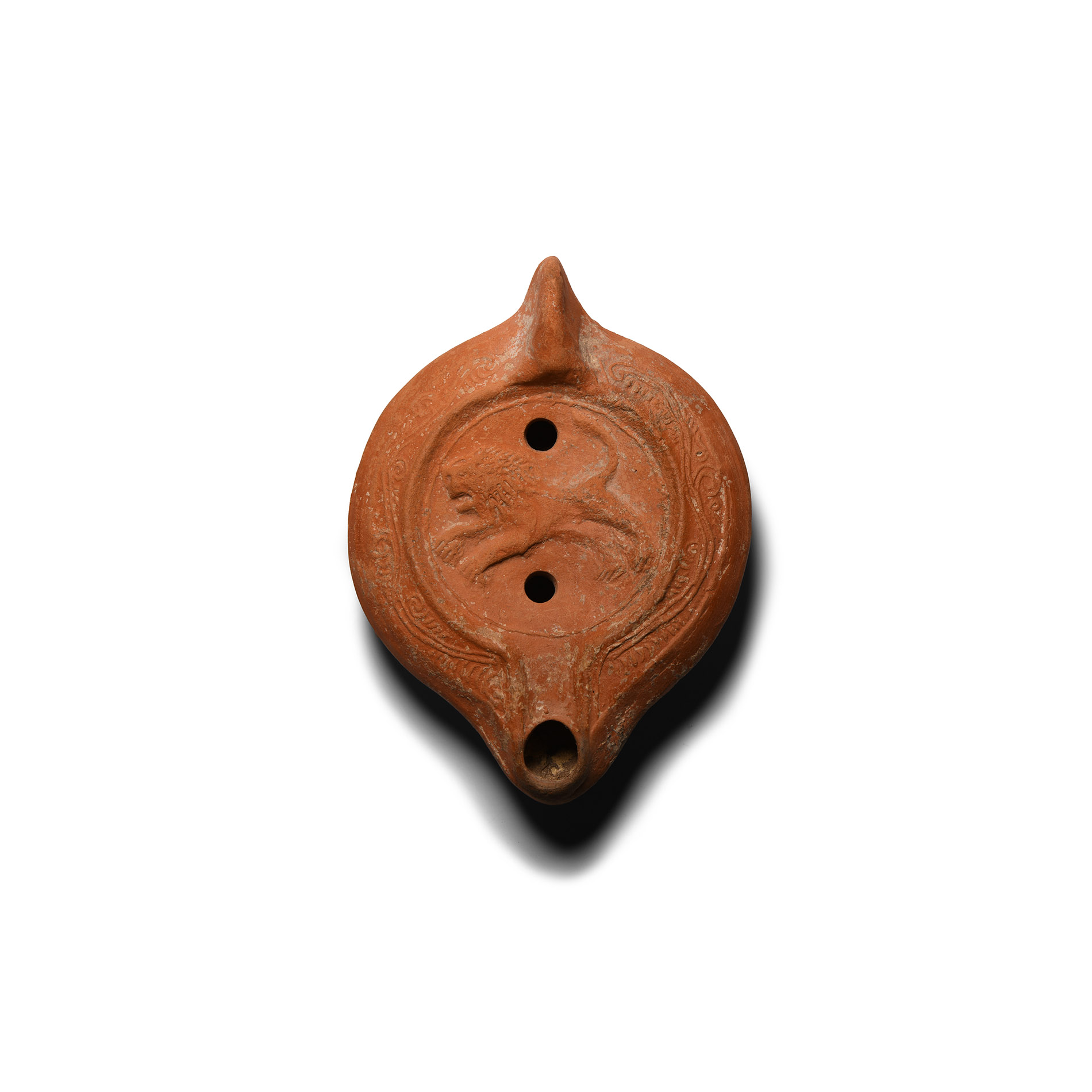
Large Roman Redware Lamp with Lion
4TH CENTURY A.D. OR LATER
5 1/4 in. (163 grams, 13.5 cm).
A clay lamp with rounded lug handle, shoulder with foliage in relief on each side, separated from the slightly concave discus by a ridge, which continues toward the round-tipped nozzle forming a wide channel between the discus and the wick hole; two equal-sized filling-holes at upper and lower part of the discus decorated with a lion running left, raised slightly convex base-ring with an additional inner ring.
ProvenanceAcquired from a central London Antiquities Dealers Association (ADA) member's gallery in 1990.
From the estate of a Lancashire gentleman.
See Bussière, J., Lindros Wohl, B., Ancient Lamps in the J. Paul Getty Museum, Malibu, 2017, p.349, no.488, for the type.
FootnotesThe present lamps seems to be molded in Terra Sigillata Africana (TSA) = African Red Slip (ARS) and can be related to Atlante types VI. The passage from lamps of Loeschcke type VIII in TSA with a heart-shaped nozzle ( = Atlante form I) to the channelled so-called Christian lamps ( = Atlante forms VIII and X, or Hayes types I and II) was progressively achieved by three factors: the transformation of the initially circular discus into an oval shape, the elongation of the nozzle, and the increased width and length of the channel.
CONDITIONTimeLine Auctions follows a vetting process to ensure the authenticity and legality of all items, reinforcing our commitment to integrity and responsible trading. Each antiquity, antique, and coin lot undergoes thorough examination by a vetting committee of at least ten external specialists, professional trade association members, scientists, and archaeologists: Our Vetting Process
AUCTIONS:
TimeLine is a leading auction house specialising in antiquities, ancient art, collectables, natural history, coins, medals, and books. Our auctions offer museums, collectors, historians, and enthusiasts the opportunity to acquire unique and historically significant pieces.
LOT 0595
Large Roman Redware Lamp with Lion
Estimate £250 - 350€290 - 410 (for guidance only)$340 - 470 (for guidance only)
-
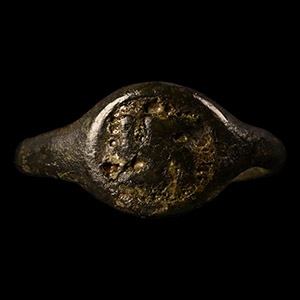
Roman Enamelled Ring with Fylfot
3rd-4th century A.D.Sold for (Inc. bp): £312
A bronze ring composed of a D-section hoop with overlapping arms, the discoid bezel displaying a fylfot with remains of an enamelled field. 2.17 grams, 22.62 mm overall, 19.94 mm internal diameter (approximate size British Q, USA 8, Europe 17.49, Japan 16)
Private collection formed since the 1940s. UK art market. Property of an Essex gentleman. -
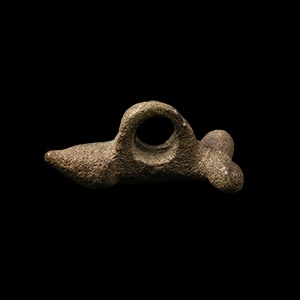
Roman Phallic Pendant
2nd-4th century A.D.Sold for (Inc. bp): £72
A bronze phallic pendant with stylised anatomical detailing and integral suspension loop. 8.28 grams, 30 mm
Acquired before 2000. From the collection of a European gentleman living in the UK. -
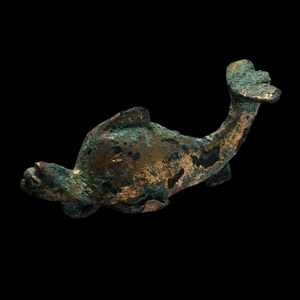
Roman Gilt Dolphin Fibula
2nd-3rd century A.D.Sold for (Inc. bp): £286
A gilt dolphin fibula brooch; pin lug and catchplate to reverse. 14.66 grams, 42 mm
Fine condition.
Acquired 1980-2015. Ex Abelita family collection.
