
Loading, please wait...
_900x900.jpg "Large Roman Iridescent Glass Vessel")
_200x200.jpg "Large Roman Iridescent Glass Vessel")
.jpg "Large Roman Iridescent Glass Vessel")
LOT 0608
Large Roman Iridescent Glass Vessel
3RD-4TH CENTURY A.D.
6 5/8 in. (143 grams, 17 cm high).
With broad shoulder, slender neck, stepped neck and upwards-flaring rim, two applied rectangular handles; iridescent surfaces.
ProvenanceAcquired early 1990s.
Ex private American collection; thence by descent.
Private collection since 1998.
Cf. The Corning Museum Of Glass, accession number 52.1.75, for similar.
CONDITIONTimeLine Auctions follows a vetting process to ensure the authenticity and legality of all items, reinforcing our commitment to integrity and responsible trading. Each antiquity, antique, and coin lot undergoes thorough examination by a vetting committee of at least ten external specialists, professional trade association members, scientists, and archaeologists: Our Vetting Process
AUCTIONS:
TimeLine is a leading auction house specialising in antiquities, ancient art, collectables, natural history, coins, medals, and books. Our auctions offer museums, collectors, historians, and enthusiasts the opportunity to acquire unique and historically significant pieces.
LOT 0608
Large Roman Iridescent Glass Vessel
Estimate £400 - 600€460 - 700 (for guidance only)$540 - 810 (for guidance only)
-
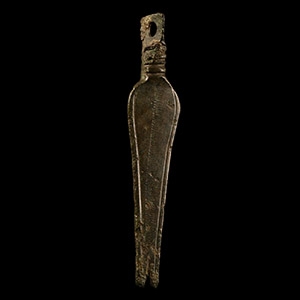
Roman Bronze Lanceolate Nail Cleaner
Circa 2nd-3rd century A.D.Sold for (Inc. bp): £33
Of pendant type with ribbed loop, flat-section neck with chamfered sides, piriform plate extending to split finial; central vertical panel of engraved Late Roman military style zig-zag ornament. 3.23 grams, 49 mm
Acquired late 1980s-early 1990s. Ex private collection, Nottinghamshire, UK. Acquired on the UK art market in 2012. Property of a Kent lady collector. -
.jpg)
Roman Gold Ring with Gryllos Gemstone
Circa 2nd-3rd century A.D.Sold for (Inc. bp): £4,160
Hollow-formed gold ring in Hellenistic style with beaded rim to the broad bezel, inset amethyst cabochon with intaglio gryllos motif; repaired, a marriage. 5.35 grams, 25.07 mm overall, 21.07 mm internal diameter (approximate size British T 1/2, USA 9 3/4, Europe 21.89, Japan 21)
From a collection of a London lady, acquired during 1990s-2000s. This lot has been checked against the Interpol Database of stolen works of art and is accompanied by search certificate no.11961-210872.
The gryllos comprises three radiating profile faces - two youthful females and the aged Silenus. -
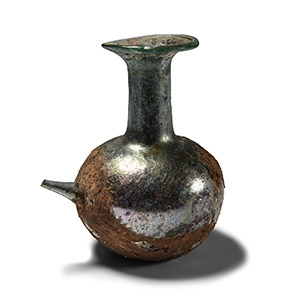
Roman Iridescent Glass Feeder Bottle
2nd-4th century A.D.Estimate: £300 - 400 (‡+bp*)
Opening Bid: £150
With bulbous bottle, tubular neck, broad everted rim and conical spout; extensive iridescence. 40 grams, 10.2 cm high
Acquired early 1990s. Ex private American collection; thence by descent. Private collection since 1998.
