
Loading, please wait...
LOT 0152
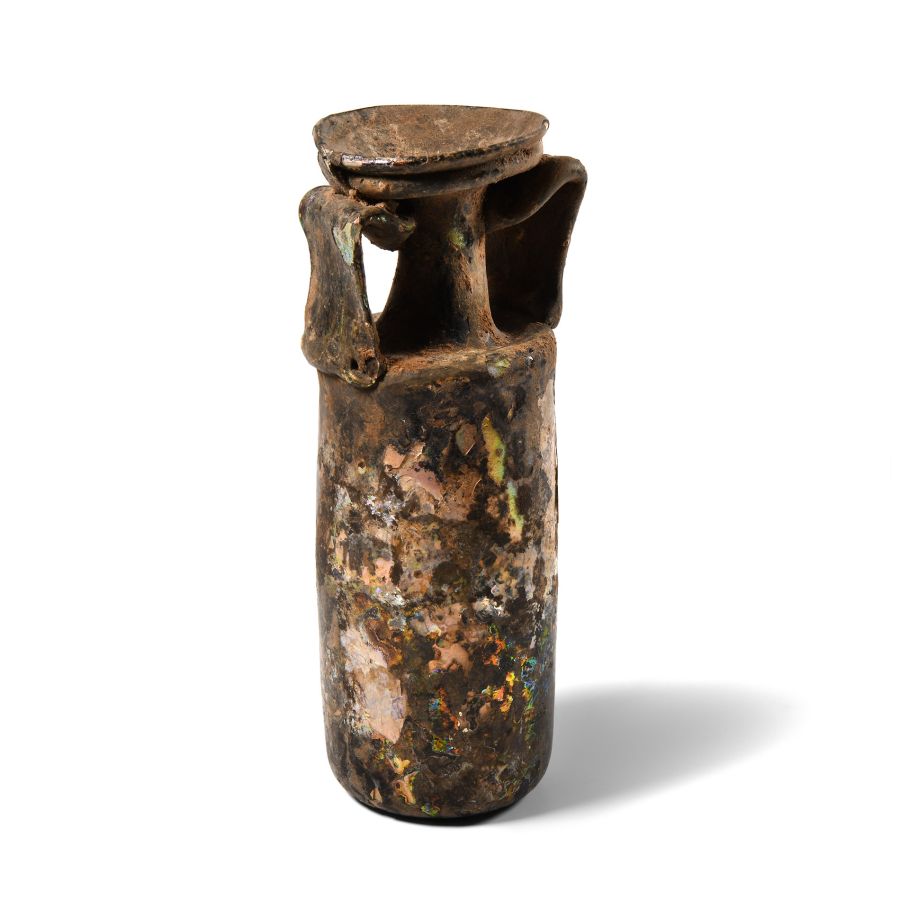
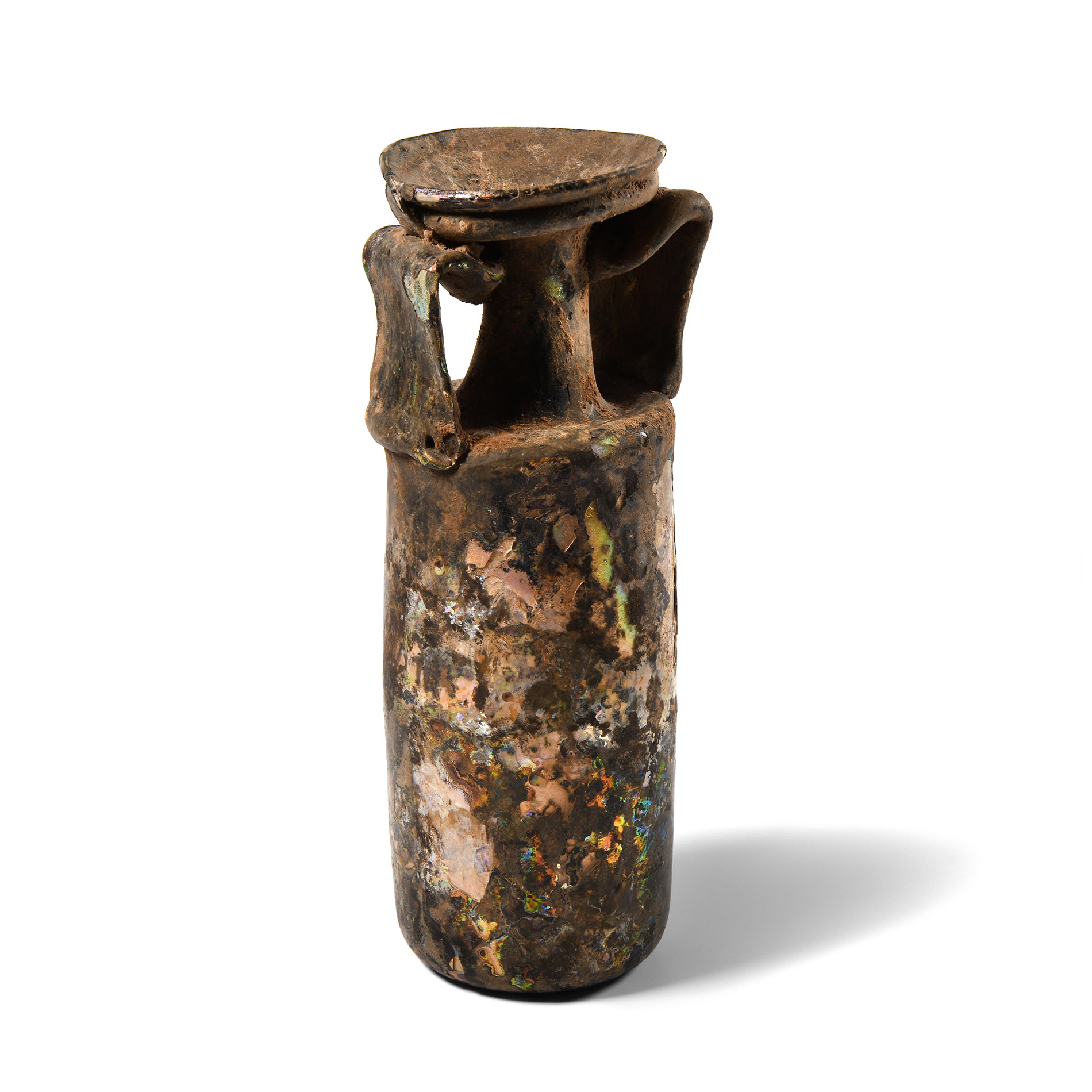
Large Roman Iridescent Glass Vessel
3RD-4TH CENTURY A.D.
6 5/8 in. (143 grams, 17 cm high).
A broad cylindrical bottle with broad shoulder, slender neck, stepped neck and upwards-flaring rim, two applied rectangular handles; iridescent surfaces.
ProvenanceAcquired early 1990s.
Ex private American collection; thence by descent.
Private collection since 1998.
Cf. The Corning Museum Of Glass, accession number 52.1.75, for similar.
CONDITIONTimeLine Auctions follows a vetting process to ensure the authenticity and legality of all items, reinforcing our commitment to integrity and responsible trading. Each antiquity, antique, and coin lot undergoes thorough examination by a vetting committee of at least ten external specialists, professional trade association members, scientists, and archaeologists: Our Vetting Process
AUCTIONS:
TimeLine is a leading auction house specialising in antiquities, ancient art, collectables, natural history, coins, medals, and books. Our auctions offer museums, collectors, historians, and enthusiasts the opportunity to acquire unique and historically significant pieces.
LOT 0152
Large Roman Iridescent Glass Vessel
Estimate £500 - 700€580 - 810 (for guidance only)$680 - 950 (for guidance only)
-
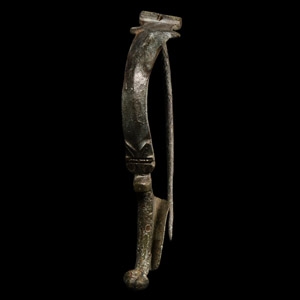
Large Roman Aucissa Bow Brooch with Wolf's Face
1st-2nd century A.D.Sold for (Inc. bp): £91
A large bronze Aucissa variant type bow brooch with annulet decoration to the head, narrow half-round cross-section bow; the lower bow and foot forming a stylised wolf's face with pellet eyes and curved muzzle; hinged pin and catch to the reverse. 36 grams, 94 mm
German art market before 2000. With a European gentleman living in the UK. Property of a Surrey gentleman.
The fibula belongs to the series C of the Buchem classification of variant Aucissa fibulae. According to Kovrig, these military fibulae were produced in specific centres like Siscia (Sisak) in Pannonia and distributed throughout the Empire because of the mobility of the army. -
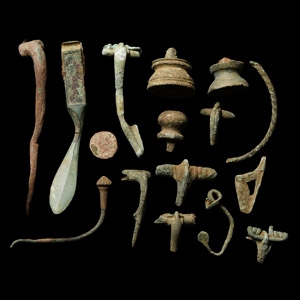
Roman Artefact Group
1st-4th century A.D.Sold for (Inc. bp): £52
A group of bronze artefacts comprising: two pommel or box mounts with concentric decoration, a section of a twisted wire bracelet, a dress pin, nice bow brooch fragments, a 4th century coin and a implement handle. 123 grams total, 13-82 mm
Found Rodings, Essex, UK. Acquired on the UK antiques market between 1974-1985. Albert Ward collection, Essex, UK. -
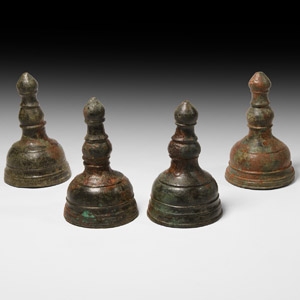
Roman Triclinium Finial Set
1st-4th century A.D.Estimate: £400 - 600 (+bp*)
Opening Bid: £200
A set of four copper-alloy triclinium (bed) finials, each with a bell-shaped body and baluster style finial; hollow to base. 1.18 kg total, 9.6-10.1 cm
Acquired before 2000. From the collection of a European gentleman living in the UK.
The Romans, like the Greeks, ate whilst reclined on beds. The eating bed (lectus triclinaris) was a luxury furniture item crafted by carpenters. From the 2nd century B.C., Romans started to create 'lecti aerati, inargentati, inaurati, eborati, testudinei,' i.e. beds made of wood and covered with bronze, silver, gold and ivory fittings (as in our specimens) or with scales of other precious material. Such elements were sometimes sculpted in the shape of an animal protome, or were simply bell-shaped, like our specimens.
