
Loading, please wait...
_900x900.jpg "Large Roman Green Mosaic Glass Fragment")
_200x200.jpg "Large Roman Green Mosaic Glass Fragment")
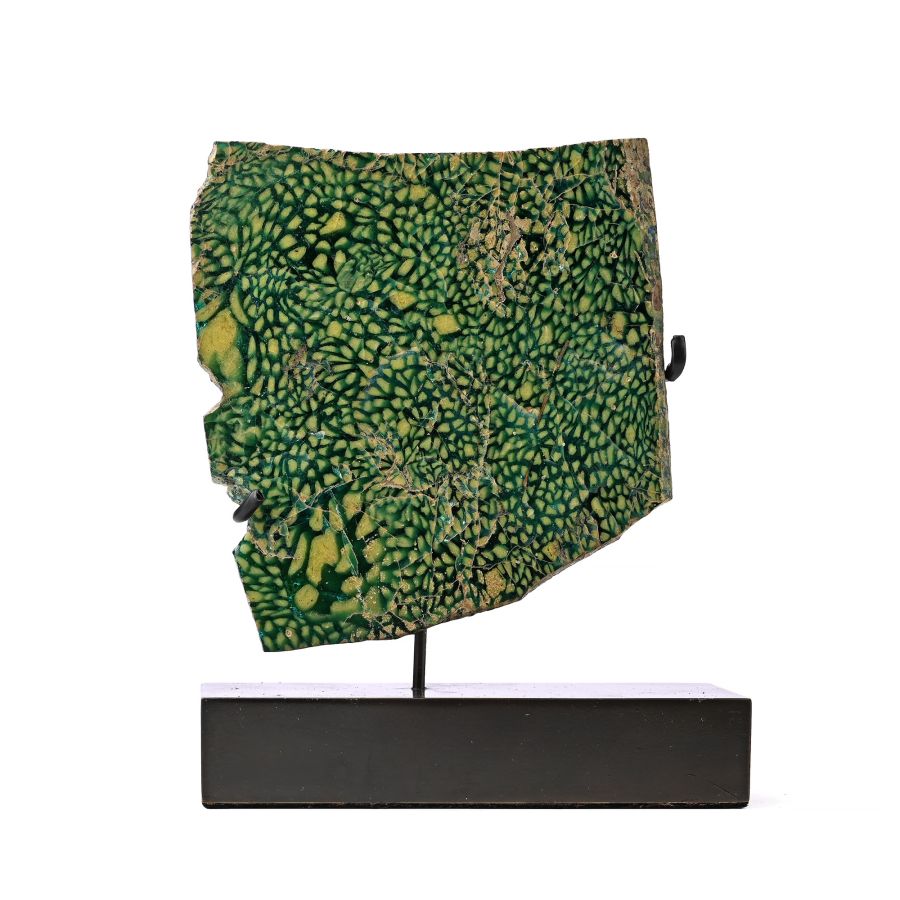

.jpg "Large Roman Green Mosaic Glass Fragment")
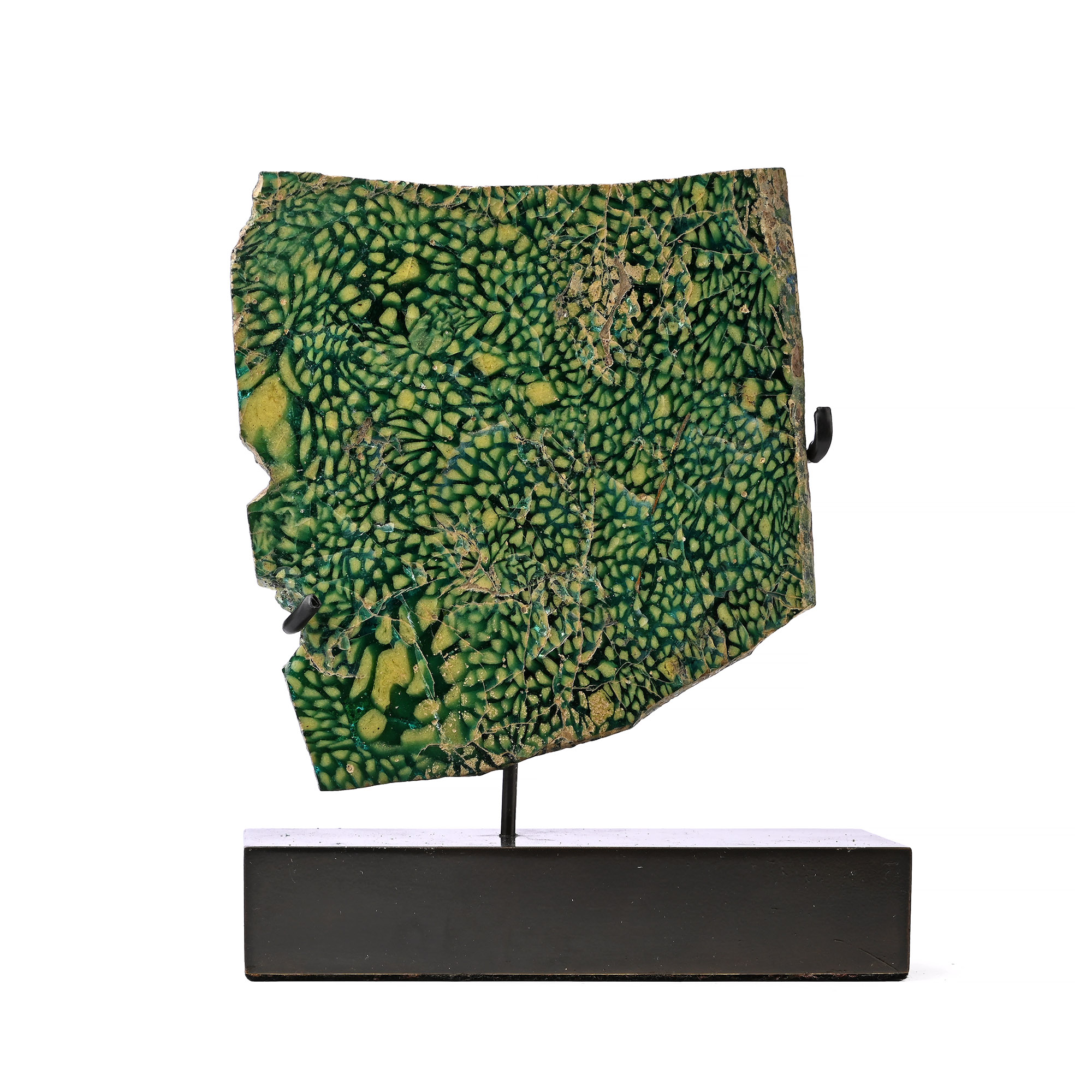
LOT 0148
Large Roman Green Mosaic Glass Fragment
LATE 1ST CENTURY B.C.-EARLY 1ST CENTURY A.D.
6 1/8 in. (193 grams, 15.5 cm (454 grams total including stand)).
Large fragment of green glass with white swirls and petals, accompanied by a custom-made display stand.
ProvenanceBearing an old collection number '240' on the reverse.
Dr Jutaro Kawabe, Nagoya, Japan, assembled during the 1960s-1980s.
with Hoshigaoka Gallery until the late 1990s.
This lot has been checked against the Interpol Database of stolen works of art and is accompanied by search certificate number no.13410-258950.
Cf. Goldstein, S.M., Pre-Roman and Early Roman Glass in The Corning Museum of Glass, New York, 1979, p.185, items 463,468,469,491 for type of glass green mosaic.
FootnotesThe decoration is well documented in the Eastern Roman Empire, especially the Syro-Palestinian coast. The most frequently occurring colours in these glass mosaics are opaque red, but green and blue tints are not uncommon.
CONDITIONTimeLine Auctions follows a vetting process to ensure the authenticity and legality of all items, reinforcing our commitment to integrity and responsible trading. Each antiquity, antique, and coin lot undergoes thorough examination by a vetting committee of at least ten external specialists, professional trade association members, scientists, and archaeologists: Our Vetting Process
AUCTIONS:
TimeLine is a leading auction house specialising in antiquities, ancient art, collectables, natural history, coins, medals, and books. Our auctions offer museums, collectors, historians, and enthusiasts the opportunity to acquire unique and historically significant pieces.
LOT 0148
Large Roman Green Mosaic Glass Fragment
Estimate £2,000 - 3,000€2,320 - 3,480 (for guidance only)$2,700 - 4,050 (for guidance only)
-
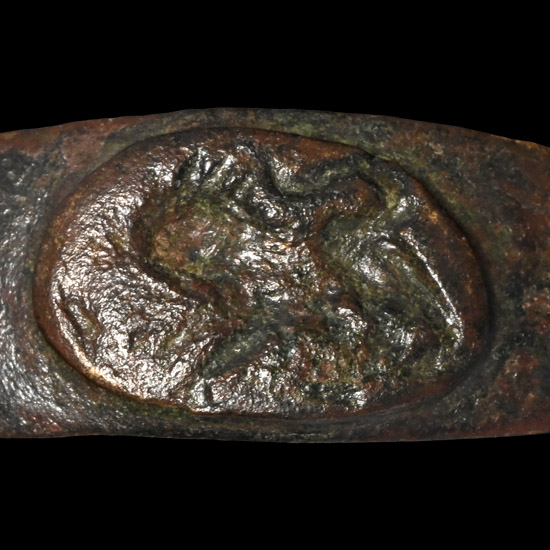
Roman Bronze Ring with Lion
1st-2nd century A.D.Sold for (Inc. bp): £46
The hoop expanding towards the angled shoulders, oval bezel with a leaping lion facing left. 4.71 grams, 23.21mm overall, 19.26 x 14.59 mm internal diameter (approximate size British K, USA 5 1/4, Europe 9.95, Japan 9)
Ex German art market, 2000s. Acquired from an EU collector living in London. From the collection of a Surrey, UK, gentleman. -
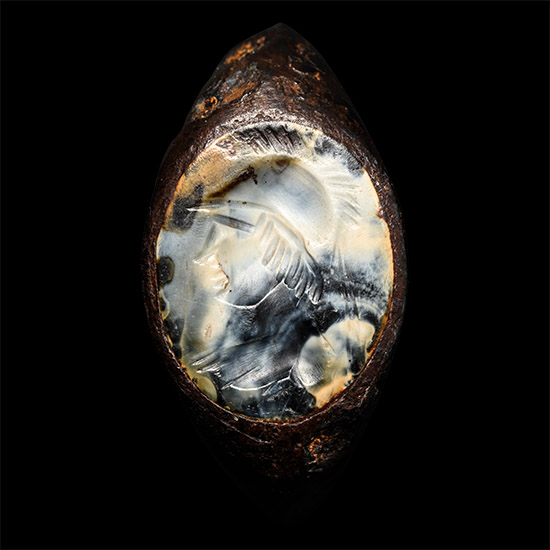
Roman Imperial Military Iron Ring with Burnt Agate Gemstone with a Helmetted Warrior
1st century A.D.Sold for (Inc. bp): £572
Comprising a slender D-section hoop expanding at the shoulders, oval bezel set with an intaglio of a young soldier wearing a crested helmet, either Minerva or Roma. 6.30 grams, 25.14 mm overall, 19.63 x 16.97 mm internal diameter (approximate size British P, USA 7 1/2, Europe 16.23, Japan 15)
UK private collection, acquired on the English market in the 2000s. -
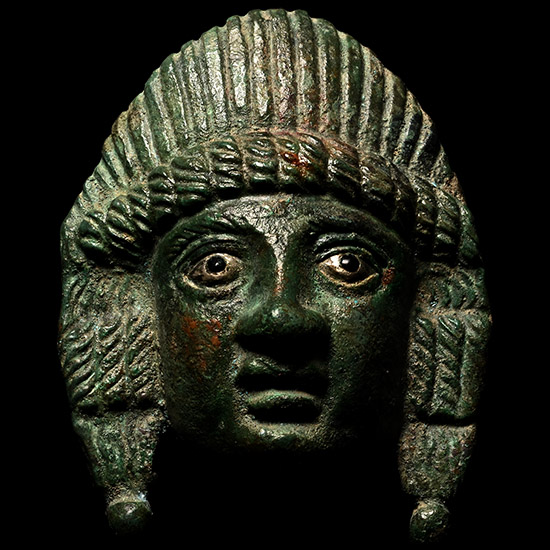
Roman Bronze Theatrical Mask Mount
2nd-4th century A.D.Sold for (Inc. bp): £624
Modelled in the half-round with large eyes and hair arranged in orderly curls, applied silver panels to the eyes and enamel pupils. 57.3 grams, 64 mm
Ex German art market, 2000s. Acquired from an EU collector living in London. From the collection of a Surrey, UK, gentleman.
