
Loading, please wait...
LOT 0676
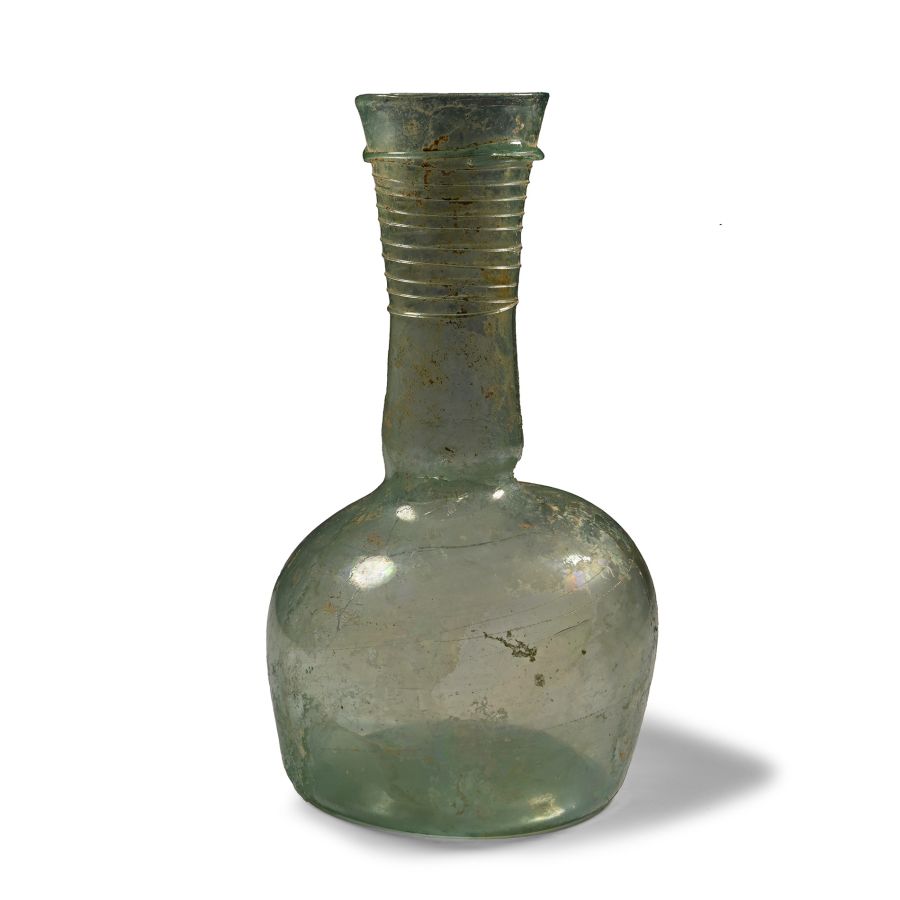
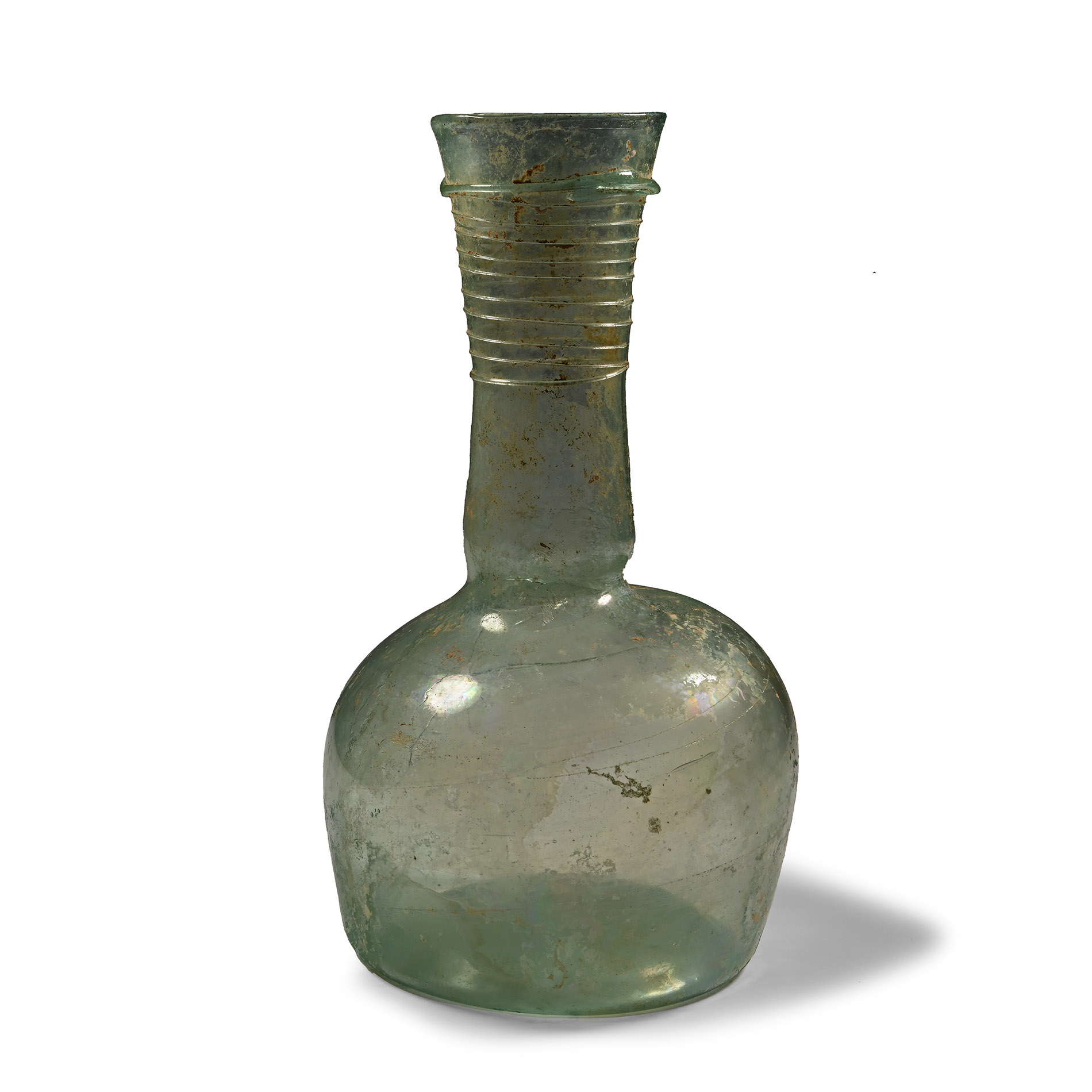
Large Roman Green Glass Bottle
2ND-4TH CENTURY A.D.
8 1/2 in. (170 grams, 21.7 cm).
Aqua glass, with rounded shoulder, tubular neck tapering slightly and flaring towards the mouth; applied trail to the upper neck, pontil base; some fine encrustations, slightly iridescent; reassembled from fragments, with small lacuna.
ProvenanceProf. Skalweit, Bonn, acquired in the 1970s.
Two labels on the base: "92" and "09-22 DRR".
Accompanied by a copy of an Art Loss Register certificate no.S00097255.
This lot is accompanied by an illustrated lot declaration signed by the Head of the Antiquities Department, Dr Raffaele D’Amato.
Cf. Whitehouse, D., Roman Glass in the Corning Museum of Glass, vol.1, New York, 1997, item 217, for type.
CONDITIONTimeLine Auctions follows a vetting process to ensure the authenticity and legality of all items, reinforcing our commitment to integrity and responsible trading. Each antiquity, antique, and coin lot undergoes thorough examination by a vetting committee of at least ten external specialists, professional trade association members, scientists, and archaeologists: Our Vetting Process
AUCTIONS:
TimeLine is a leading auction house specialising in antiquities, ancient art, collectables, natural history, coins, medals, and books. Our auctions offer museums, collectors, historians, and enthusiasts the opportunity to acquire unique and historically significant pieces.
-
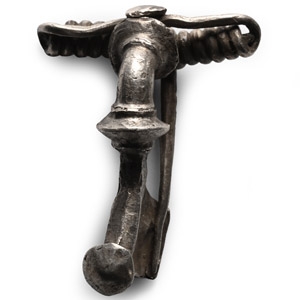
Roman Silver Trumpet Brooch
2nd-3rd century A.D.Sold for (Inc. bp): £130
With chord, spring and pin, and trumpet-shaped headplate; scooped collar to bow and discoid finial at base of flared foot; articulated pin intact; catchplate projecting from the reverse of the lower bow, curving at the outer edge to house the pin. 7.28 grams, 31 mm
Acquired from Coincraft, London, UK. From the private collection of Kenneth Machin (1936-2020), Buckinghamshire, UK; his collection of antiquities and natural history was formed since 1948; thence by descent. Accompanied by an original certificate of authenticity from Coincraft. This lot is accompanied by an illustrated lot declaration signed by the Head of the Antiquities Department, Dr Raffaele D’Amato. -
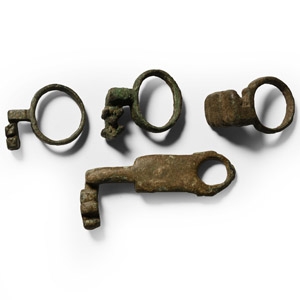
Roman Bronze Key Collection
1st-2nd century A.D.Sold for (Inc. bp): £142
Most comprising a narrow hoop, short shank, lateral lobe with teeth. 42 grams total, 26-53 mm
From an English collection formed before 2000. This lot is accompanied by an illustrated lot declaration signed by the Head of the Antiquities Department, Dr Raffaele D’Amato. -
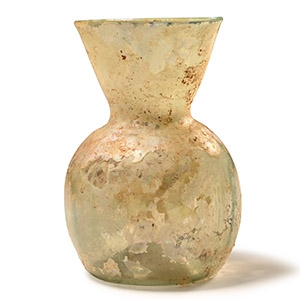
Roman Green Glass Vessel
4th-5th century A.D.Sold for (Inc. bp): £117
Transparent pale green with bulbous body, rounded lip, flared neck and concave base. 48 grams, 11 cm
Ex London, UK, collection, 1980-1990s. This lot is accompanied by an illustrated lot declaration signed by the Head of the Antiquities Department, Dr Raffaele D’Amato.
The small bottle can be associated with the Isings form 104b. There are some parallels from graves at Beit Ras, Jordan and Samaria-Sebaste. Some models of the type have faint ribs.
