
Loading, please wait...
LOT 0106
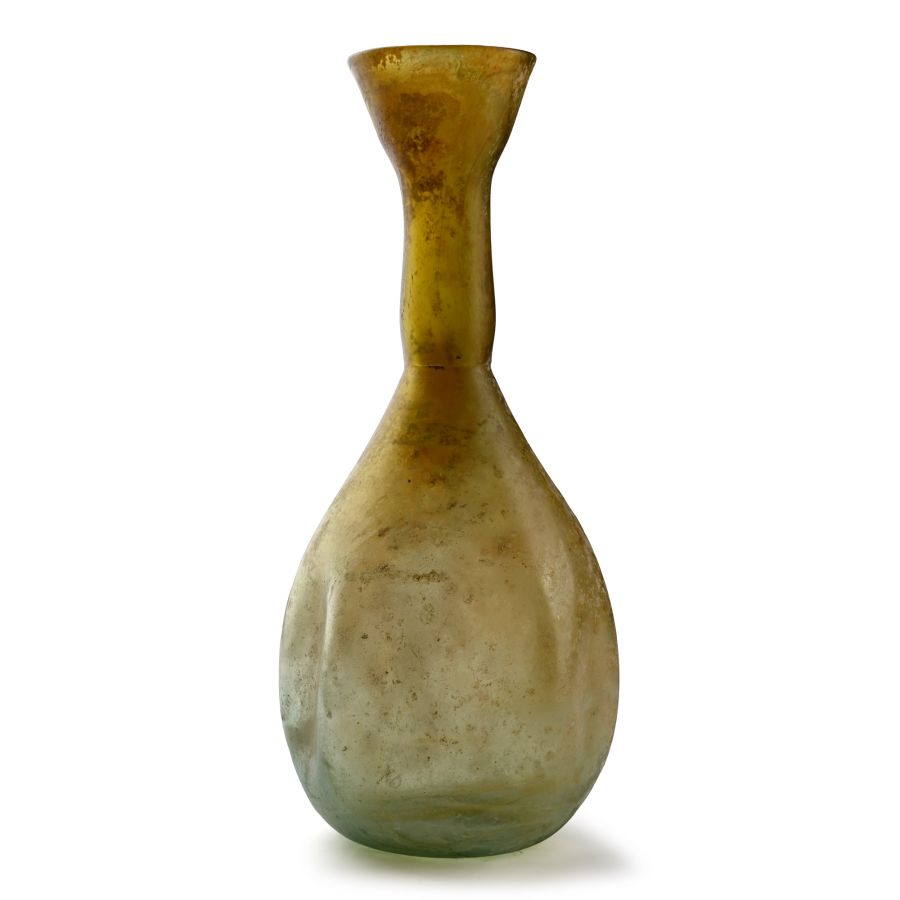
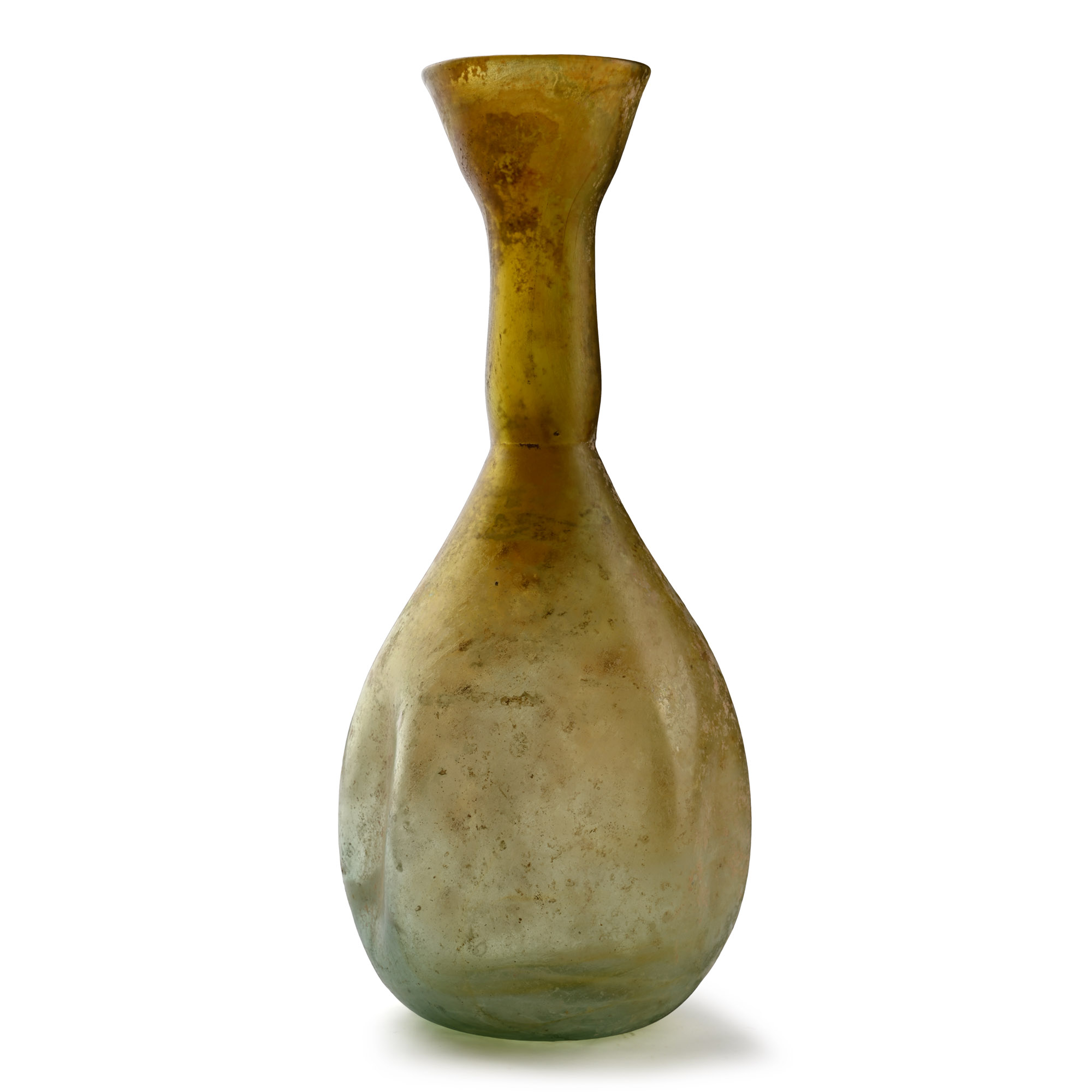
Large Roman Dimple-Sided Glass Flask
1ST-4TH CENTURY A.D.
9 5/8 in. (240 grams, 24.5 cm).
Comprising a piriform body with vertical fluting, flat base, tapering tubular neck with pinched and everted rim.
ProvenanceEx Mayfair, London, UK, gallery, 1990s-2000s.
From an important collection of glass, the property of a London gentleman.
This lot is accompanied by an illustrated lot declaration signed by the Head of the Antiquities Department, Dr Raffaele D'Amato.
Cf. Whitehouse, D., Roman Glass in the Corning Museum of Glass, vol.1, New York, 1997, item 236, for type.
CONDITIONTimeLine Auctions follows a vetting process to ensure the authenticity and legality of all items, reinforcing our commitment to integrity and responsible trading. Each antiquity, antique, and coin lot undergoes thorough examination by a vetting committee of at least ten external specialists, professional trade association members, scientists, and archaeologists: Our Vetting Process
AUCTIONS:
TimeLine is a leading auction house specialising in antiquities, ancient art, collectables, natural history, coins, medals, and books. Our auctions offer museums, collectors, historians, and enthusiasts the opportunity to acquire unique and historically significant pieces.
LOT 0106
Large Roman Dimple-Sided Glass Flask
Estimate £1,200 - 1,700€1,390 - 1,970 (for guidance only)$1,620 - 2,300 (for guidance only)
-
.jpg)
Roman Silver-Gilt Statuette of Mercury
1st-2nd century A.D.Estimate: £600 - 800 (+bp*)
Opening Bid: £300
Modelled in the round in advancing pose, with traveling cloak wrapped around his shoulder and left arm; petasos covering his hair and talaria on his feet. 8.76 grams, 37 mm
Acquired in the late 1980s-early 1990s. Private collection, London, UK. This lot is accompanied by an illustrated lot declaration signed by the Head of the Antiquities Department, Dr Raffaele D'Amato. -
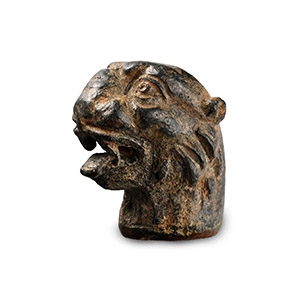
Roman Bronze Knife Pommel with Head of a Lion
1st-4th century A.D.Sold for (Inc. bp): £117
Hollow-formed with collar to the lower rim, voided mouth to accept a ring; probable knife pommel. 26.5 grams, 24 mm
From the collection of a gentleman, acquired on the London art market in the 1990s. This lot is accompanied by an illustrated lot declaration signed by the Head of the Antiquities Department, Dr Raffaele D'Amato. -

Roman Carnelian Gemstone with Figures
2nd-3rd century A.D.Sold for (Inc. bp): £351
Ellipsoid in plan with two incuse standing figures flanking two facing busts above a bar with 'XΛIΛ' and a perching bird. 0.59 grams, 13 mm
From the Fadel family collection, London, UK, 1970s. This lot is accompanied by an illustrated lot declaration signed by the Head of the Antiquities Department, Dr Raffaele D'Amato.
