
Loading, please wait...
LOT 0121
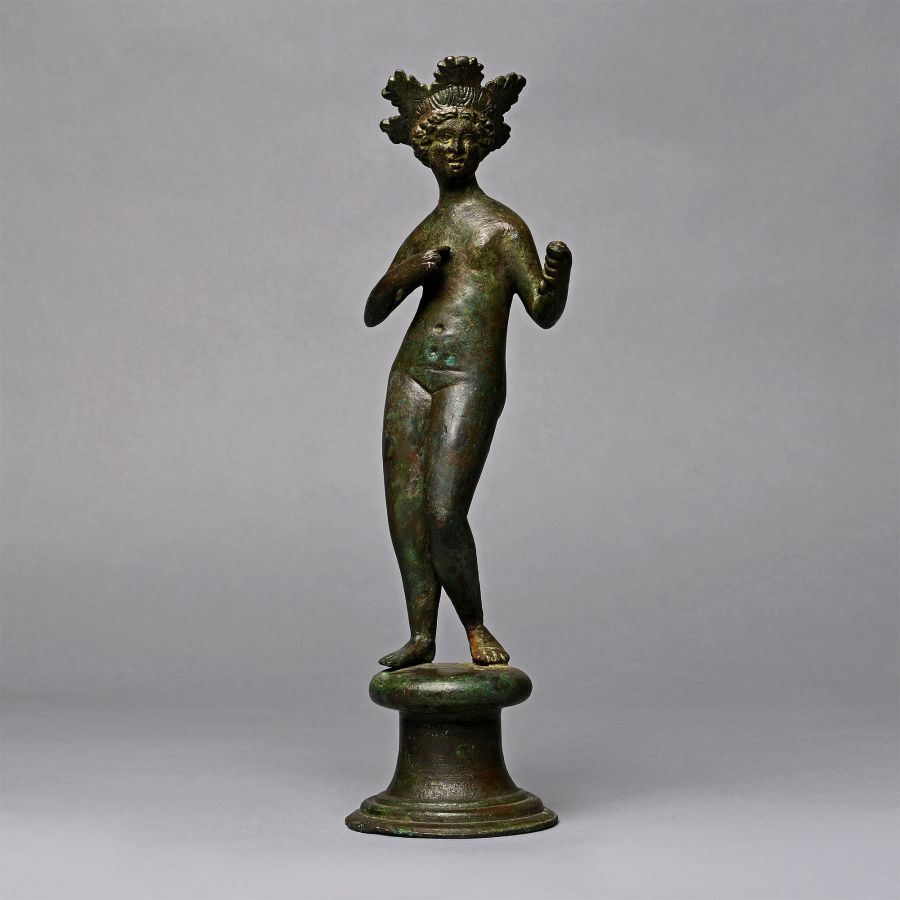
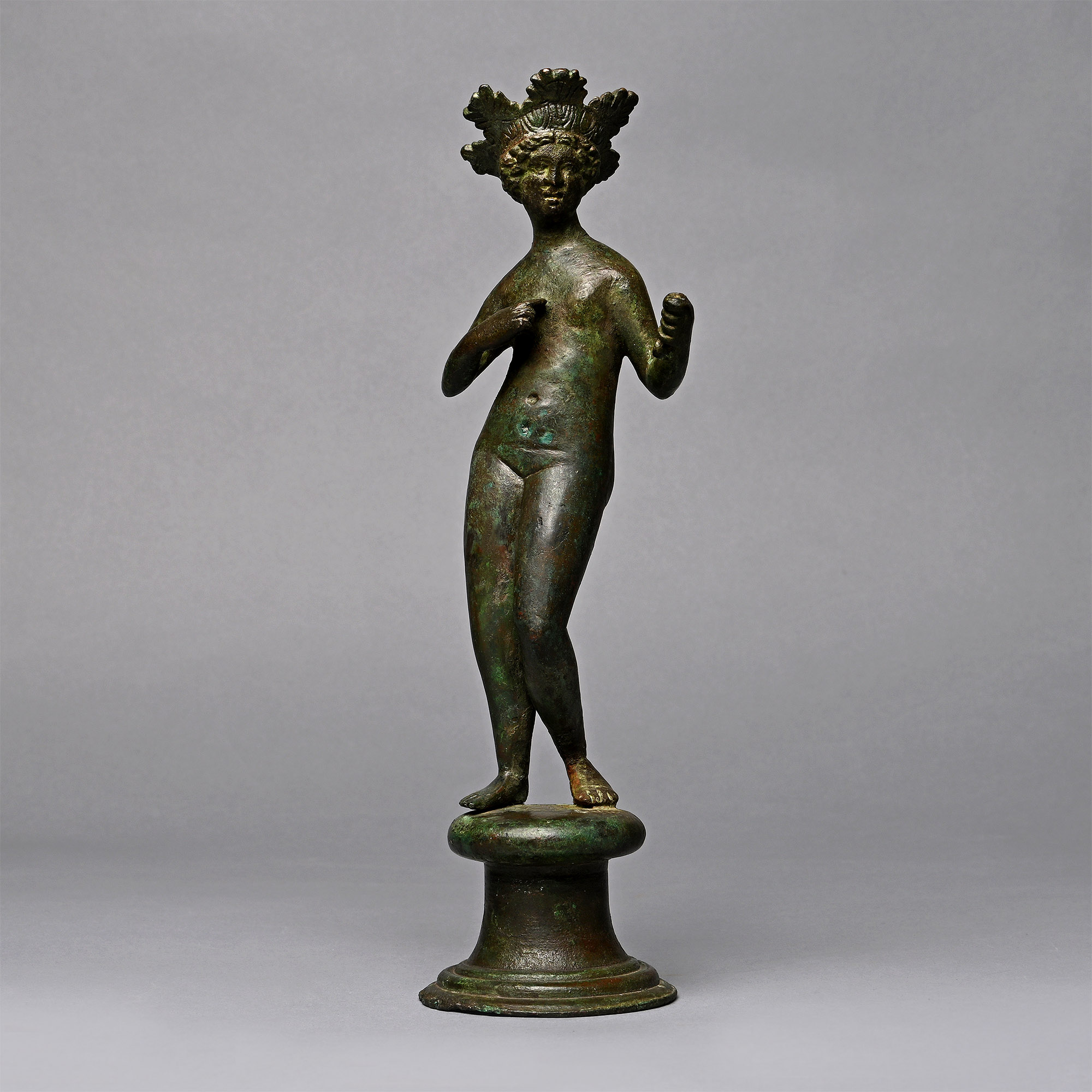
Large Roman Bronze Statue of Venus
1ST-2ND CENTURY A.D.
10 3/4 in. (996 grams, 27.3 cm).
Modelled in the round, the goddess standing nude on a socle base and holding a frond in her extended left hand; right hand with thumb and forefinger extended; crown of oak leaves encompassing her chignon.
Provenancewith Sotheby's, New York, 7 December 1973, no.78.
Private collection, London.
Accompanied by copies of the relevant Sotheby's catalogue pages.
Accompanied by an academic report by Dr Raffaele D’Amato.
This lot has been checked against the Interpol Database of stolen works of art and is accompanied by search certificate number no.12819-241350.
This lot has been cleared against the Art Loss Register database, and is accompanied by an illustrated lot declaration signed by the Head of the Antiquities Department, Dr Raffaele D'Amato.
See Reinach, S., Repertoire de la statuarie grecque et romaine, Paris, 1930, p.342 no.7, for a similar statuette.
FootnotesThe Venus Anadyomene shows the birth of the Goddess of Love, conceived in the womb of the sea after the Titan Chronos castrated his father, Uranus, and cast his genitals into the water. Venus was born from the sea, fully grown. In ancient tradition, Aphrodite had her great sanctuary at Paphos, because it was here that she was thought to have risen from the water. Apelles, the great painter, was said to have painted the original, creating the prototype then imitated in paintings, sculptures, and across Graeco-Roman iconography. However, his work is now lost, and from the late 2nd century/early first century B.C. until the late antique period, the Anadyomene appeared in nearly every format imaginable. Like many other naked Aphrodites, the Anadyomene was not posed to conceal the body, but was naked and unashamed, exposing the goddess’ body to the gaze of the viewer.
CONDITIONTimeLine Auctions follows a vetting process to ensure the authenticity and legality of all items, reinforcing our commitment to integrity and responsible trading. Each antiquity, antique, and coin lot undergoes thorough examination by a vetting committee of at least ten external specialists, professional trade association members, scientists, and archaeologists: Our Vetting Process
AUCTIONS:
TimeLine is a leading auction house specialising in antiquities, ancient art, collectables, natural history, coins, medals, and books. Our auctions offer museums, collectors, historians, and enthusiasts the opportunity to acquire unique and historically significant pieces.
-
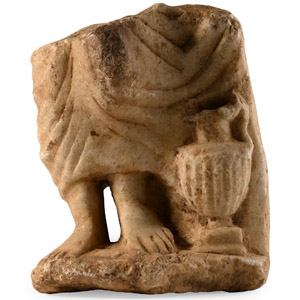
Roman Marble Sculpture Fragment
1st-2nd century A.D.Sold for (Inc. bp): £520
Carved in the half-round, pair of feet emerging from below a draped robe or toga, ewer to right on a square base. 708 grams, 11.6 cm
From the estate of a Yorkshire, UK, gentleman collector, acquired 1970s-1980s. This lot is accompanied by an illustrated lot declaration signed by the Head of the Antiquities Department, Dr Raffaele D'Amato. -
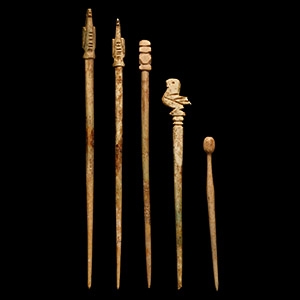
Roman Bone Pin Implement Group
3rd-4th century A.D.Sold for (Inc. bp): £247
Each with hipped and tapering shank; balustered, aviform and other finials. 19.6 grams total, 9-16.6 cm
Private collection of Mr K.A., acquired in the 1990s-early 2000s. This lot is accompanied by an illustrated lot declaration signed by the Head of the Antiquities Department, Dr Raffaele D'Amato. -
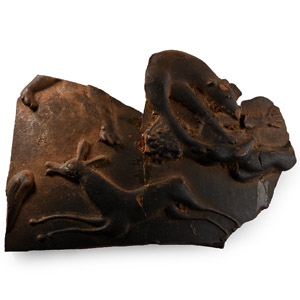
Roman Pottery Sherd with Hunting Dog Scene
1st century A.D.Sold for (Inc. bp): £124
Fragment of the curved shoulder of a vessel with high-relief scene depicting a dog attacking a human (child?) lying nude and supine, a deer or fawn running past below. 53 grams, 11.1 cm
Found Colchester, Essex. From the private collection of a Colchester, UK, lady, since the 1980s. This lot is accompanied by an illustrated lot declaration signed by the Head of the Antiquities Department, Dr Raffaele D'Amato.
