
Loading, please wait...
_900x900.jpg "Large Roman Bronze Robed Torso")
_200x200.jpg "Large Roman Bronze Robed Torso")
.jpg "Large Roman Bronze Robed Torso")
LOT 0150
Large Roman Bronze Robed Torso
1ST CENTURY B.C.-1ST CENTURY A.D.
21 in. (7.55 kg total, 53.5 cm high including stand).
Likely representing Harpocrates, depicted frontally and wearing a draped full-length himation, the right arm raised and left arm bent at the elbow; mounted on a custom-made display stand.
ProvenancePrivate collection, Hong Kong, acquired in the 1970s.
Spanish art market.
Acquired by the present owner from the above.
Accompanied by an academic report by Dr Raffaele D'Amato.
This lot has been checked against the Interpol Database of stolen works of art and is accompanied by a search certificate number no.13040-248071.
Cf. Reinach, S., Répertoire de la statuaire grecque et romaine, Paris, 1897, for similar statuettes, p.484 nos.7,8,9; Rolland, H., Bronzes Antiques de Haute Provence, Paris, 1965, item 211; cf. also the Portable Antiquities Scheme, BH-F25093 T, for a similar statuette found in England.
FootnotesThe body of this statue was hollow-cast by the lost wax method; traces of solder within the arm sockets and around the neck indicate that the arms and head were cast separately. The position of the body and comparative images suggest the statue represents Harpocrates. Harpocrates, the son of Isis and Horus, was one of the most represented children, especially after the diffusion of his cult into the Roman Empire. He is usually depicted naked, but draped figures of the god were produced in the Hellenised east and spread throughout the Empire. Statues of Harpocrates were at the entrance of almost all temples, to indicate that in those places the gods should have been honoured with silence, or, according to Plutarch, men who had an imperfect knowledge of the divinity should only speak of it with respect.
CONDITIONTimeLine Auctions follows a vetting process to ensure the authenticity and legality of all items, reinforcing our commitment to integrity and responsible trading. Each antiquity, antique, and coin lot undergoes thorough examination by a vetting committee of at least ten external specialists, professional trade association members, scientists, and archaeologists: Our Vetting Process
AUCTIONS:
TimeLine is a leading auction house specialising in antiquities, ancient art, collectables, natural history, coins, medals, and books. Our auctions offer museums, collectors, historians, and enthusiasts the opportunity to acquire unique and historically significant pieces.
LOT 0150
Large Roman Bronze Robed Torso
Estimate £30,000 - 40,000€34,800 - 46,400 (for guidance only)$40,500 - 54,000 (for guidance only)
-
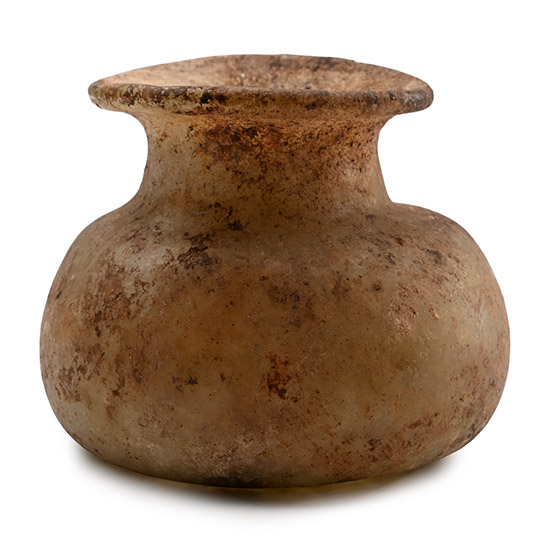
Roman Glass Flask
3rd-4th century A.D.Estimate: £120 - 170 (+bp*)
Opening Bid: £60
Squat in profile with trumpet-shaped neck and mouth, rolled rim, dimple base. 93 grams, 78 mm
From a London, UK, collection of glass, 1970-2000s. -
.jpg)
Roman Iron Ring with Jasper Intaglio of a Quadriga
2nd-3rd century A.D.Sold for (Inc. bp): £364
Round-section hoop with expanding shoulders enclosing an intaglio depicting a quadriga. 4.46 grams, 24.62 mm overall, 19.35 x 14.91 mm internal diameter (approximate size British K 1/2, USA 5 1/2, Europe 10.58, Japan 10)
Private collection, Europe. -
.jpg)
Roman Miniature Military Silver Eagle Statuette
2nd century A.D.Estimate: £100 - 140 (+bp*)
Opening Bid: £50
Modelled in the round with folded wings andsplit tail; socket to the chest. 11.6 grams, 28 mm
Private collection, England.
