
Loading, please wait...
LOT 0614
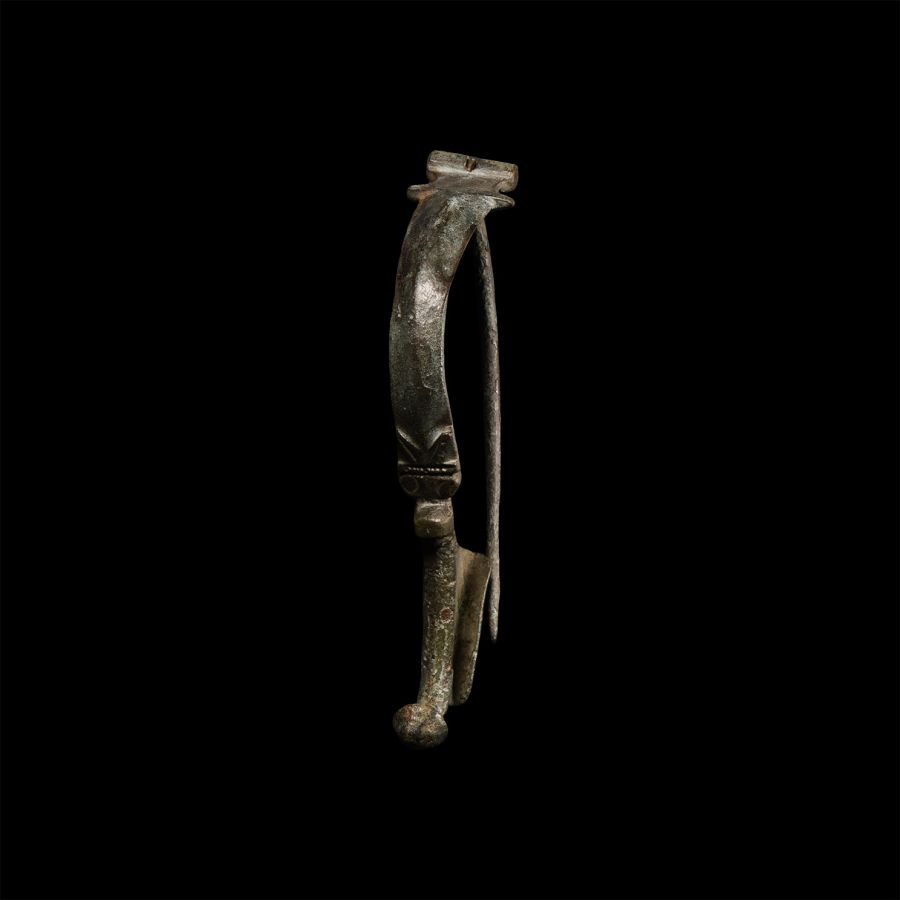
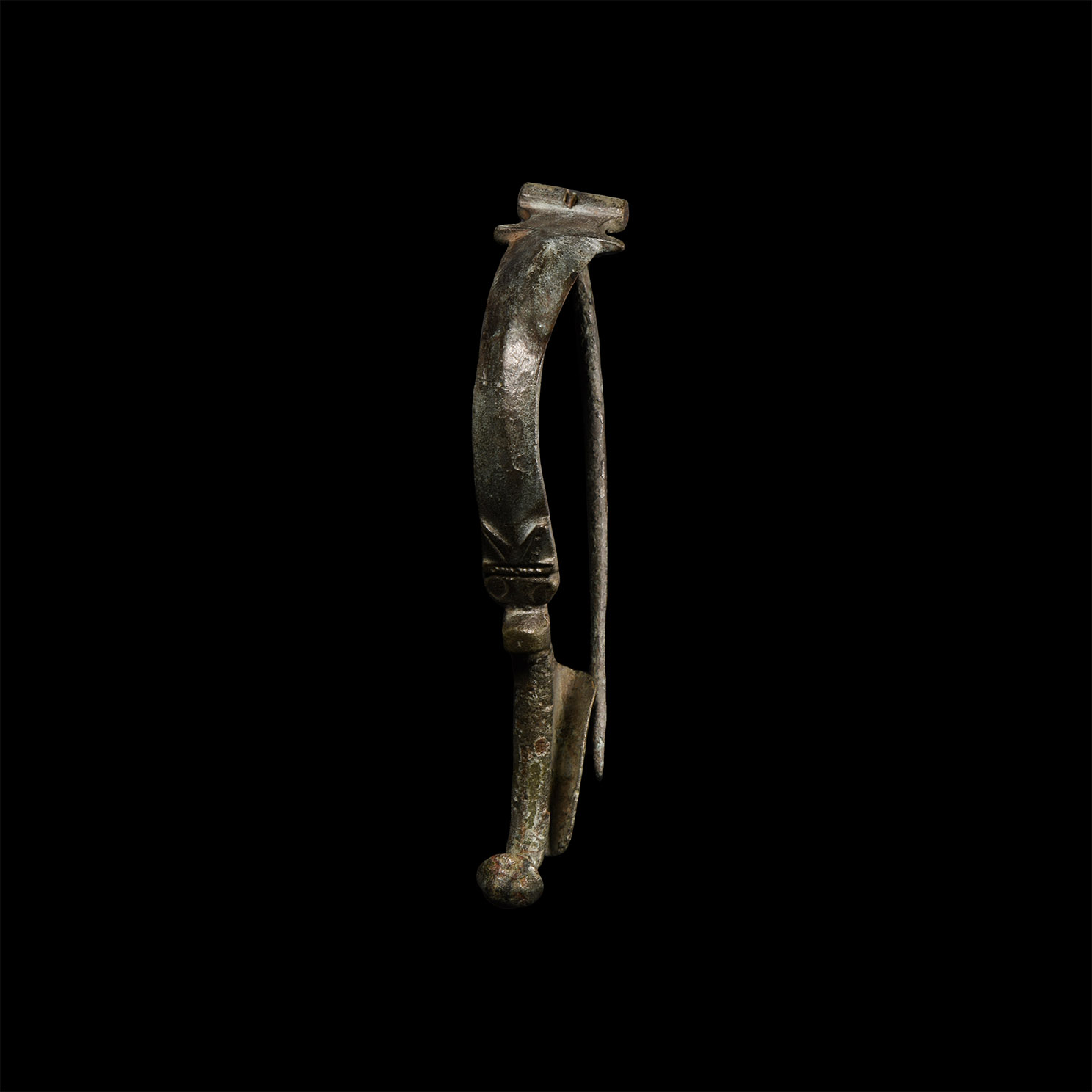
Large Roman Aucissa Bow Brooch with Wolf's Face
1ST-2ND CENTURY A.D.
3 3/4 in. (36 grams, 94 mm).
A large bronze Aucissa variant type bow brooch with annulet decoration to the head, narrow half-round cross-section bow; the lower bow and foot forming a stylised wolf's face with pellet eyes and curved muzzle; hinged pin and catch to the reverse. [No Reserve]
ProvenanceGerman art market before 2000.
With a European gentleman living in the UK.
Property of a Surrey gentleman.
Cf. Van Buchem, H., De Fibulae Van Nijmegen, Nijmegen, 1941, pl.IX, figs.26-27.
FootnotesThe fibula belongs to the series C of the Buchem classification of variant Aucissa fibulae. According to Kovrig, these military fibulae were produced in specific centres like Siscia (Sisak) in Pannonia and distributed throughout the Empire because of the mobility of the army.
CONDITIONTimeLine Auctions follows a vetting process to ensure the authenticity and legality of all items, reinforcing our commitment to integrity and responsible trading. Each antiquity, antique, and coin lot undergoes thorough examination by a vetting committee of at least ten external specialists, professional trade association members, scientists, and archaeologists: Our Vetting Process
AUCTIONS:
TimeLine is a leading auction house specialising in antiquities, ancient art, collectables, natural history, coins, medals, and books. Our auctions offer museums, collectors, historians, and enthusiasts the opportunity to acquire unique and historically significant pieces.
-
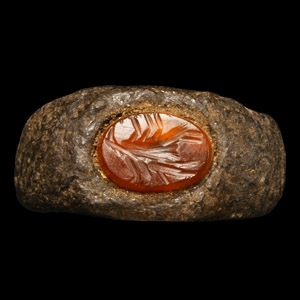
Roman Military Ring with Scorpion Gemstone
Circa 2nd century A.D.Sold for (Inc. bp): £111
A bronze finger ring with inset carnelian gemstone, intaglio scorpion. 4.31 grams, 21.20 mm overall, 17.45 mm internal diameter (approximate size British J, USA 4 3/4, Europe 8.69, Japan 8)
Acquired before 2000. From the collection of a European gentleman living in the UK.
The ring could have belonged to a praetorian guardsman. The scorpion was one of the main symbols of the praetorian guard since the age of Augustus. -
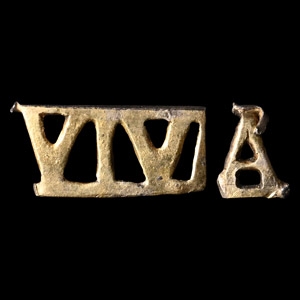
Roman Gilt Silver Openwork Lettering Group
3rd-4th century A.D.Estimate: £100 - 140 (+bp*)
Opening Bid: £50
A gilt-silver openwork bar displaying the Latin word 'VIVA'; the A now separate. 0.53 grams total, 6-13 mm
Acquired in the late 1990s-2000. Property of an East London gentleman. -
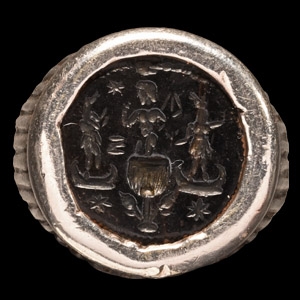
Roman Magical Gnostic Gemstone in Silver Ring
2nd-3rd century A.D. and laterEstimate: £1,000 - 1,400 (+bp*)
Opening Bid: £550
A glass intaglio with Gnostic symbolism including a figure emerging from a poppy-head, asterisks and other symbols; set in an early 20th century silver finger ring; supplied with a museum-quality impression. 12.32 grams, 25.86 mm overall, 19.79 mm internal diameter (approximate size British T 1/2, USA 9 3/4, Europe 21.89, Japan 21)
Acquired in the late 1980s-early 1990s. Important North West London collection.
