
Loading, please wait...
_900x900.jpg "Large Roman Aubergine Glass Twin-Handled Jar")
_200x200.jpg "Large Roman Aubergine Glass Twin-Handled Jar")
.jpg "Large Roman Aubergine Glass Twin-Handled Jar")
LOT 0746
Large Roman Aubergine Glass Twin-Handled Jar
3RD-4TH CENTURY A.D.
7 in. (246 grams, 18 cm high).
An aubergine glass jar with onion-shaped body, cylindrical neck, trumpet-style mouth and rolled lip; two applied green glass handles and pie crust frill around neck, body with decorative raised lobes; some iridescence.
ProvenanceMitsukoshi, Tokyo, Japan, 1981.
Kokusai Bijutsu: Ninth International Art Exhibition, no.46.
Acquired Bonhams, New Bond Street, 28 November 2019, lot 146.
Ex J.L. collection Surrey, UK.
Accompanied by copies of the Bonhams catalogue pages.
Cf. The British Museum, museum number 1890,1115.3, for a similar vessel.
CONDITIONTimeLine Auctions follows a vetting process to ensure the authenticity and legality of all items, reinforcing our commitment to integrity and responsible trading. Each antiquity, antique, and coin lot undergoes thorough examination by a vetting committee of at least ten external specialists, professional trade association members, scientists, and archaeologists: Our Vetting Process
AUCTIONS:
TimeLine is a leading auction house specialising in antiquities, ancient art, collectables, natural history, coins, medals, and books. Our auctions offer museums, collectors, historians, and enthusiasts the opportunity to acquire unique and historically significant pieces.
-
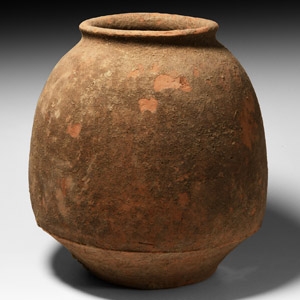
Roman Pottery Jar
4th-5th century A.D.Sold for (Inc. bp): £221
A ceramic jar with a carinated body and rolled rim. 2.07 kg, 22.5 cm high
Acquired 1980-2015. Ex Abelita family collection. -
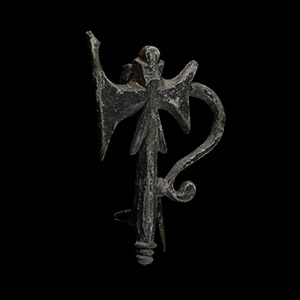
Roman Axe Plate Brooch
2nd-3rd century A.D.Sold for (Inc. bp): £117
A bronze plate brooch formed as an axe, scrolled tendrils to socket and butt, slender handle; hinged pin and catch to the reverse. 13.6 grams, 47 mm
Acquired before 2000. From the collection of a European gentleman living in the UK.
The fibula, made for a military cloak, belongs to the type 28 of Jobst classification. Similar fibulae were widespread in the central part of the Limes between Germania Superior and Raetia. -
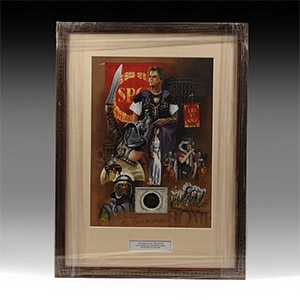
Roman Coin and Limited Edition Framed Print
3rd century A.D. and laterSold for (Inc. bp): £13
A Roman coin mounted on 22 carat gold foil, framed with an art print signed by the artist David McAllister, depicting scenes of Roman military activity; limited edition number 61/1150. 1.25 kg, 49 x 36 cm
Essex gallery, early 2000s.
David McAllister's exciting design is a 'one of a kind' work that portrays the might and riches of the Roman civilisation. This limited edition print is a celebration of the award winning artist's lifetime dedication to historical paintings of the ancient world. To enhance appreciation of this rare and historic work, each individual print is signed and numbered by the artist.
