
Loading, please wait...
LOT 0268
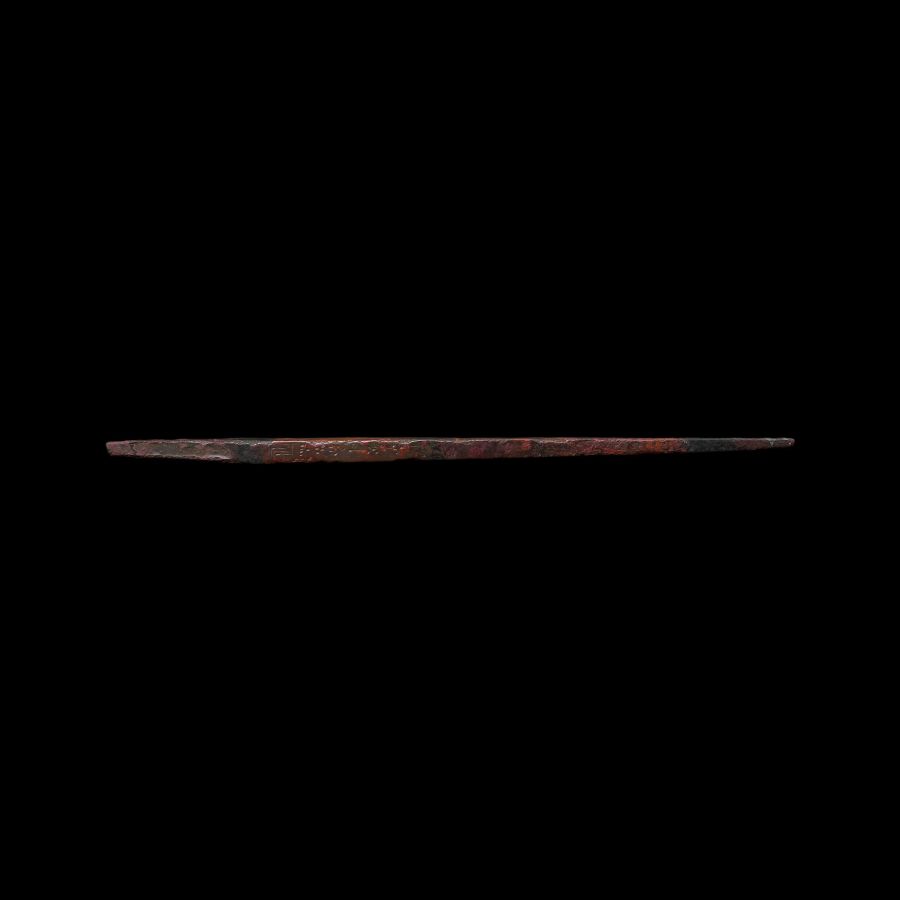
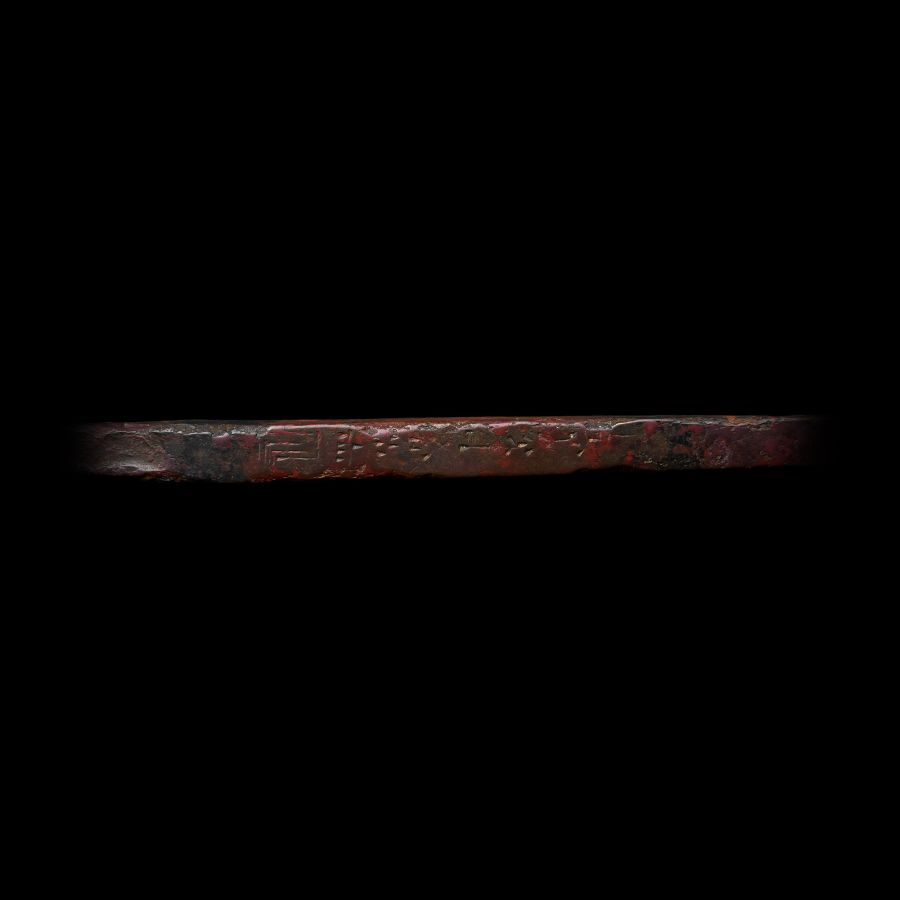
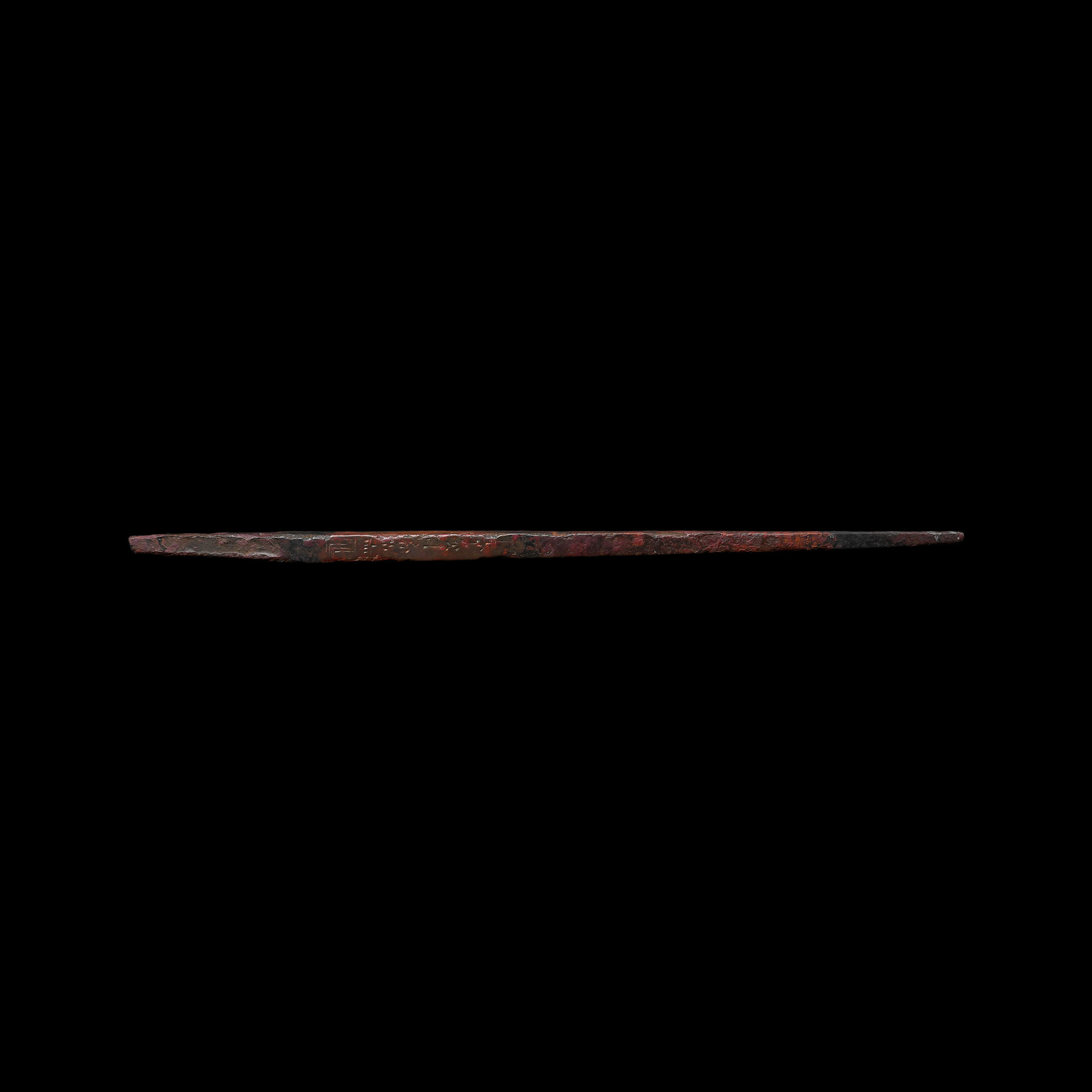
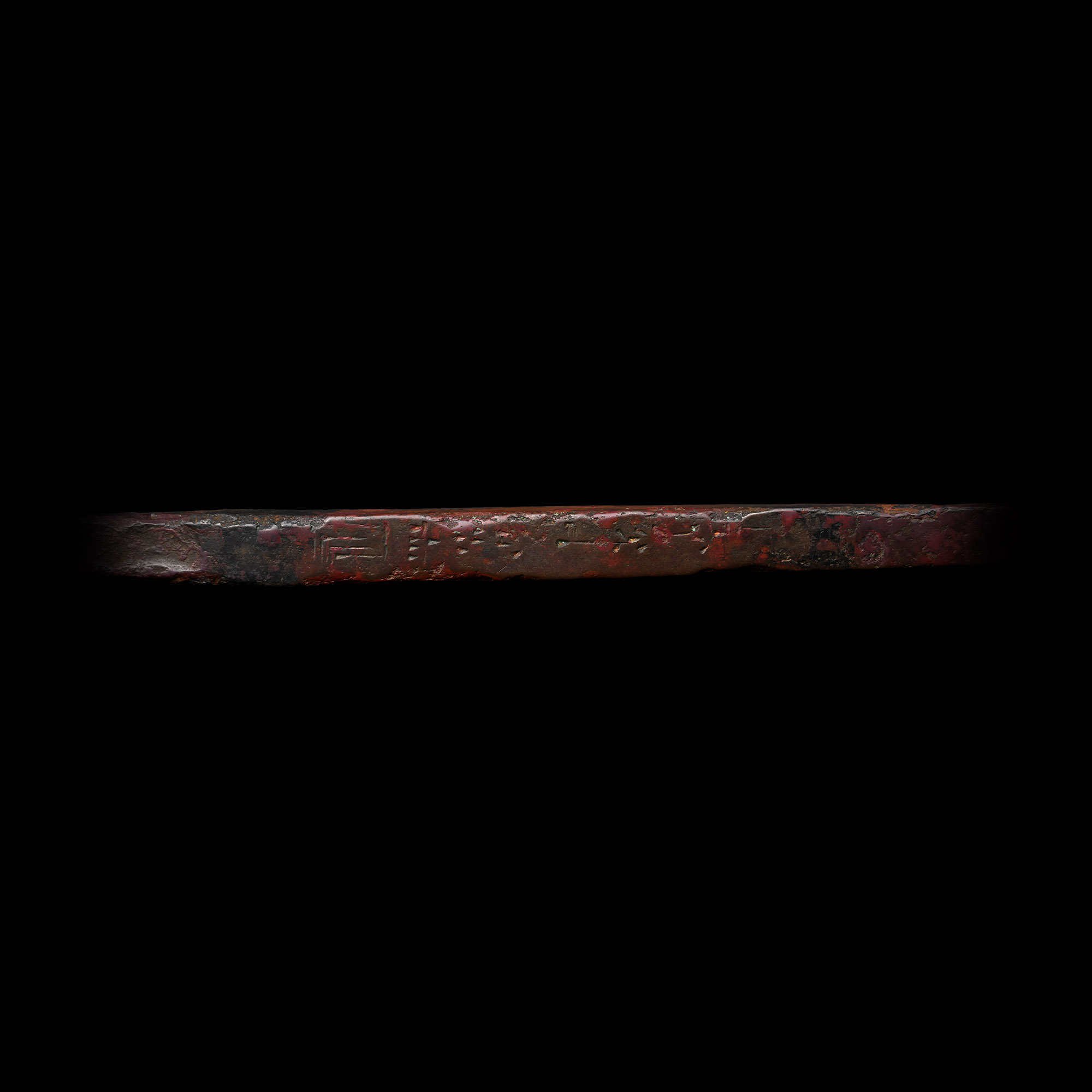
Large Mesopotamian Bronze Spearhead Inscribed: 'Belonging to the Palace of Ipiq-Adad' a King of the city Eshnunna
2ND MILLENNIUM B.C.
14 1/8 in. (260 grams, 36 cm).
Rectangular-section tapering body with a short tang with cuneiform text to one side translating to: '(belonging to) the Palace of Ipiq-Adad'.
ProvenanceUK private collection before 2000.
Acquired on the UK art market.
Private collection, London, UK.
This lot has been checked against the Interpol Database of stolen works of art and is accompanied by search certificate number no.13259-253470.
Cf. Gernez, G., L’armament en métal au Proche et Moyen-Orient: des origines a 1750 av. J.C., Paris, 2007, fig.2.82, subtypes L1A.a, for the type.
FootnotesThere were three kings of the name Ipiq-Adad, kings of the city Eshnunna in the Diyala region of Mesopotamia in the early Old Babylonian period. Eshnunna was an ancient Sumerian (and later Akkadian) city and city-state 12.6 miles northwest of Tell Agrab. Although situated in the Diyala Valley northwest of Sumer proper, the city nonetheless belonged securely within the Sumerian cultural milieu. Ipiq-Adad II was the son of Ibal-pi-el I, king of Eshnunna. Upon his ascent, he used the title ensi; later in his reign, he shifted to describing himself as lugal (king). He was the first ruler of Eshnunna to use the term lugal since Shu-iliya. Inscriptions also refer to him as 'king who enlarges Eshnunna', 'shepherd of the black-headed people', and 'king of the universe'. He oversaw a great expansion of the state and laid the foundation for Eshnunna to become a regional power.
The spearhead belongs to the category of bipartite pikes (Gernez classification L 1.A.a). It is the simplest category of spearheads. The butt consisted solely of a widening located at the junction between the point and the tang. The tang was inserted into the handle up to the butt. The wood, split and/or hollowed out to allow for the passage of the tang, was then secured with a cord or strap wrapped around it, probably up to the base of the blade, thus ensuring its stability.
TimeLine Auctions follows a vetting process to ensure the authenticity and legality of all items, reinforcing our commitment to integrity and responsible trading. Each antiquity, antique, and coin lot undergoes thorough examination by a vetting committee of at least ten external specialists, professional trade association members, scientists, and archaeologists: Our Vetting Process
AUCTIONS:
TimeLine is a leading auction house specialising in antiquities, ancient art, collectables, natural history, coins, medals, and books. Our auctions offer museums, collectors, historians, and enthusiasts the opportunity to acquire unique and historically significant pieces.
LOT 0268
Large Mesopotamian Bronze Spearhead Inscribed: 'Belonging to the Palace of Ipiq-Adad' a King of the city Eshnunna
Sold for (Inc. bp): £3,380
-
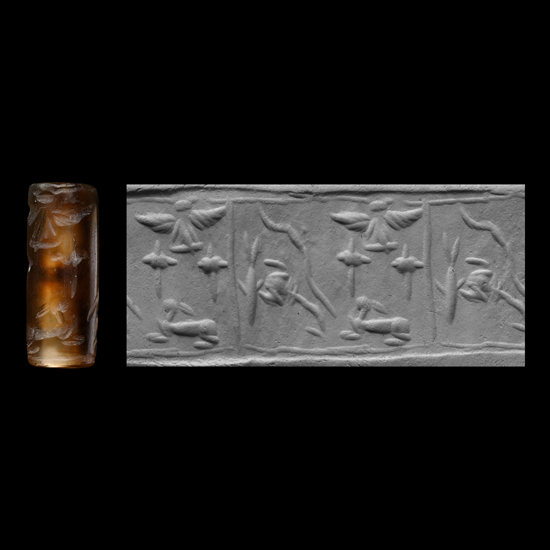
Western Asiatic Carnelian Cylinder Seal with Animals
2nd-1st millennium B.C.Sold for (Inc. bp): £104
Frieze with bird in flight above a crouching quadruped, among trees; supplied with a museum-quality impression. 0.68 grams, 13.97 mm
From the private collection of a European gentleman (1942-2024), formed since the 1970s. -
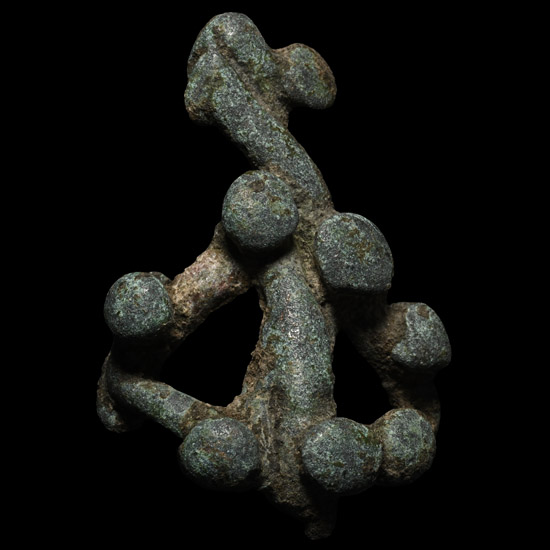
Amlash Figure Fragment
Circa 6th century A.D.Sold for (Inc. bp): £13
With openwork body and lug to reverse, cage-style torso. 20.6 grams, 42.8 mm
From the private collection of a European gentleman (1942-2024), formed since the 1970s. -
.jpg)
Western Asiatic Black Terracotta Cuneiform Tablet
2nd millennium B.C.Estimate: £1,200 - 1,700 (‡+bp*)
Opening Bid: £600
Pillow-shaped with columnar ribbing to the broad faces, dense cuneiform text in the columns. 57.2 grams, 63 mm
Private collection of Mr K., Maryland, USA. Private collection, Switzerland, acquired in 2000. This lot has been checked against the Interpol Database of stolen works of art and is accompanied by a search certificate number no.12893-241757.
The 2nd millennium B.C. (about 2000–1000 B.C.) was an important period in the ancient Near East, when major civilisations such as the Babylonians, Assyrians, Hittites, and Egyptians grew in power and influence. It was a time of progress in trade, government, law, and writing, helping us understand how people lived and worked. Cuneiform tablets, which are small clay tablets written in one of the earliest writing systems, were widely used to record business, legal matters, letters, and stories. When these tablets are found outside their place of origin, it can show connections through trade, travel, or official communication, offering insight into both the ancient world and how such objects later moved through collections.
