
Loading, please wait...
_900x900.jpg "Large Medieval Stone Church Gargoyles")
_200x200.jpg "Large Medieval Stone Church Gargoyles")
_900x900.jpg "Large Medieval Stone Church Gargoyles")
_200x200.jpg "Large Medieval Stone Church Gargoyles")
_900x900.jpg "Large Medieval Stone Church Gargoyles")
_200x200.jpg "Large Medieval Stone Church Gargoyles")
_900x900.jpg "Large Medieval Stone Church Gargoyles")
_200x200.jpg "Large Medieval Stone Church Gargoyles")
_900x900.jpg "Large Medieval Stone Church Gargoyles")
_200x200.jpg "Large Medieval Stone Church Gargoyles")
.jpg "Large Medieval Stone Church Gargoyles")
.jpg "Large Medieval Stone Church Gargoyles")
.jpg "Large Medieval Stone Church Gargoyles")
.jpg "Large Medieval Stone Church Gargoyles")
.jpg "Large Medieval Stone Church Gargoyles")
LOT 0311
Large Medieval Stone Church Gargoyles
ENGLAND, 15TH CENTURY A.D.
46 1/2 - 47 3/4 in. (400 kg total, 118 -121.5 cm).
Matched pair of carved stone corbels, each a mythical beast with a rounded body, bat-like wings folded behind the back, long arched neck and reptilian head with gaping mouth; mounted on an integral square-section base with stepped rear face; socket to forward face with bronze insert; some surface accretions. [2]
ProvenancePrivate collection, UK.
This lot has been checked against the Interpol Database of stolen works of art and is accompanied by search certificate number no.13385-259013.
Cf. Trubshaw, B., Good Gargoyle Guide. Medieval Carvings in Leicestershire and Rutland, 2025, pp.43,77, for similar figures.
FootnotesFrom the Romanesque era onwards, images of demons, often carved on the external sides of cathedrals and churches, were strongly linked to the fantastical and monstrous creatures of ancient myth and legend. For theologians, supernatural creatures which could not otherwise be explained were not of God and therefore had to be demonic: their incorporation in the ecclesiastic structures showed that their malevolent powers could be kept under control only through the protection of the church. This origin of Christian demons is likely to have influenced the visual representation in medieval culture as hybrid and monstrous, especially given the increased interest in Greek works from the twelfth century onwards in the West.
CONDITIONTimeLine Auctions follows a vetting process to ensure the authenticity and legality of all items, reinforcing our commitment to integrity and responsible trading. Each antiquity, antique, and coin lot undergoes thorough examination by a vetting committee of at least ten external specialists, professional trade association members, scientists, and archaeologists: Our Vetting Process
AUCTIONS:
TimeLine is a leading auction house specialising in antiquities, ancient art, collectables, natural history, coins, medals, and books. Our auctions offer museums, collectors, historians, and enthusiasts the opportunity to acquire unique and historically significant pieces.
-
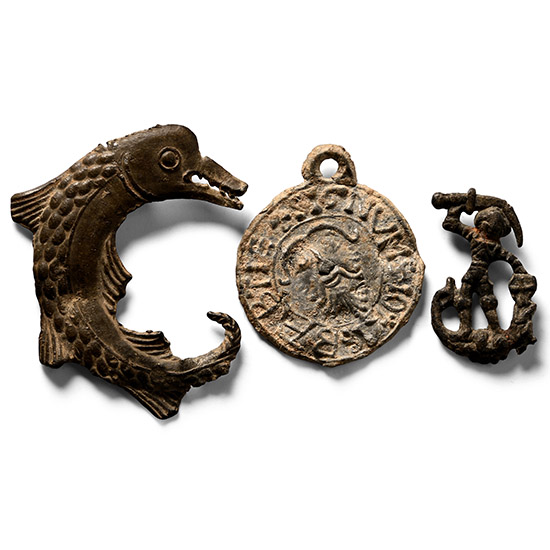
Three Pewter Pilgrim Badges
France, 14th-15th century A.D.Sold for (Inc. bp): £442
The first a circular badge of St John the Baptist, his severed head depicted on the circular plate with small loop for attachment at the top, inscription reading 'SIGNVM S’ IOhIS BABTIS' with a horizontal stroke to the 'h' so that it doesbles as a cross; a small badge of the Archangel Michael, shown fully armored and holding a sword above his head having bested Satan in personal combat; the final badge in the form of a dolphin, a secular piece likely worn by a follower of the French Dauphiné Charles V. 10.5 grams total, 24-38 mm
Former Forgeais (1822-1878) collection, France, thence by family descent. Arthur Forgeais was a noted 19th-century French archaeologist. Born in 1822 in the city of Paris, Forgeais held a special interest and specialism in the medieval history of his home city. When, in the mid-19th century, the Seine was dredged during Haussmann's renovation of the city, the scholar worked to recover a great number of archaeological remains from the silts of the river. He subsequently published his findings in the five-volume title Collection of Historiated Leaves Found in the Seine and Collected by Arthur Forgeais (published 1862-1866). The present collection of pewter pilgrim badges, all French in origin, is likely to have been recovered at this time. -
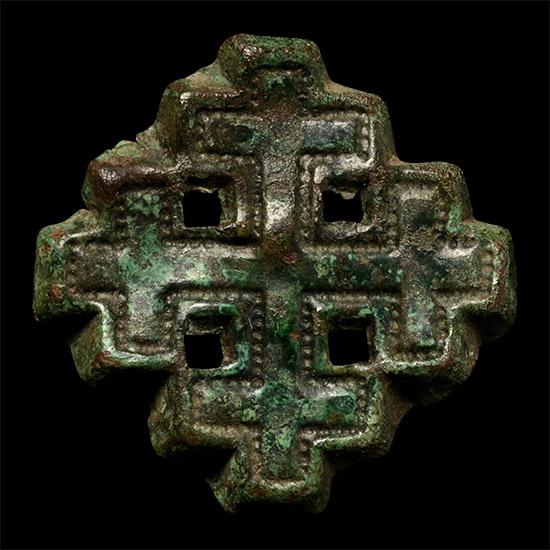
Medieval Bronze Knight's Holy Sepulchre Badge
Circa 13th-14th century A.D.Sold for (Inc. bp): £46
Formed as a cross-crosslet, the symbol of the Knights of the Holy Sepulchre, with a punched-point border. 1.13 grams, 23 mm
From a UK collection formed in the 1980s. Property of an Essex, UK, gentleman.
The 'Equestrian Order of the Holy Sepulchre of Jerusalem' was an order of knighthood under the protection of the Pope, formed around 1099 AD by Duke Godfrey of Bouillon, the leader of the First Crusade. It was established for the protection of pilgrims travelling to the Holy Land and was recognised by a Papal Bull in about 1113 AD. -
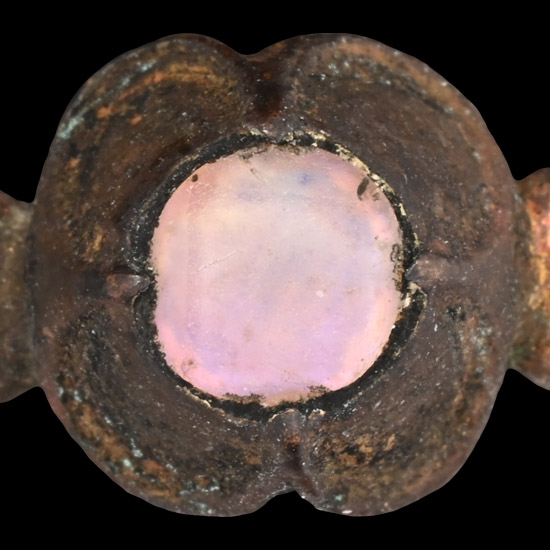
Medieval Bronze Ring with Gem
Circa 14th century A.D.Sold for (Inc. bp): £59
Featuring a narrow hoop and expanding shoulders, a conical bezel with four petals, set with a pale purple glass gem. 1.64 grams, 23.82 mm overall, 17.73 mm internal diameter (approximate size British N 1/2, USA 6 3/4, Europe 14.35, Japan 13)
From the private collection of a European gentleman (1942-2024), formed since the 1970s.
