
Loading, please wait...


LOT 0419
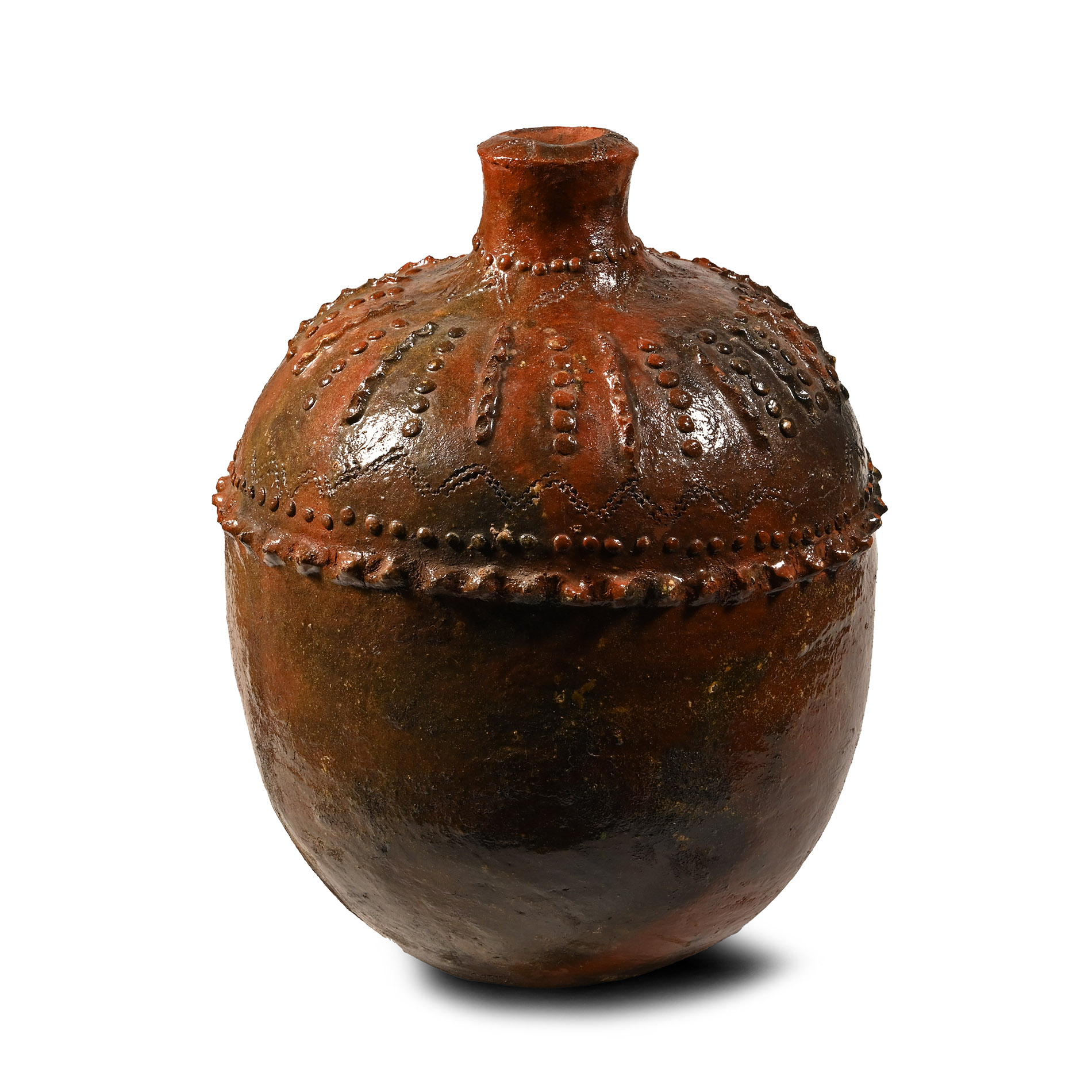
Large Medieval Glazed Red Ware Water Container
ENGLAND, 15TH-16TH CENTURY A.D.
13 in. (4.2 kg, 33 cm).
Acorn-shaped with rounded underside, ring of studs to the equator, applied pellets and pie-crust bands, pointillé zigzags to shoulder; thick mouth with incised pointillé lines. [No Reserve]
ProvenanceFrom a family collection mostly formed in the 1940s-1950s, thence by descent.
CONDITIONTimeLine Auctions follows a vetting process to ensure the authenticity and legality of all items, reinforcing our commitment to integrity and responsible trading. Each antiquity, antique, and coin lot undergoes thorough examination by a vetting committee of at least ten external specialists, professional trade association members, scientists, and archaeologists: Our Vetting Process
AUCTIONS:
TimeLine is a leading auction house specialising in antiquities, ancient art, collectables, natural history, coins, medals, and books. Our auctions offer museums, collectors, historians, and enthusiasts the opportunity to acquire unique and historically significant pieces.
-

Medieval Bronze Animal Head Knife Handle
12th-14th century A.D.Sold for (Inc. bp): £26
Pommel formed as a Romanesque style beast head with bared teeth, shank split for attachment to the tang. 11.6 grams, 15 mm
Acquired on the UK art market before 2000. Property of an Essex, UK, gentleman. -

Medieval Lead Artefact Group
14th-15th century A.D.Sold for (Inc. bp): £39
Including a small dish, pendant cross and other items. 298 grams total, 3-12.5 cm
Acquired on the European art market since the early 2000s. From the private Northern Ireland collection of R.M. -

Medieval Iron Single-Edged Dagger
14th-15th century A.D.Sold for (Inc. bp): £65
Comprising a slender cutting edge and a long tang. 123 grams, 29.3 cm
Acquired 1960s-1990s. Late Alison Barker collection, a retired London barrister.
From the documentary evidence, the dagger was not a weapon in widespread use. In some sources, daggers are called handsets, presumably originating from the Anglo-Saxon scramasaxes, implying that they were a single-bladed knife rather than a dual-bladed dagger. It is unclear whether such daggers were primarily intended for military or civilian functions; although they may have been used in both, their primary uses were likely to be civilian.
