
Loading, please wait...
_900x900.jpg "Large Medieval Bronze Vesica-Shaped Seal Matrix for John the Clerk of Hilgay")
_200x200.jpg "Large Medieval Bronze Vesica-Shaped Seal Matrix for John the Clerk of Hilgay")
.jpg "Large Medieval Bronze Vesica-Shaped Seal Matrix for John the Clerk of Hilgay")
LOT 0389
Large Medieval Bronze Vesica-Shaped Seal Matrix for John the Clerk of Hilgay
CIRCA 13TH-15TH CENTURY A.D.
1 1/2 in. (12.5 grams, 39 mm).
With central 'pelican in her piety' motif, linear border and legend '+ S' IOH'IS. CŁCI. DE.HELEGEIA.' (seal of John the clerk of Hilgay); strap and loop to the reverse.
ProvenanceFound Southern England.
Acquired on the UK art market in the 1980s.
From an East Anglian private collection.
Hilgay is a parish in Norfolk, near Downham Market.
CONDITIONTimeLine Auctions follows a vetting process to ensure the authenticity and legality of all items, reinforcing our commitment to integrity and responsible trading. Each antiquity, antique, and coin lot undergoes thorough examination by a vetting committee of at least ten external specialists, professional trade association members, scientists, and archaeologists: Our Vetting Process
AUCTIONS:
TimeLine is a leading auction house specialising in antiquities, ancient art, collectables, natural history, coins, medals, and books. Our auctions offer museums, collectors, historians, and enthusiasts the opportunity to acquire unique and historically significant pieces.
LOT 0389
Large Medieval Bronze Vesica-Shaped Seal Matrix for John the Clerk of Hilgay
Sold for (Inc. bp): £845
-
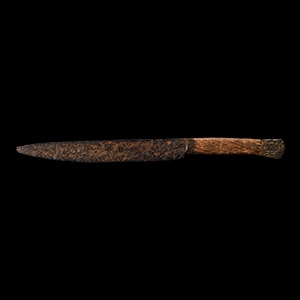
Medieval Iron Knife with Bronze Pommel
Circa 1500 A.D.Estimate: £150 - 200 (+bp*)
Opening Bid: £80
Comprising a single cutting edge and scale tang, bifacial pommel incised with a female figure possibly holding an arrow to one face and what is apparently a mythical beast or other animal to the other. 23 grams, 18.7 cm
Acquired 1960s-1990s. Late Alison Barker collection, a retired London barrister. -
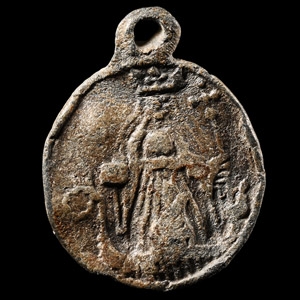
Medieval Lead Pilgrim's Pendant with Saint
Circa 14th-15th century A.D.Sold for (Inc. bp): £117
Obverse with low-relief Christ enthroned holding orb and sceptre, regal crown; reverse with low-relief 'ihs' christogram. 7.21 grams, 32 mm
Found Southern England. Acquired on the UK art market in the 1980s. From an East Anglian private collection. -
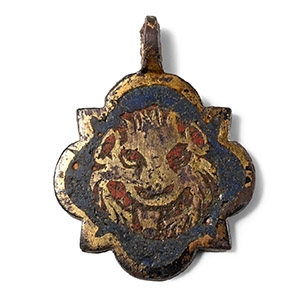
Medieval Knight's Gilt Bronze Enamelled Heraldic Horse Harness Pendant with Face
Circa 14th-15th century A.D.Sold for (Inc. bp): £1,950
Quatrefoil pendant with interstitial spurs; reserved lion mask on an enamelled field, with tongue protruding. 12.6 grams, 39 mm
Found Southern England. Acquired on the UK art market in the 1980s. From an East Anglian private collection.
