
Loading, please wait...
LOT 1845
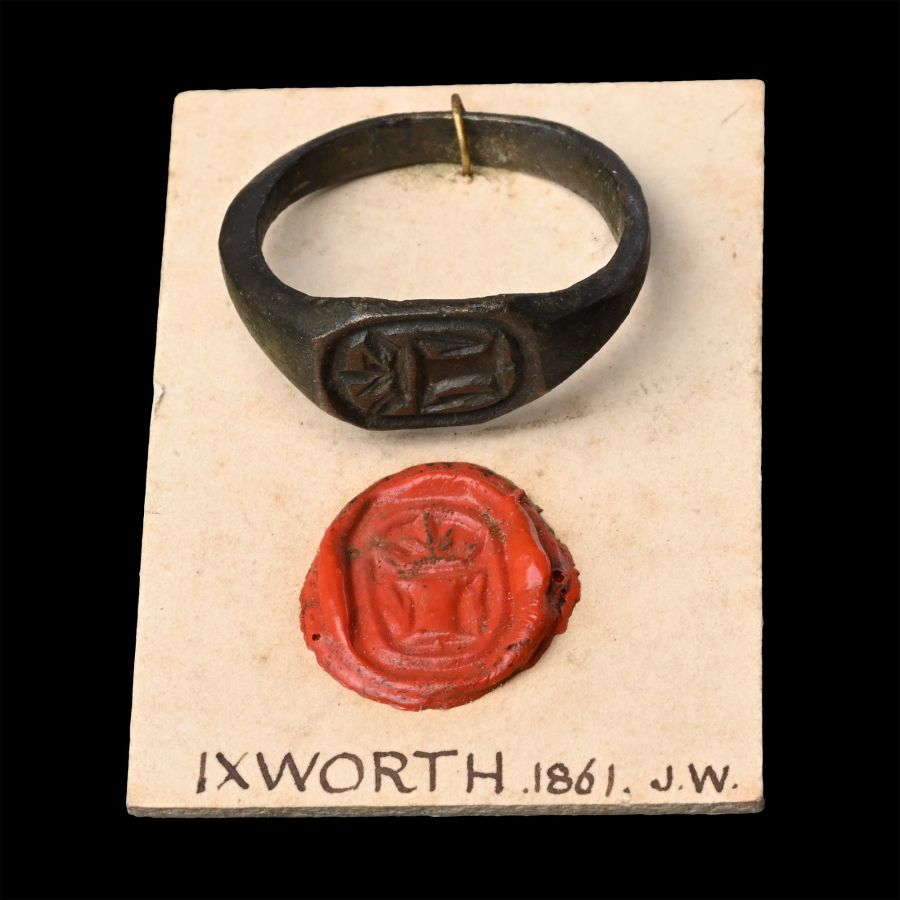
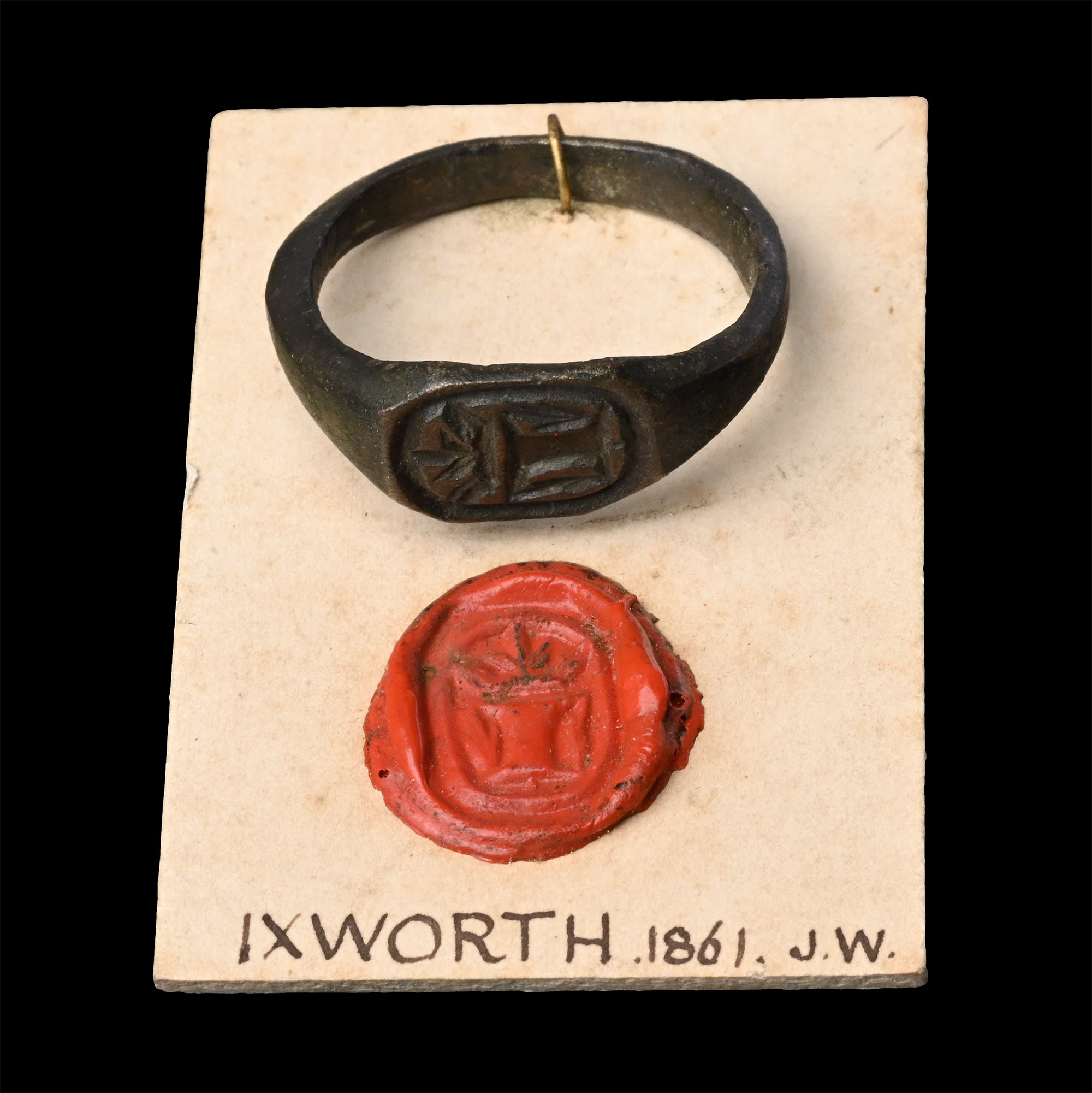
Large Medieval Bronze 'Ixworth' Signet Ring with Crowned I
15TH-16TH CENTURY A.D.
1 in. (10.66 grams total, 26.89 mm overall, 22.20 mm internal diameter (approximate size British X 1/2, USA 11 3/4, Europe 26.92, Japan 25)).
D-section hoop and ellipsoid bezel with 'I' beneath a crown in a frame; attached to a collector's card with sample seal impression and legend 'Ixworth 1861 J.W.'. [No Reserve]
ProvenanceFound Ixworth, Suffolk, UK, 1861 by J.W.
From the collection of Dame Joan Evans (1893-1977), thence gifted during her lifetime to a gentleman collector friend from South East England.
Cf. Chadour, A.B., Rings. The Alice and Louis Koch Collection, volume I, Leeds, 1994, item 640, for type.
FootnotesDame Joan Evans, DBE, FSA, FRHistS, enjoyed a long and distinguished career as an author and historian. She was appointed the president of the Society of Antiquaries in 1959, the first woman to hold this position, serving until 1964. From 1948 to 1951, Joan Evans served as President of the Royal Archaeological Institute. She received the Society’s gold medal in 1973. Joan Evans was honoured with a host of honorary degrees and fellowships, as well as fellowships of the Royal Historical Society and the Royal Society of Literature. She was a Chevalier of the Légion d’Honneur, and was appointed a Dame of the British Empire in 1976. She served as a trustee of both the London and the British museums, and as a member of the advisory council of the Victoria and Albert Museum.
CONDITIONTimeLine Auctions follows a vetting process to ensure the authenticity and legality of all items, reinforcing our commitment to integrity and responsible trading. Each antiquity, antique, and coin lot undergoes thorough examination by a vetting committee of at least ten external specialists, professional trade association members, scientists, and archaeologists: Our Vetting Process
AUCTIONS:
TimeLine is a leading auction house specialising in antiquities, ancient art, collectables, natural history, coins, medals, and books. Our auctions offer museums, collectors, historians, and enthusiasts the opportunity to acquire unique and historically significant pieces.
LOT 1845
Large Medieval Bronze 'Ixworth' Signet Ring with Crowned I
Sold for (Inc. bp): £59
-
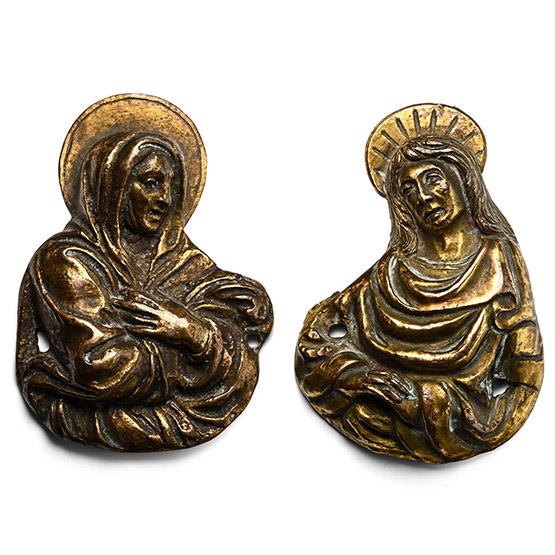
Medieval Gilt Bronze Plaques of Mary Magdalene and Saint John the Evangelist
Italian, 16th century A.D.Estimate: £200 - 300 (+bp*)
Opening Bid: £100
Comprising: nimabte figure of Mary, dressed in voluminous robes, arms crossed at the chest and pierced through the edges; nimabte figure of John wearing voluminous robes, gazing down with a solemn expression on his face, hands clasped at the waist, pierced through the edges. 57.2 grams total, 61 mm each
Private collection, UK. -
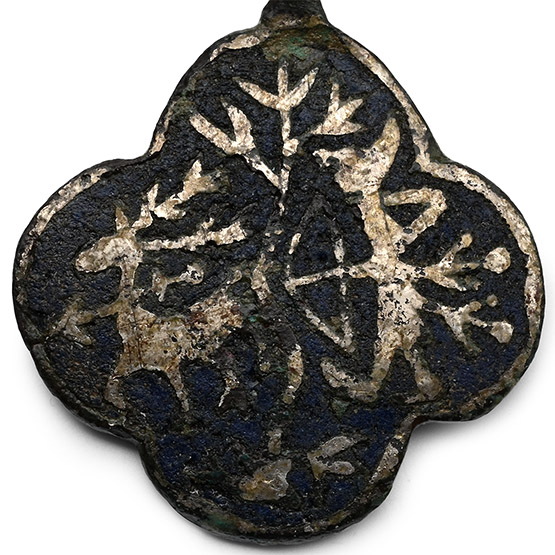
Medieval Knight's Heraldic Horse Harness Pendant with Royal Hunting Scene
13th century A.D.Sold for (Inc. bp): £2,340
Quatrefoil-type with integral loop and broad lobes; niello surface with reserved image of a bowman (right) with arrow nocked and one arm bent, advancing towards a stag (left) with tined antlers, an arrow having pierced it through the neck; scene divided by a median vertical tree with three radiating boughs. 11.36 grams, 38 mm
Found by Robert Wiseman in Longdon, Worcestershire, UK, circa 2015, next to a trackway leading to St John the Baptist church that was built by the military order of the Knights Hospitaller in the 12th century. Recorded with Mark Lodwick of the National Museum of Wales, Cardiff, UK.
Described by Phil Parkes, the conservator at the National Museum of Wales, as the best of its type that he had ever seen or worked on to clean and preserve, in 30 years. -
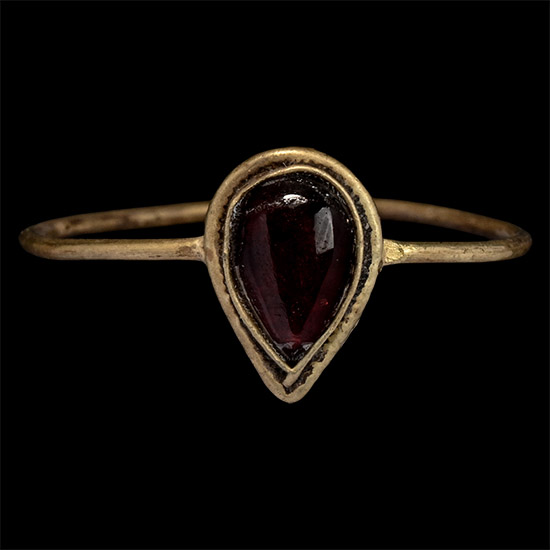
Medieval Gold Ring with Garnet
14th-16th century A.D.Sold for (Inc. bp): £390
Slender hoop and teardrop-shaped bezel with inset garnet cabochon. 0.79 grams, 20.15 mm overall, 16.97 mm internal diameter (approximate size British M 1/2, USA 6 1/4, Europe 13.09, Japan 12)
From the collection of a late Japanese gentleman, 1970-2000s.
