
Loading, please wait...
LOT 0140
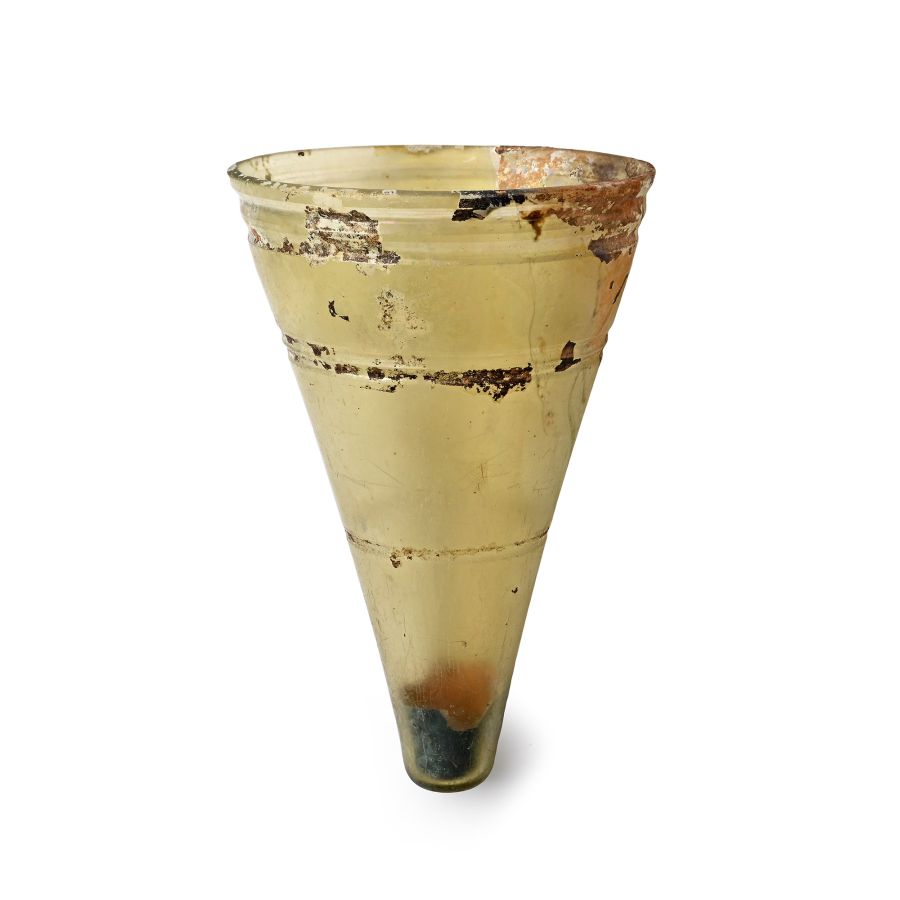
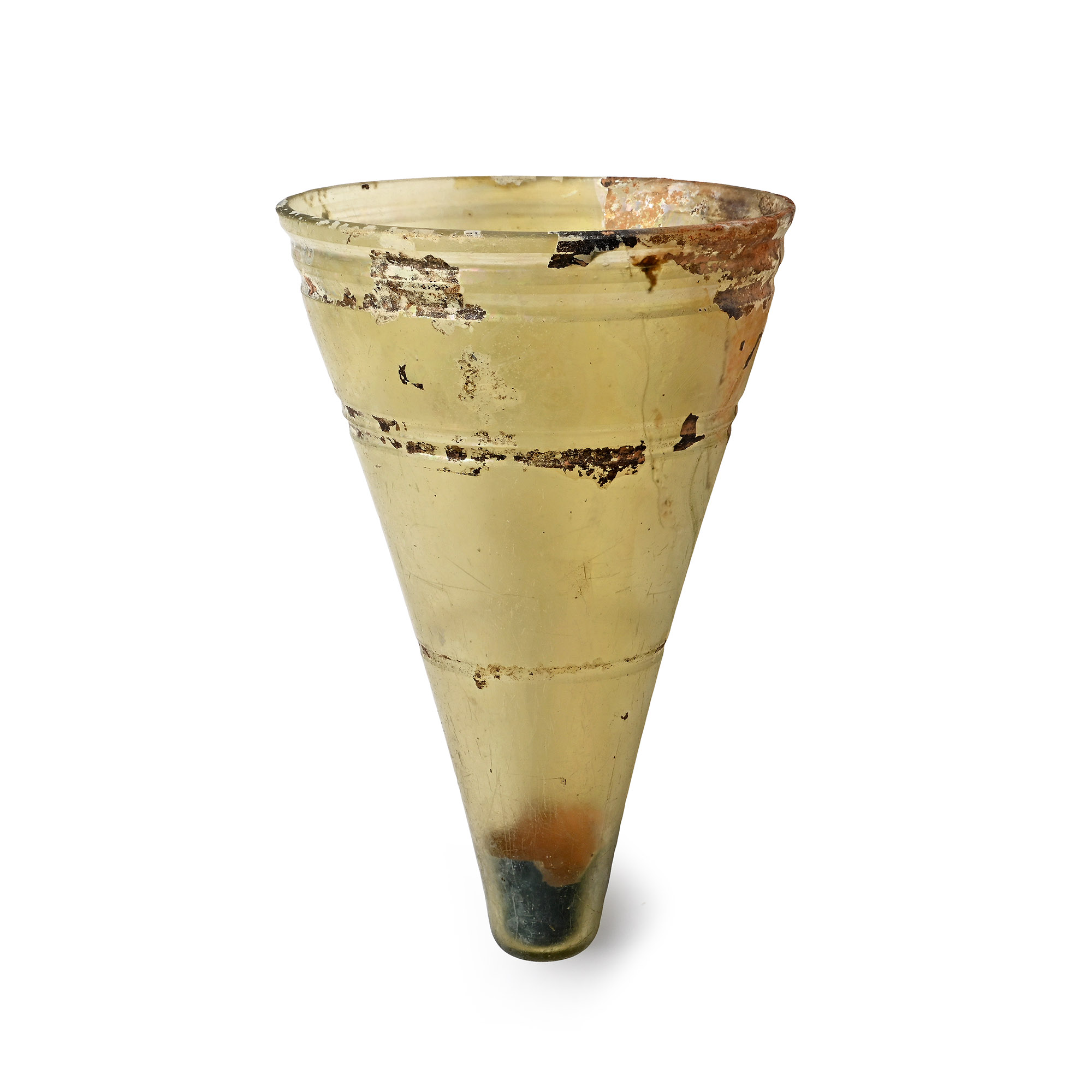
Large Late Roman Glass Lamp or Beaker
4TH-5TH CENTURY A.D.
7 1/4 in. (293 grams, 18.5 cm).
Conical body with pontil base, five horizontal grooves cut around the body; traces of iridescence.
ProvenanceDr Jutaro Kawabe, Nagoya, Japan, his collection formed in the 1960s-1970s.
with Hoshigaoka Gallery until the late 1990s.
Private collection, London, UK.
This lot has been checked against the Interpol Database of stolen works of art and is accompanied by a search certificate number no.12830-241334.
This lot has been cleared against the Art Loss Register database, and is accompanied by an illustrated lot declaration signed by the Head of the Antiquities Department, Dr Raffaele D'Amato.
Cf. Auth, H.S., Ancient Glass at the Newark Museum, New Jersey, 1976, items 200 and 201; Whitehouse, D., Roman Glass in The Corning Museum of Glass: Volume Three, New York, 2003, item 1180; The Metropolitan Museum of Art, item 74.51.310.
FootnotesConical vessels of this form were either used as a lamp or a beaker; notably during late imperial period in the eastern provinces of the Roman Empire and in early Migration period. Deep cuts on this piece suggests they were used for suspension chains or ropes, making it highly likely that this example was used as a lamp.
CONDITIONTimeLine Auctions follows a vetting process to ensure the authenticity and legality of all items, reinforcing our commitment to integrity and responsible trading. Each antiquity, antique, and coin lot undergoes thorough examination by a vetting committee of at least ten external specialists, professional trade association members, scientists, and archaeologists: Our Vetting Process
AUCTIONS:
TimeLine is a leading auction house specialising in antiquities, ancient art, collectables, natural history, coins, medals, and books. Our auctions offer museums, collectors, historians, and enthusiasts the opportunity to acquire unique and historically significant pieces.
LOT 0140
Large Late Roman Glass Lamp or Beaker
Estimate £4,000 - 6,000€4,640 - 6,960 (for guidance only)$5,400 - 8,100 (for guidance only)
-
.jpg)
Roman Cobalt Blue Mould-Blown Glass Juglet
4th-5th century A.D.Estimate: £800 - 1,000 (+bp*)
Opening Bid: £400
With bands of impressed triangle motifs forming a reticulation to the upper body, pinched trefoil mouth and strap handle to rear. 110 grams, 10.2 cm
Acquired on the European art market in the early 2000s. with Galerie Rhéa, Zurich, Switzerland. This lot is accompanied by an illustrated lot declaration signed by the Head of the Antiquities Department, Dr Raffaele D'Amato. -
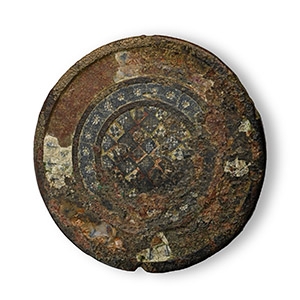
Roman Bronze Plate Mount with Millefiori
2nd century A.D.Sold for (Inc. bp): £72
Comprising a discoid plaque with a stud on the reverse, the obverse divided into three fields, each with a millefiori decoration. 16 grams, 38 mm
Ex German art market, 2000s. Acquired from an EU collector living in London. From the collection of a Surrey, UK, gentleman. This lot is accompanied by an illustrated lot declaration signed by the Head of the Antiquities Department, Dr Raffaele D'Amato. -
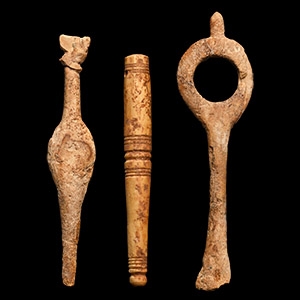
Roman Bone Pin and Implement Group
3rd-4th century A.D.Estimate: £100 - 140 (+bp*)
Opening Bid: £50
Each with round-section shank, one with hoop finial. 29.3 grams total, 9.2-11.3 cm
Private collection of Mr K.A., acquired in the 1990s-early 2000s. This lot is accompanied by an illustrated lot declaration signed by the Head of the Antiquities Department, Dr Raffaele D'Amato.
