
Loading, please wait...
LOT 0232
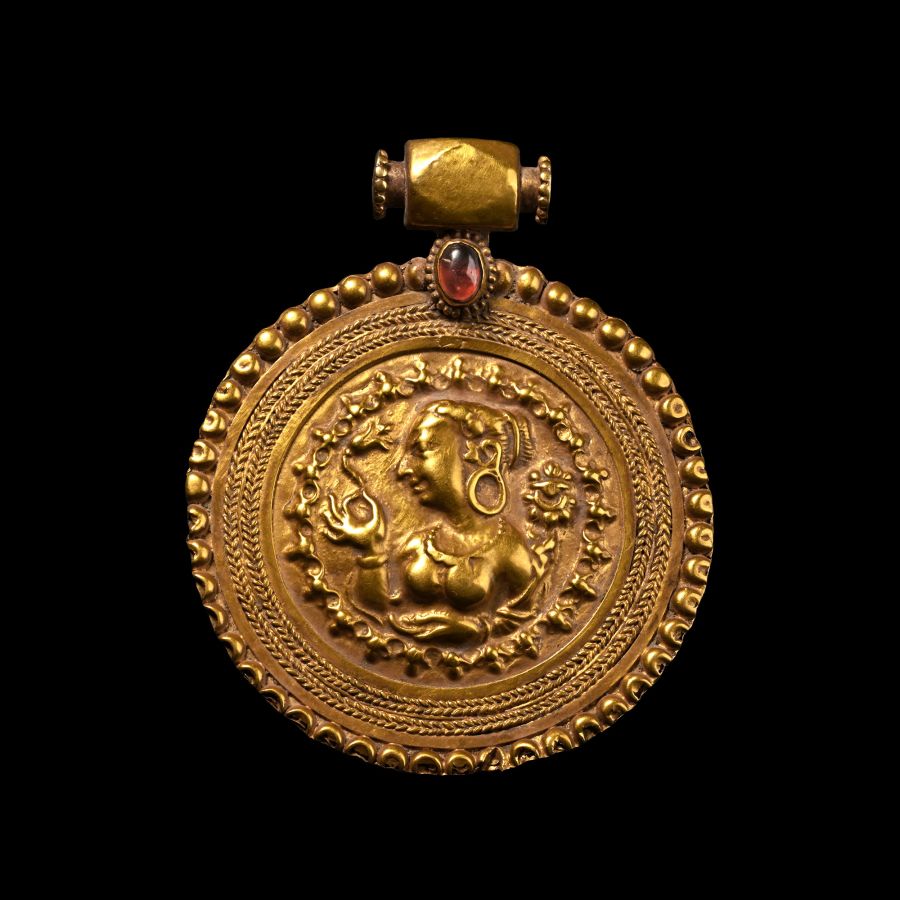
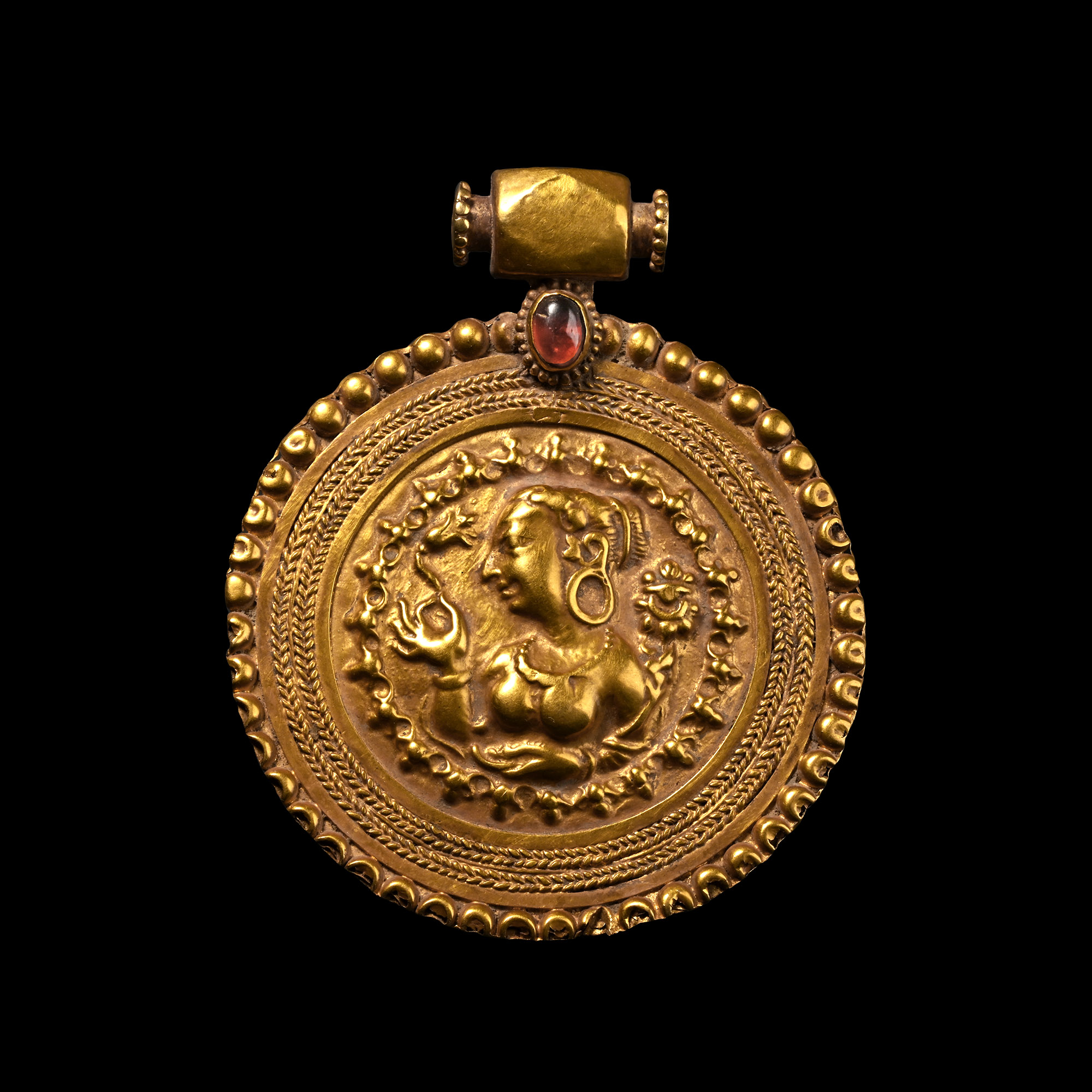
Large Kushan Gold Pendant with Bust of a Goddess
CIRCA 4TH CENTURY A.D.
2 3/4 in. (22.11 grams, 71 mm).
A late Kushan or Hephthalites Dynasty discoid pendant with a female deity, possibly Nana, at the centre holding a lotus flower in her right hand, hair elaborately dressed and wearing large earrings, necklace and bracelets; enclosed by a border of stylised bull heads and a double-plaited border, the outer edge with raised bosses; later applied polygonal suspension loop with granulated collars and an oval garnet cabochon.
ProvenanceAcquired by a Swiss family in the mid-1980s to late 1990s, thence by descent.
Private collection, Switzerland, since the late 1990s.
Accompanied by an academic report by Dr Raffaele D’Amato.
This lot has been checked against the Interpol Database of stolen works of art and is accompanied by search certificate number no.13021-246776.
Cf. Academy of the Science, Painting of ancient Panjikent, (in Russian), Moscow, 1954, figs. 11,12, esp.18; Madhuvanti, G., ‘Nana: the ‘Original’ Goddess of the Lion’ in Journal of Inner Asian Art and Archaeology, volume 1, 2006, pp.98-112; Saadi-Nejad, M., ‘The Goddess Nana and the Kušan Empire: Mesopotamian and the Iranian Traces’ in Acta via Serica, Vol.4, no.2, December 2019, pp.129-140.
FootnotesNana (Kushan Greek: Νανα, Ναναια, Ναναϸαο, Sogdian Nni) was a Bactrian female deity, a variation of the pan-Asian Nana, a fusion of the Sumero-Babylonian Inanna-Ishtar with a local deity, in her Kushan form with the local (Zoroastrian) Harakhvati Aredvi Sura Anahita. Such syncretism was common among Kušan deities. She was an important patron deity in the Kushan Empire and the most important deity worshipped by Emperor Kaniška (c. 127-150 A.D.).
CONDITIONTimeLine Auctions follows a vetting process to ensure the authenticity and legality of all items, reinforcing our commitment to integrity and responsible trading. Each antiquity, antique, and coin lot undergoes thorough examination by a vetting committee of at least ten external specialists, professional trade association members, scientists, and archaeologists: Our Vetting Process
AUCTIONS:
TimeLine is a leading auction house specialising in antiquities, ancient art, collectables, natural history, coins, medals, and books. Our auctions offer museums, collectors, historians, and enthusiasts the opportunity to acquire unique and historically significant pieces.
-
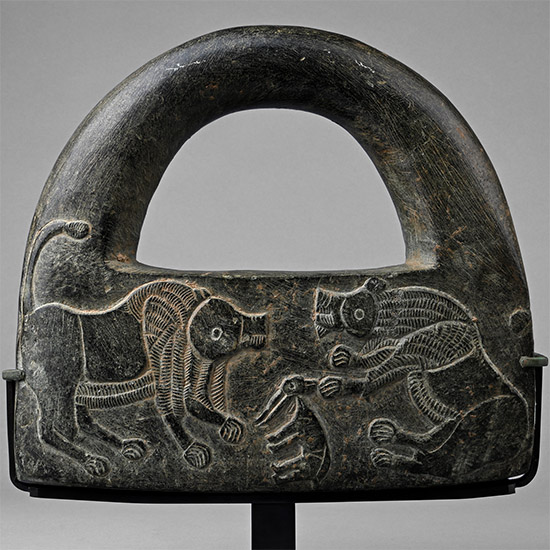
Large Bactrian Black Chlorite 'Hand Bag' Ceremonial Weight
3rd millennium B.C.Sold for (Inc. bp): £13,000
D-shaped in profile with a round-section loop; obverse with a reserved scene of two lions with hatched detailing to the fur advancing towards a small quadruped placed perpendicular to them; reverse with a median eagle with wings extended and feather detailing, flanked by rearing serpents and a scorpion; mounted on a custom-made stand. 6.25 kg total, 28.3 cm high including stand
with Gallery Rosen Ancient Art, Tel Aviv, 10 November 1969. Ex London, UK, gallery, 1971-early 2000s. London, UK, collection. Accompanied by a copy of an original invoice from Gallery Rosen Ancient Art, 10 November 1969. Accompanied by an academic report by Dr Raffaele D’Amato. This lot has been checked against the Interpol Database of stolen works of art and is accompanied by search certificate number no.13246-252973.
Among the most iconic intercultural style objects are the so-called 'lock' or 'handbag' weights. They have been found in a variety of different colourful stones, such as breccia, chlorite, fossiliferous limestone, calcite and onyx. At the beginning, these objects were probably not weights at all, but were likely badges of high office, carried to indicate authority. Similar objects have been found throughout Mesopotamia, the islands of the Persian Gulf, on the Iranian steppe, and in the Indus Valley. -
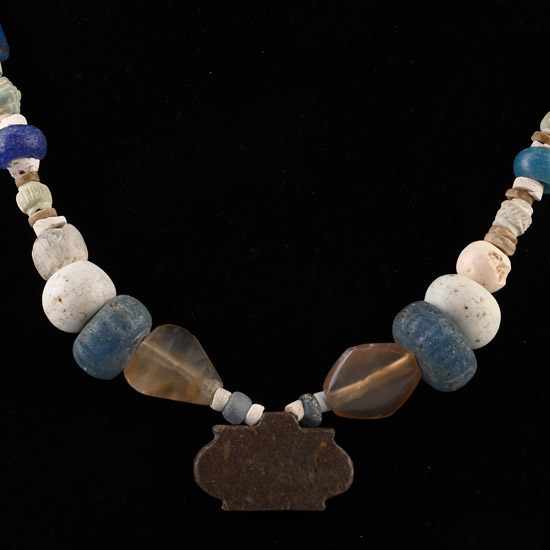
Western Asiatic Stone, Faience and Glass Bead Necklace
1st millennium B.C. and laterSold for (Inc. bp): £26
Restrung group including blue glass melon beads, gold-in-glass square-section beads, fusiform beads and other types. 39.7 grams, 51 cm
From the private collection of Mr Brian Edwards, New Malden, Surrey, UK, formed from the late 1970s-early 1980s; thence by descent. -
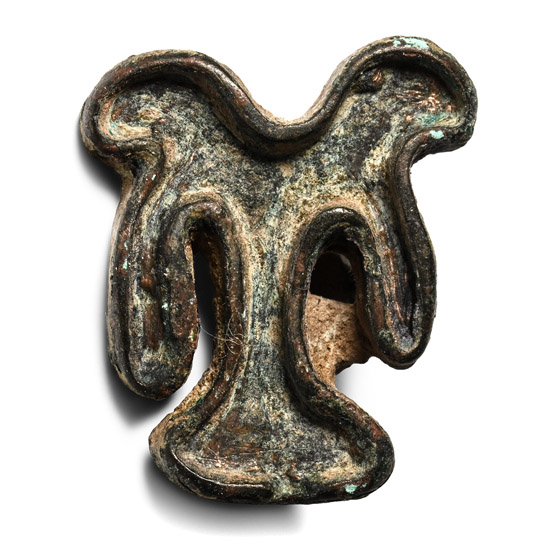
West Central Asian Bronze Double-Headed Heraldic Eagle Seal Matrix
Circa 2300-2000 B.C.Sold for (Inc. bp): £117
Eagle-shaped seal matrix with a large loop on the back, accompanied by an old scholarly note, typed and signed by W.G. Lambert, late Professor of Assyriology, University of Birmingham, 1970-1993, which states: 'Stamp Seal of Bronze, 25 x 21.5 x 1mm. This bears the shape of the design, with flat compartmented face and flat back of which is mounted a loop handle of metal rod. The design shows a heraldic eagle with two heads: heads at the top sideways, wings hanging beneath, and tail feathers spread at the bottom. This comes from west central Asia and dates to c. 2300-2000 B.C. It is a rare type (the double-headed eagle) and in very good condition save for a nick at the bottom.' 9.51 grams, 25 mm
Acquired in the late 1980s-early 1990s. Ex property of a West London businessman. Academically researched and catalogued by the late Professor Lambert in the early 1990s. Accompanied by a copy of a scholarly report, numbered V-850, typed and signed by Professor Wilfrid George Lambert.
