
Loading, please wait...
_900x900.jpg "Large Greek Silver-Gilt Bowl")
_200x200.jpg "Large Greek Silver-Gilt Bowl")
.jpg "Large Greek Silver-Gilt Bowl")
LOT 0117
Large Greek Silver-Gilt Bowl
HELLENISTIC, 2ND-1ST CENTURY B.C.
8 3/8 in. (428 grams, 21.2 cm).
A shallow phiale with chamfered, thickened rim; narrow band of gilding beneath the rim, broad parcel-gilt decorative band with wave borders framing reserved tendrils and foliage; to the centre a parcel-gilt panel with keystone border and quatrefoil motif.
ProvenanceFrench collection, 1980s.
Pierre Berge & Associes, Paris, Archéologie, 16 May 2018, lot 214.
Accompanied by a copy of a seven-page examination report number 113/2019 by Dr habil Mikhail Treister.
Accompanied by the original French archaeological passport.
Accompanied by a copy of the relevant Pierre Berge & Associes catalogue pages.
This lot has been checked against the Interpol Database of stolen works of art and is accompanied by search certificate number no.10426-168735.
Cf. Pfrommer, M., Metalwork from the Hellenized East, The J.Paul Getty Museum, Catalogue of the Collections, Malibu, 1993, pp.110-111, no.1; 114-115 no.3; 118-119, no.5; 128-129, no.10, for similar bowls and decoration.
FootnotesThe bowl is comparable to an early group of Parthian bowls, kept in the P. Getty Museum, dated to the 2nd century B.C. It belongs to a group of bowls with parcel-gilt decoration on the interior, most probably manufactured in one of the Eastern Hellenistic workshops.
CONDITIONTimeLine Auctions follows a vetting process to ensure the authenticity and legality of all items, reinforcing our commitment to integrity and responsible trading. Each antiquity, antique, and coin lot undergoes thorough examination by a vetting committee of at least ten external specialists, professional trade association members, scientists, and archaeologists: Our Vetting Process
AUCTIONS:
TimeLine is a leading auction house specialising in antiquities, ancient art, collectables, natural history, coins, medals, and books. Our auctions offer museums, collectors, historians, and enthusiasts the opportunity to acquire unique and historically significant pieces.
LOT 0117
Large Greek Silver-Gilt Bowl
Estimate £18,000 - 24,000€20,880 - 27,840 (for guidance only)$24,300 - 32,400 (for guidance only)
-
.jpg)
Parthian Bronze Satyr Oil Lamp Section
1st century B.C.-1st century A.D.Estimate: £600 - 800 (+bp*)
Opening Bid: £300
Fragment comprising: tubular body with raised neck to the filler hole, everted rim and spur to reverse; raised tubular neck and head with pelletted collar, hair and bead, pinched nose, pellet eyes, crescent brow, goat's horn extending above in an arch to meet lateral extension from the brow and remains of similar to the other side; goat's legs below the body with hooves, pelletted bracket at the thigh and part of an arched extension connecting to the brow; nozzle to the forward edge and ovoid everted rim. 799 grams, 21 cm
Acquired before 1983. Ex London gallery, 1990s. Private collection, London, UK.
The theme of the item is similar to the classical satyr, part human and part goat. -
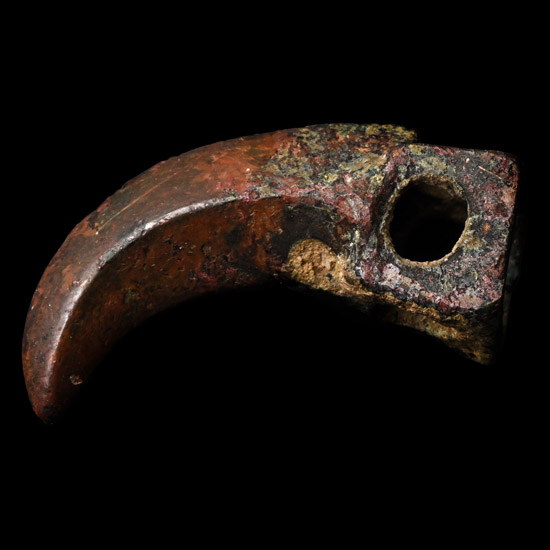
Scythian Bronze Eagle's Talon Pendant
Circa 6th century B.C.Sold for (Inc. bp): £156
Curved square-section hook with cuboid finial pierced on all four sides and to the top. 12.45 grams, 36.19 mm
From the private collection of a European gentleman (1942-2024), formed since the 1970s. -
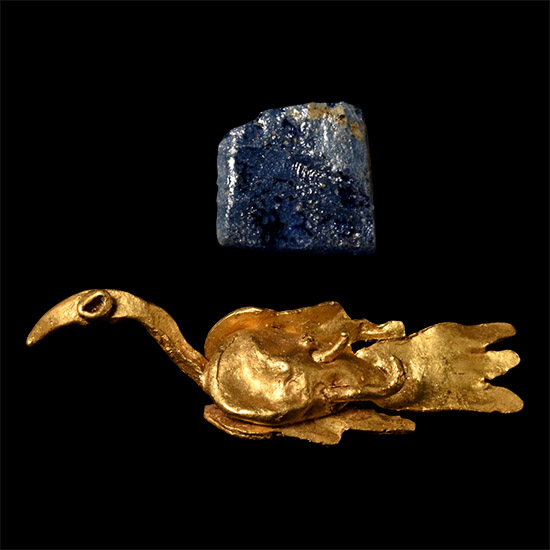
Greek Gold Amuletic Bird
5th-1st century B.C.Estimate: £1,500 - 2,000 (‡+bp*)
Opening Bid: £750
Comprising a sheet-gold hollow-formed avian figure with applied filigree detailing, and a separate beaked head; accompanied by a rectangular blue glass fragment. 0.57 grams, bird: 19 mm
Private collection, USA and Switzerland, acquired in the late 1980s-early 1990s; thence by descent.
