
Loading, please wait...
LOT 0103
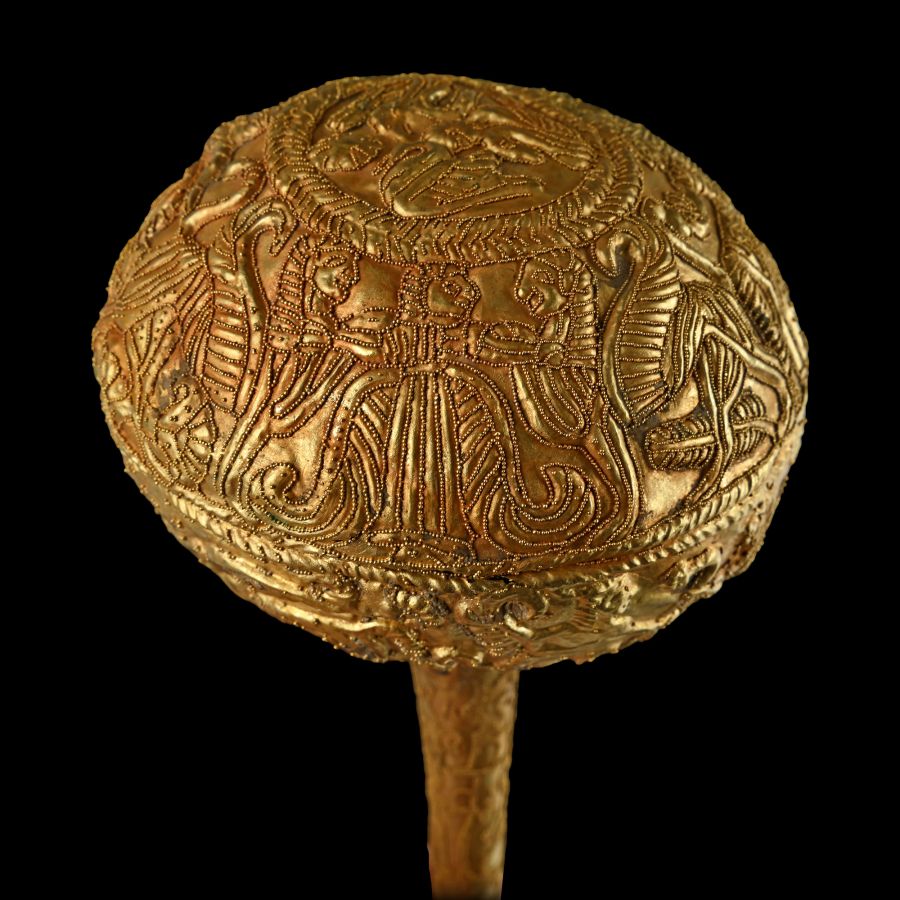
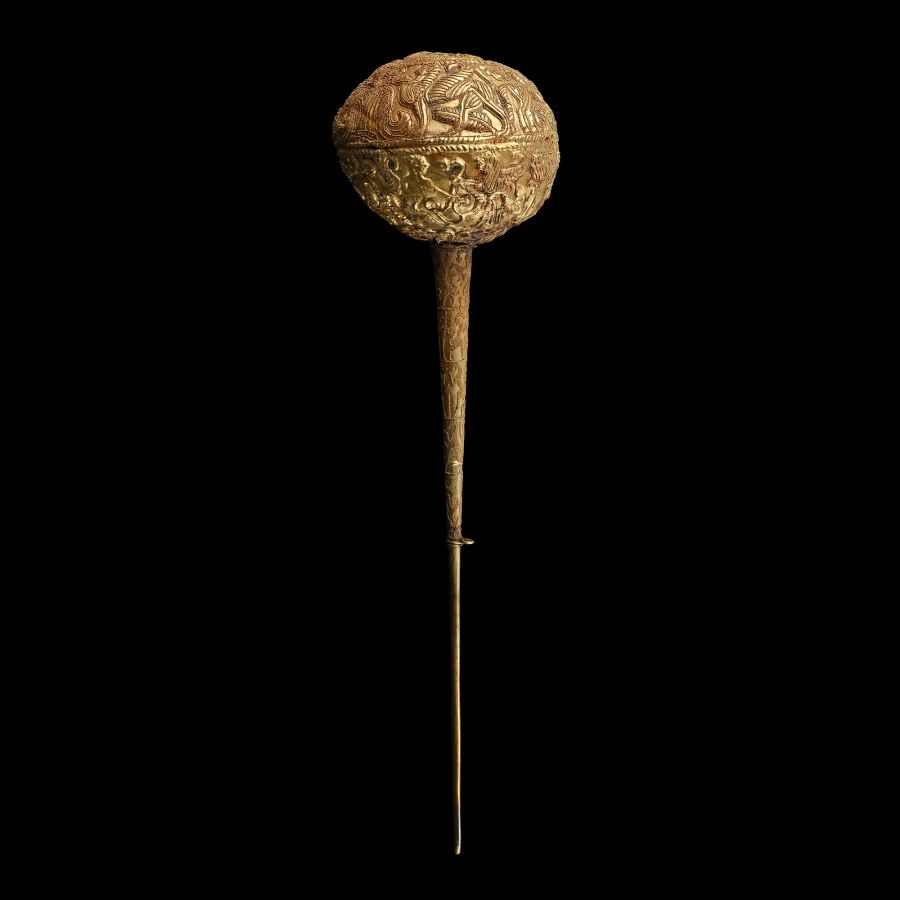
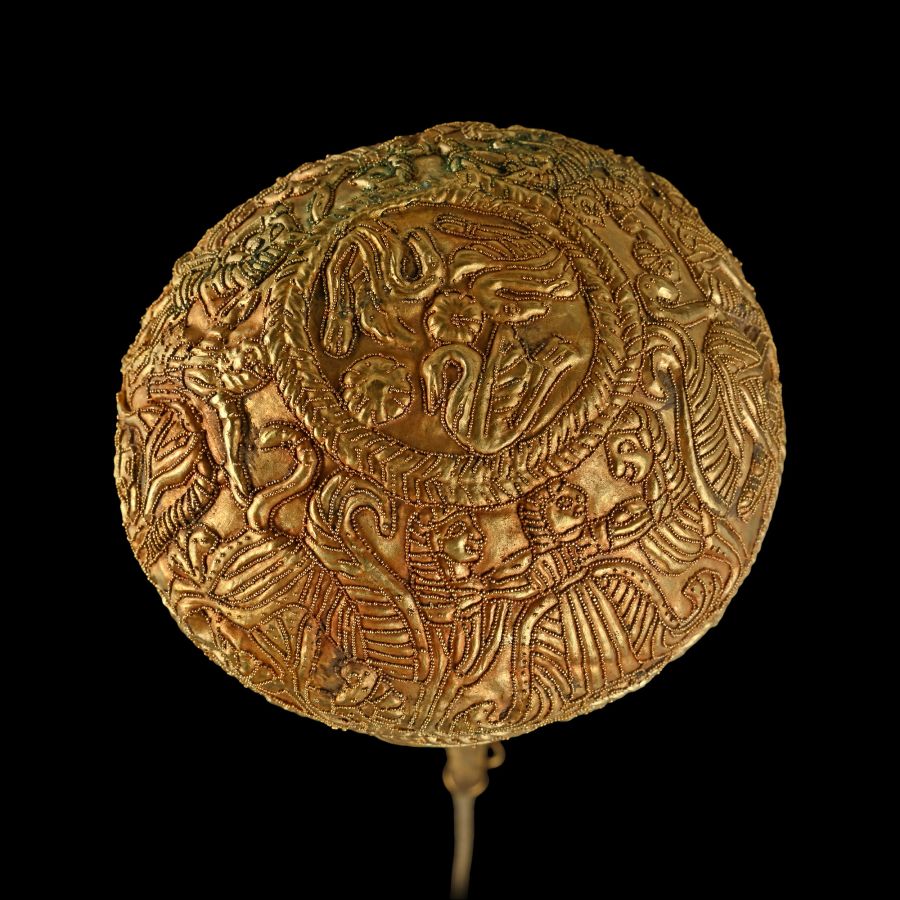
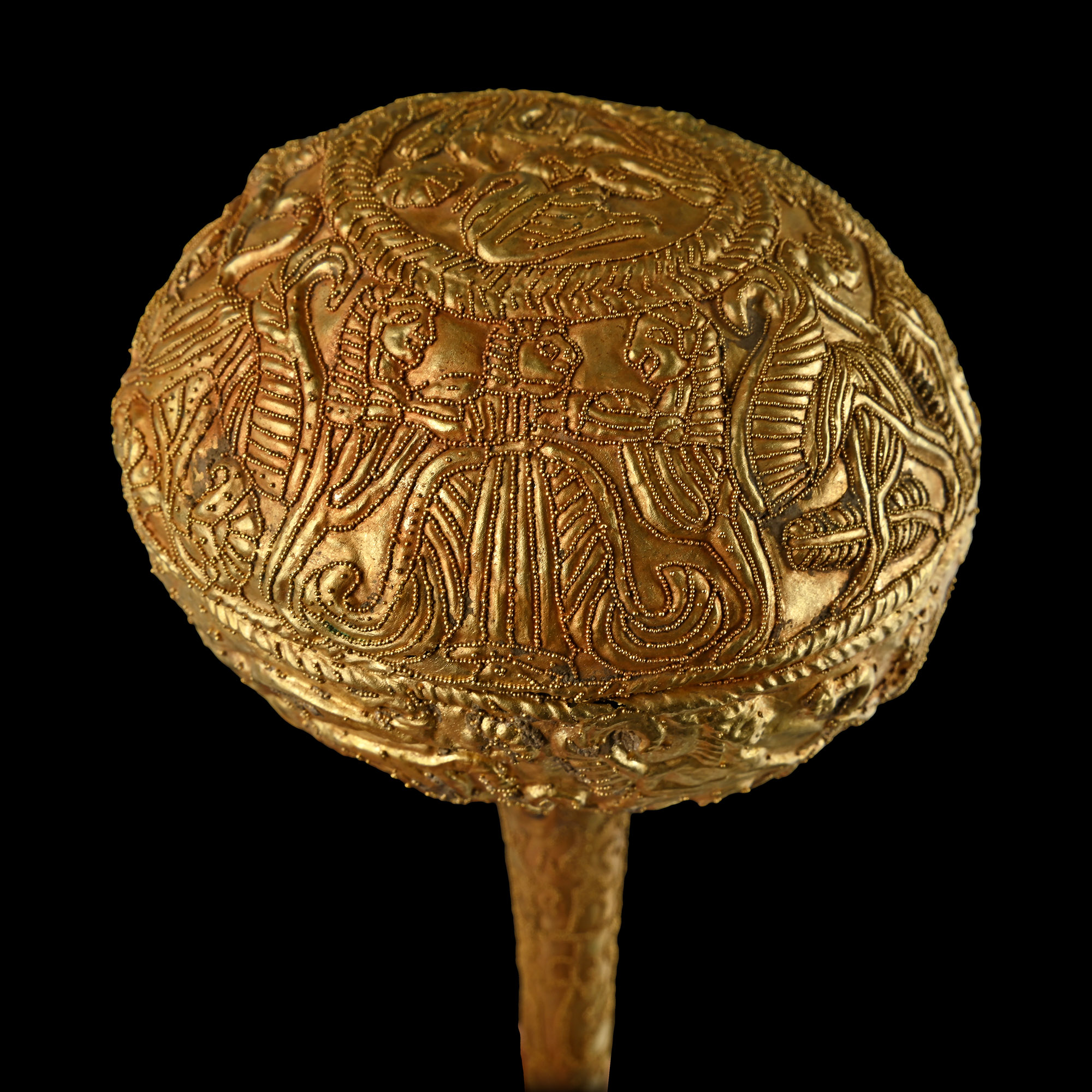
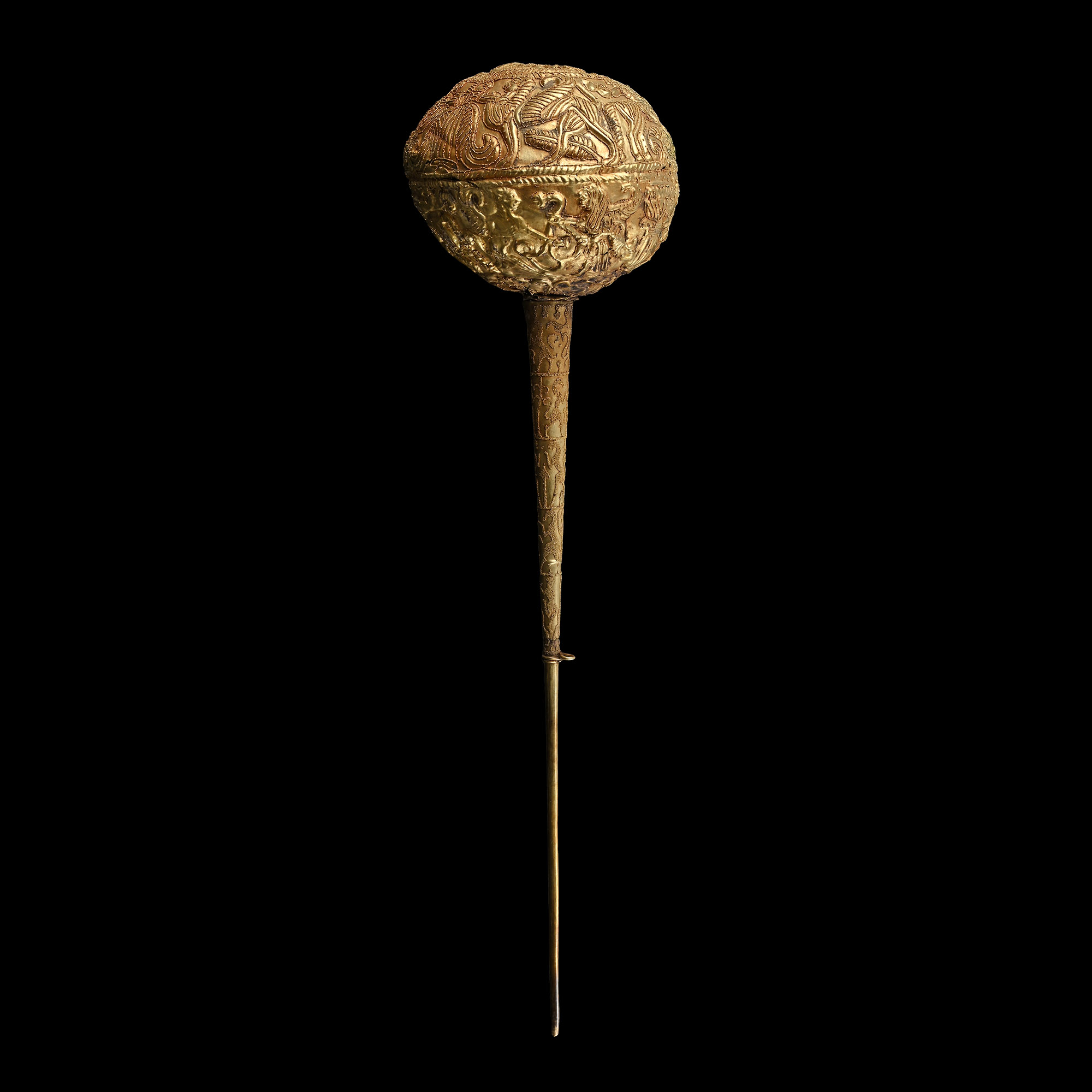
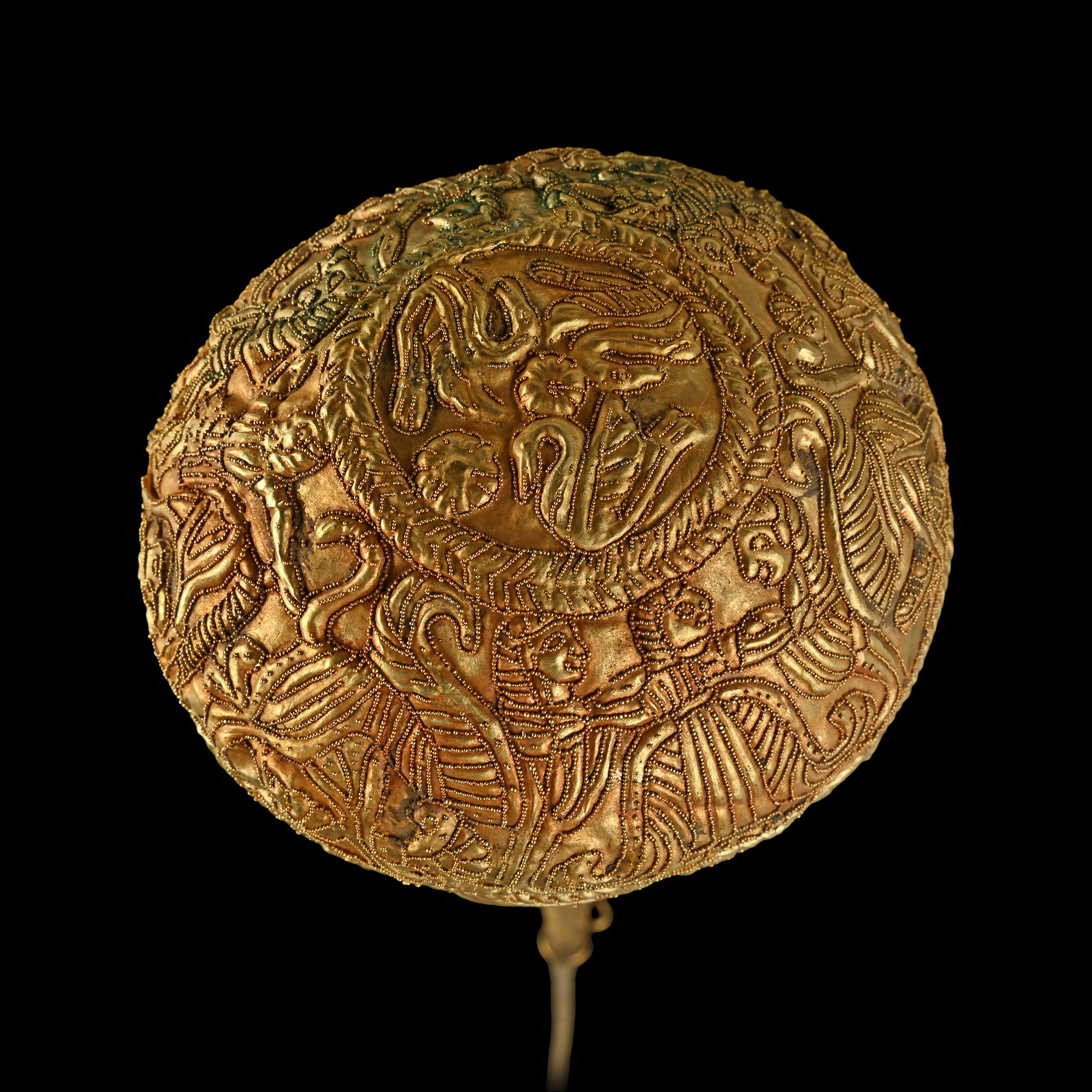
Large Greek Gold Repoussé Dress Pin with Figural Scenes
ARCHAIC, CIRCA 6TH CENTURY B.C.
11 in. (71.1 grams, 28 cm).
Composed of a round-section stem tapering to a point (chipped), the upper section with five figural panels separated by horizontal bands of granulation; each panel with figures executed in granulation including opposed pairs of rearing lions, perching bird, dancing humans, two-headed figure with fronds; below these panels, an applied gold wire loop with recurved end; above, a hollow-formed bulbous finial with a repoussé frieze in two registers: below - winged heroes grappling with gryphons and other beasts in a landscape with granulated detailing, with ropework bands to the equator; above - opposed gryphons flanking a facing master of beasts with head turned, and horsemen advancing towards an anguiped; disc finial to the apex with three repoussé swans in profile. [No Reserve]
ProvenanceAcquired at auction in Geneva or Basel circa 1989.
From the private collection of a Swiss gentleman collector, thence by descent 2018.
Accompanied by an academic report by Dr Raffaele D'Amato.
This lot has been checked against the Interpol Database of stolen works of art and is accompanied by search certificate no.13409- 259878.
Cf. Marshall, F.H., Catalogue of the jewellery Greek, Etruscan & Roman in the departments of Antiquities of the British Museum, London, 1911, pl. X (small examples of dress pins), XIV no.1250 and pl.XXXIX, n.1999, for type; cf. Elderkin, K. McK., ‘Buttons and their use on Greek garments’ in American Journal of Archaeology, vol.32, n.3, Jul-Sep., 1928, pp.333-345; for similar decorated pins cf. Despini, A., Greek Art, Ancient Gold Jewellery, Athens, 1996, figs.172-173; cf. Архипова, Є.І., Відейко М.Ю., Клочко В.І., Клочко Л.С., Левада М.Є; Симоненко О.В., Стоянов, Р.В, Колекція предметів старовини родин Платонових та Тарут, Київ, 2004; see Yavtushenko, I. (eds.), Masterpieces of Platar, Kiev, 2004; cf. Brons, C., 'Representations and realities. Fibulas and pins in Greek and Near Eastern Iconography’ in Nosch, M., & Harlow, M. (eds.), Greek and Roman textiles and dress: an interdisciplinary Anthology, Oxford, 2014, pp.60-94.
FootnotesSince Greek clothing was not sewn, straight pins and fibulae (safety pins) were used to fasten a garment at the shoulders, the sleeves, over the chest, and at other critical points. Pins were already in use in the Early Bronze Age, but highly decorated pins were in use from the 7th- 6th centuries B.C., when vertical incisions, grooves and mythical figures appeared on the spherical beads, pendants and heads of the pins. Gold pins with disc-shaped terminals and spherical heads have been recovered from the archaic tombs of Macedonia, where the decoration was developed on the surface of the spheres in filigree and repoussé techniques.
CONDITIONTimeLine Auctions follows a vetting process to ensure the authenticity and legality of all items, reinforcing our commitment to integrity and responsible trading. Each antiquity, antique, and coin lot undergoes thorough examination by a vetting committee of at least ten external specialists, professional trade association members, scientists, and archaeologists: Our Vetting Process
AUCTIONS:
TimeLine is a leading auction house specialising in antiquities, ancient art, collectables, natural history, coins, medals, and books. Our auctions offer museums, collectors, historians, and enthusiasts the opportunity to acquire unique and historically significant pieces.
LOT 0103
Large Greek Gold Repoussé Dress Pin with Figural Scenes
Estimate £5,000 - 7,000€5,800 - 8,120 (for guidance only)$6,750 - 9,450 (for guidance only)
-
Greek Terracotta Black-Figure Pyxis with Chariot
Attic, 6th century B.C.Estimate: £30,000 - 40,000 (‡+bp*)
Opening Bid: £16,667
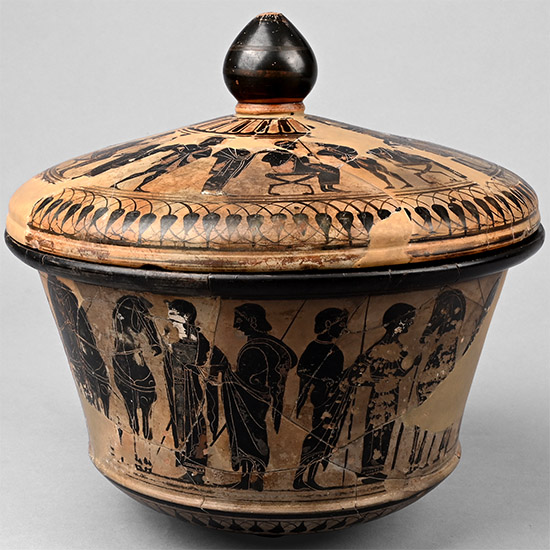
Squat vessel with rounded foot and carination with band of tendrils, flared sidewall with carination and rim, broad watchglass lid with central knop handle; blackware frieze to the sidewall, chariot with four horses and attendants carrying spears and dressed in chitons and himatia, among them a noblewoman dressed in a long chiton and chlamys; lid with frieze of profile figures seated on folding chairs with attendants and petitioners, and two women in long robes within a band of coiled tendrils; repaired and restored. 1.05 kg, 22.5 cm wide
Private collection, Mrs Lambelet, Neuchâtel, Switzerland, acquired before 1972; thence by descent. Private collection N.S., acquired in 2012. Accompanied by an academic report by Dr Raffaele D'Amato. This lot has been checked against the Interpol Database of stolen works of art and is accompanied by search certificate no.13223-249242.
Many Athenian vases depict a quadriga, often in racing or military scenes, but in this case, the depicted scene is peaceful and could be linked to a wedding. The painting can be divided into two scenes: the first, on the sides, is the bridal procession, where the bride is conducted in the chariot, which will bring her to the groom, accompanied by her father and relatives; the second, the lid painting, is where the nuptial feast is prepared, and the conversing guests are waiting for the bride. -
Greek Bronze Patera Handle in the form of a Naked Youth
5th century B.C.Estimate: £4,000 - 6,000 (+bp*)
Opening Bid: £2,000
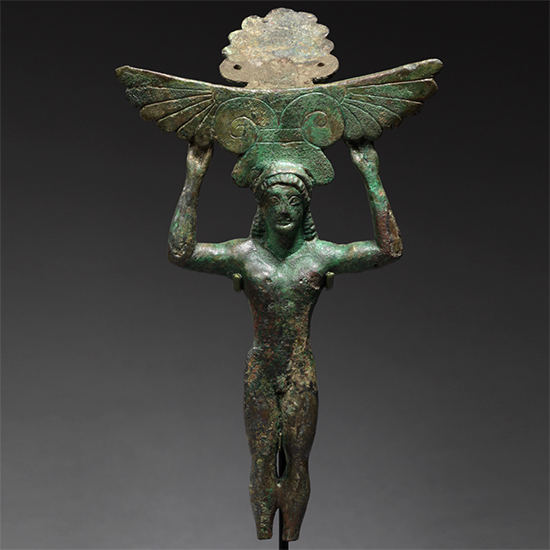
Formed as a nude kouros, hands raised to touch the elaborate palmette sitting atop the boy's head, his face framed by a thick fringe, his hair, held by a band, falling down his back in serpentine waves; the figure standing with legs held close together, broken at mid-shin; a palmette-shaped fixing plate projecting at the back with two holes for rivets to attach to the broad, shallow dish which would have been used for libations. 178 grams total, handle: 17.3 cm high, 23.5 cm high including stand
Private collection UK (N.E.), acquired prior to 1970, and thence by descent. This lot has been checked against the Interpol Database of stolen works of art and is accompanied by search certificate no.13550-263433.
Anthropomorphic handles with images of young naked boys connected with animals were widespread and used for mirrors. The object, in particular, is part of the group of mirrors and paterae with standing youths (male and female, probably symbolising athletes) and nude female mirror caryatids (Mitten-Doeringer, 1968, figs.87-88) serving as vertical handles. -
Greek Agate Gemstone with Maenad
Late Hellenistic, 1st century B.C.Estimate: £400 - 600 (‡+bp*)
Opening Bid: £180
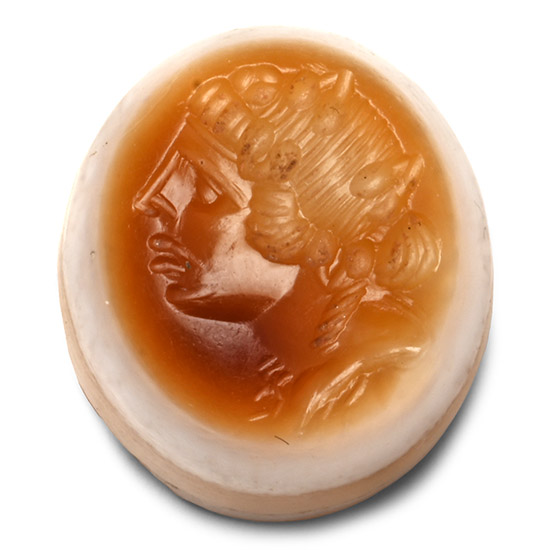
Ellipsoid type with intaglio profile female head facing left, with parted lips and face looking slightly upwards, wearing an ivy wreath in a wavy hair bundled at the temple; supplied with a museum-quality impression. 1.25 grams, 12 mm
French art market, 2016.
