
Loading, please wait...
LOT 0062
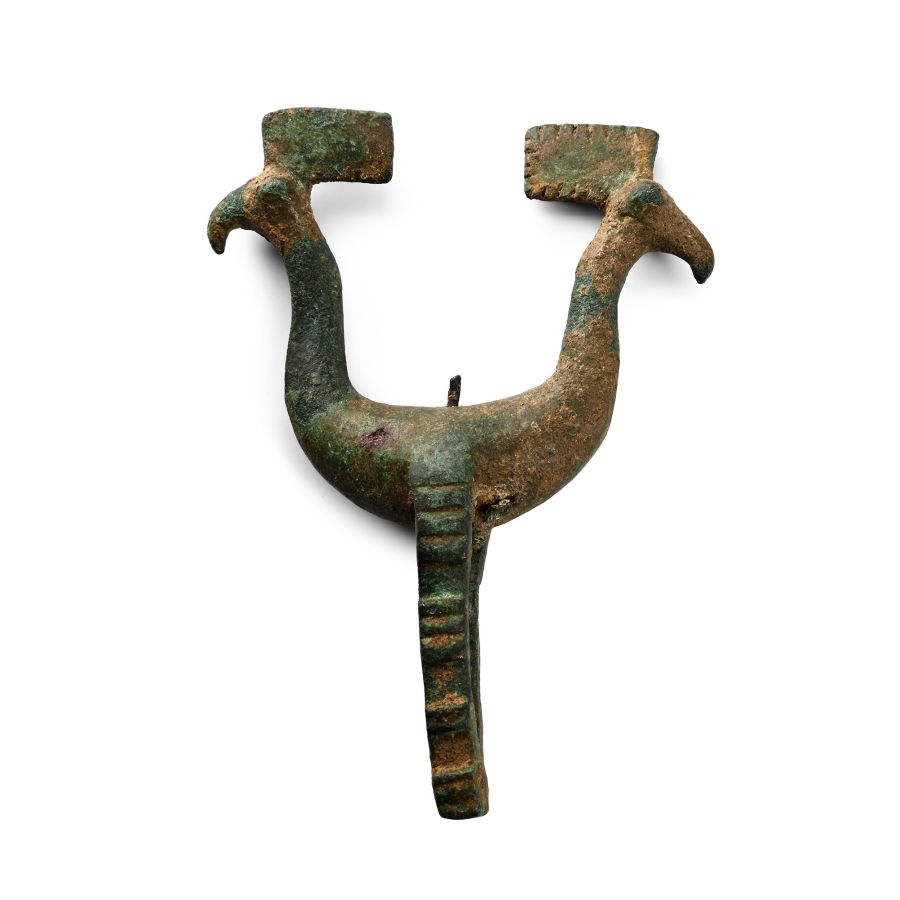
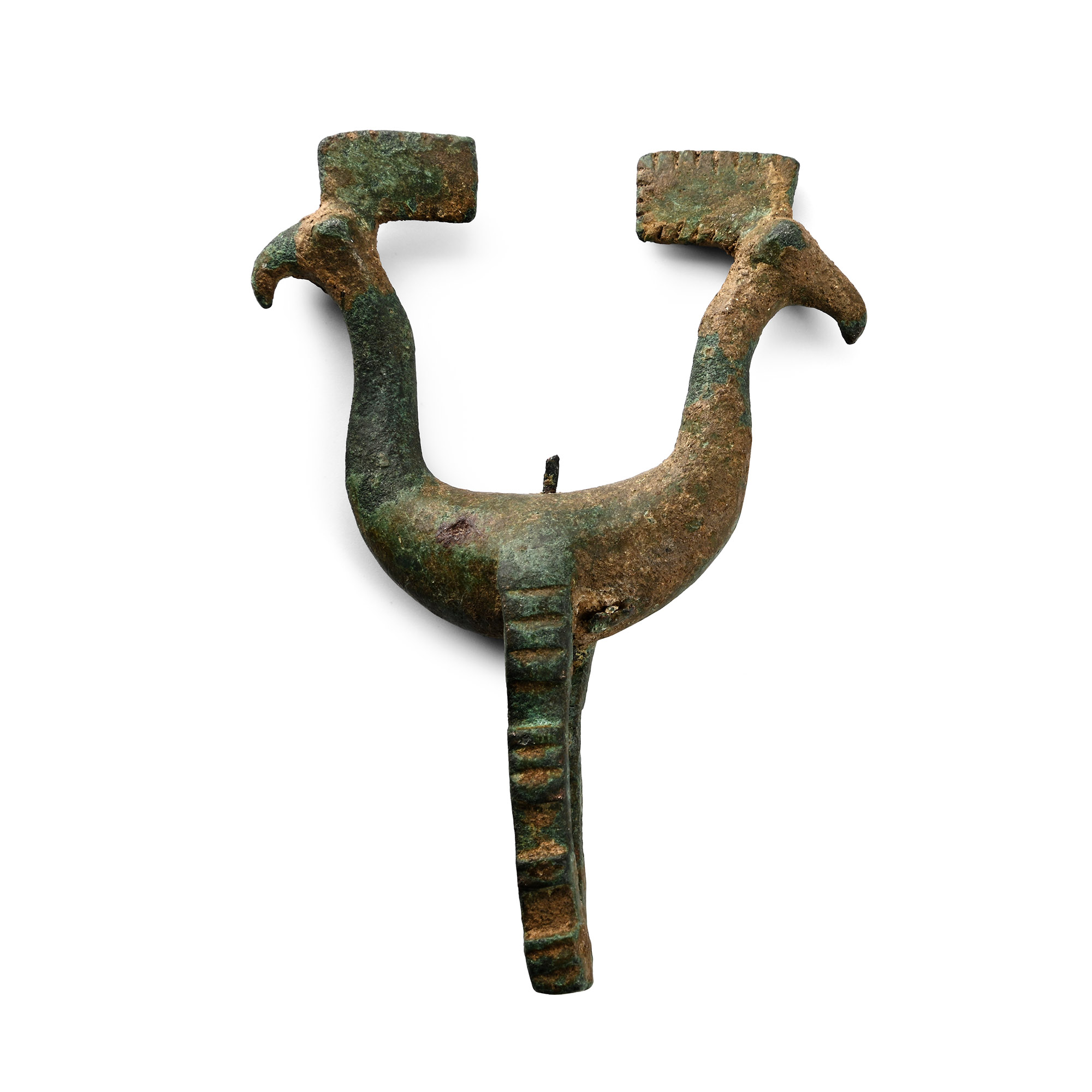
Large Greek Bronze Double-Headed Animal Terminal
GEOMETRIC, 8TH-6TH CENTURY B.C.
3 3/8 in. (55.6 grams, 86 mm).
Comprising a crescentic body with a slender neck at each end, topped by a bird-head with a rectangular crest, vertical legs with raised block detailing conjoined at the lower end into a mounting peg.
ProvenanceEx collection Mr K.H., Germany.
Private collection, acquired in 2012.
This lot has been checked against the Interpol Database of stolen works of art and is accompanied by search certificate no.13077-246757.
Cf. for similar fittings, Christiansen, J., Greece in the Geometric Period, Copenhagen, 1992, figs.70ff., esp.40,44,49-50.
FootnotesBird figures, standing on plates or discs, are found as votives mainly in Northern Greek sanctuaries of the Geometric Age. They should be regarded as symbolic and sometimes modest gifts to the gods. Some birds were also designed as pendants. The present fitting resembles a rooster, but it could also represent a peacock, and hence is connected with the goddess Hera.
CONDITIONTimeLine Auctions follows a vetting process to ensure the authenticity and legality of all items, reinforcing our commitment to integrity and responsible trading. Each antiquity, antique, and coin lot undergoes thorough examination by a vetting committee of at least ten external specialists, professional trade association members, scientists, and archaeologists: Our Vetting Process
AUCTIONS:
TimeLine is a leading auction house specialising in antiquities, ancient art, collectables, natural history, coins, medals, and books. Our auctions offer museums, collectors, historians, and enthusiasts the opportunity to acquire unique and historically significant pieces.
LOT 0062
Large Greek Bronze Double-Headed Animal Terminal
Estimate £1,200 - 1,700€1,390 - 1,970 (for guidance only)$1,620 - 2,300 (for guidance only)
-
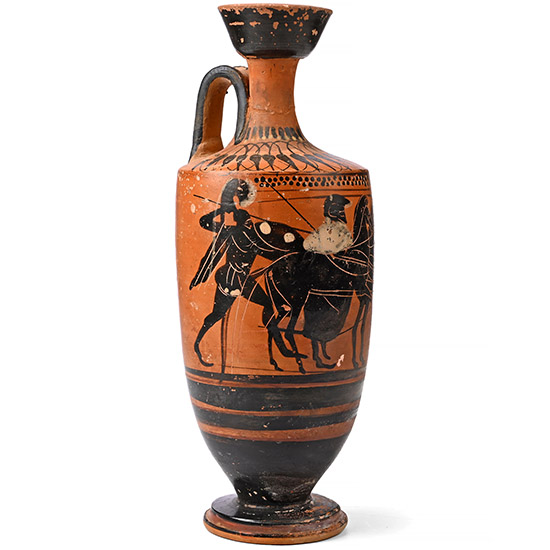
Greek Black-Figure Lekythos with Horses and Fighting Warriors
Athens, 550-500 B.C.Sold for (Inc. bp): £3,900
Cylindrical with echinus mouth and stepped torus foot, on the body a dynamic scene consisting of four rearing horses, side-by-side and wearing harnesses, nestled between the horses a standing warrior wearing a crested helmet, behind the horses an advancing warrior wearing a plumed helmet, holding a long spear in his raised hand a round shield in the other; before the horses a fleeing opponent in a running pose, facing back and holding a spear in one hand while protecting himself with a shield held in the other; long tongue motifs on the shoulder; restored. 472 grams, 23.5 cm
Ex Bonhams, Knightsbridge, London, 1990s. Private collection, Suffolk.
The scene depicts a battle between hoplites, possibly an episode from the Iliad. Originally, one or two of the combatants were positioned on a chariot; four horses from it remain visible. The scene may represent the wounding of Ares, the god of war, as he is pursued by Diomedes and accompanied by the goddess Pallas, whose helmet is emerging from behind the horses. -
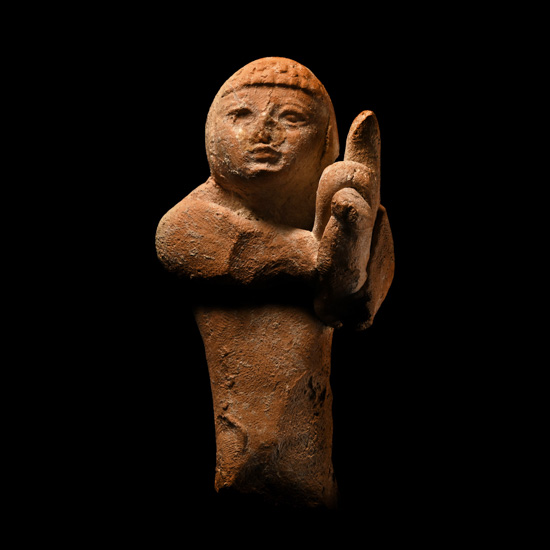
Greek Terracotta Citharode
6th-4th century B.C.Estimate: £1,200 - 1,700 (‡+bp*)
Opening Bid: £600
D-shaped in section with close-cut hairstyle, standing, holding a cithara supported on the left arm, strumming with the right hand. 62 grams, 86 mm
Ex Shlomo Moussaieff (1925-2015), Israel. European private collection. This lot has been checked against the Interpol Database of stolen works of art and is accompanied by search certificate number no.13107-246791.
The cithara was the instrument of the ‘virtuosi’, the principal concert instrument of the ancient Greeks. Its sound box was made of wood and was much bigger than that of the lyra. Strips of copper or horn were commonly incorporated into it, which resonated in sympathy with the strings, giving a great breath of sound. -
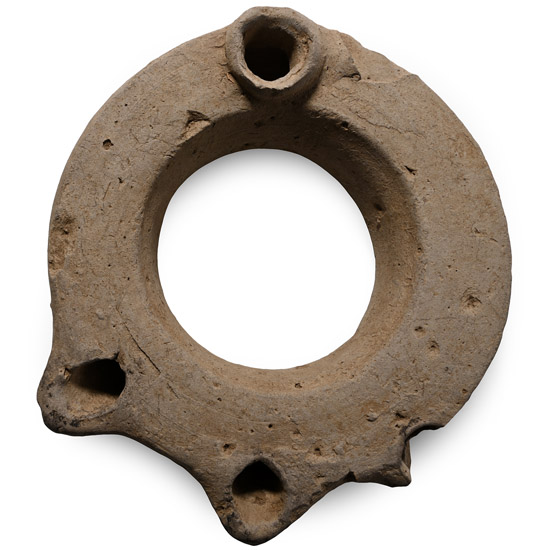
Greek Terracotta Multi-Spouted Oil Lamp
Circa 2nd-1st century B.C.Sold for (Inc. bp): £143
An annular oil lamp with three nozzles and a filler hole to the rear, an inked collector's note '423' on the underside. 513 grams, 16.6 cm
From an important collection of lamps, Germany, 1970s.
