
Loading, please wait...
LOT 0109
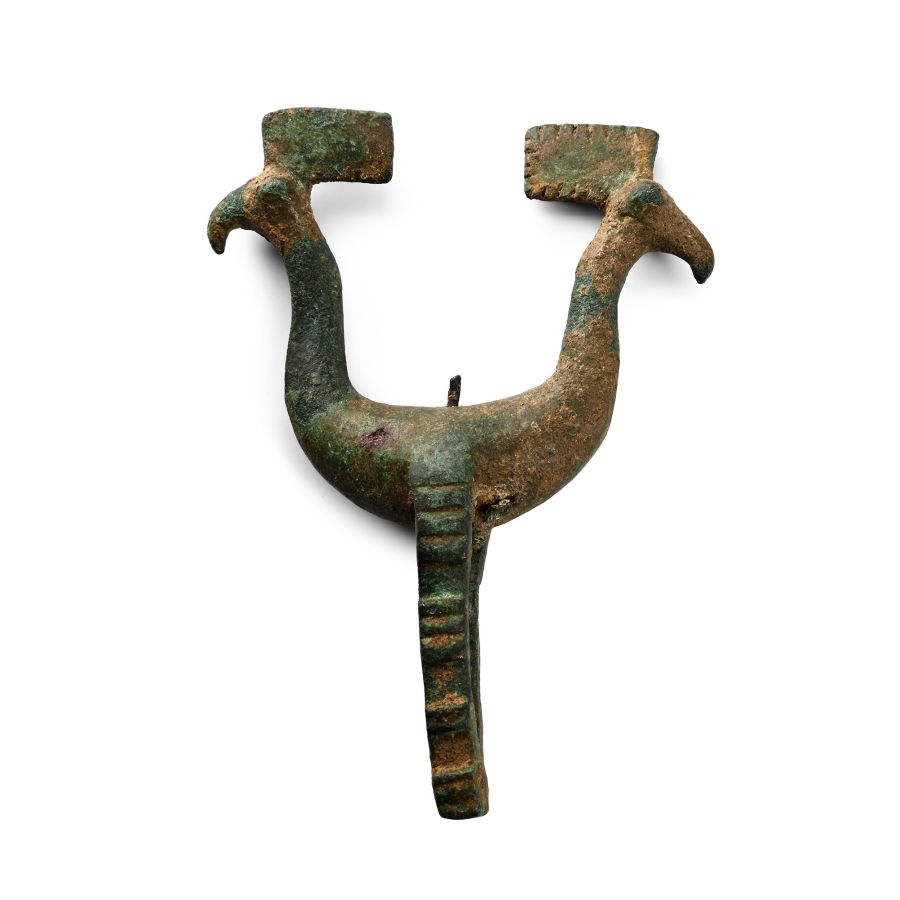
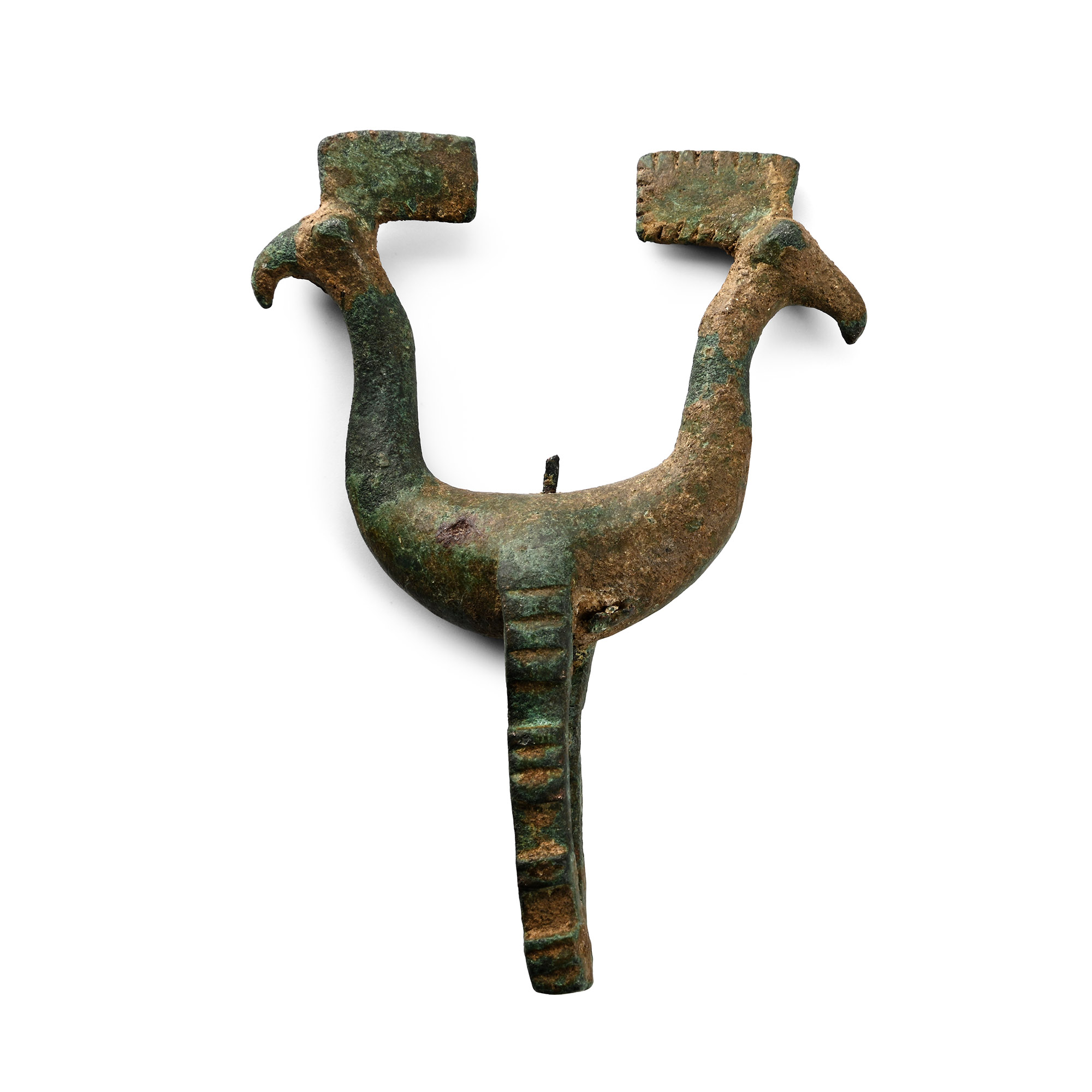
Large Greek Bronze Double-Headed Animal Terminal
GEOMETRIC, 8TH-6TH CENTURY B.C.
3 3/8 in. (55.6 grams, 86 mm).
Comprising a crescent body with a slender neck at each end, topped by a bird-head with a rectangular crest, vertical legs with raised block detailing conjoined at the lower end into a mounting peg.
ProvenanceEx collection Mr K.H., Germany.
Private collection, acquired in 2012.
This lot has been checked against the Interpol Database of stolen works of art and is accompanied by search certificate no.13077-246757.
Cf. for similar fittings, Christiansen, J., Greece in the Geometric Period, Copenhagen, 1992, figs.70ff., esp.40,44,49-50.
FootnotesBird figures, standing on plates or discs, are found as votives mainly in Northern Greek sanctuaries of the Geometric Age. They should be regarded as symbolic and sometimes modest gifts to the gods. Some birds were also designed as pendants. The present fitting evokes the rooster, but a possible representation of a peacock and its connection with Hera is not to be excluded.
CONDITIONTimeLine Auctions follows a vetting process to ensure the authenticity and legality of all items, reinforcing our commitment to integrity and responsible trading. Each antiquity, antique, and coin lot undergoes thorough examination by a vetting committee of at least ten external specialists, professional trade association members, scientists, and archaeologists: Our Vetting Process
AUCTIONS:
TimeLine is a leading auction house specialising in antiquities, ancient art, collectables, natural history, coins, medals, and books. Our auctions offer museums, collectors, historians, and enthusiasts the opportunity to acquire unique and historically significant pieces.
LOT 0109
Large Greek Bronze Double-Headed Animal Terminal
Estimate £1,500 - 2,000€1,740 - 2,320 (for guidance only)$2,030 - 2,700 (for guidance only)
-
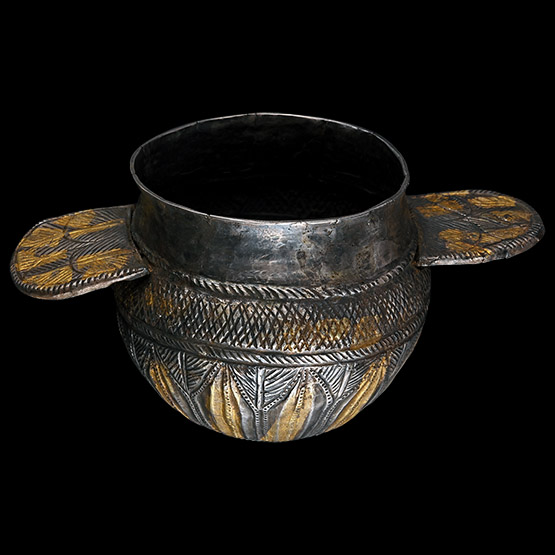
Greek Silver-Gilt Wine Cup with Handles
Hellenistic, 2nd-1st century B.C.Sold for (Inc. bp): £6,240
Comprising a globular body with a rounded underside, a repoussé rosette with ropework border, segmented band with leaf detailing, hatched shoulder framed by ropework bands, scooped neck with chamfered rim; two D-shaped ledge handles with recessed rim, ropework border, hatched panels; accompanied by a custom-made display case. 179 grams, 15.5 cm wide
Acquired on the US art market, early 1990s. Private collection, North America. Ex private collection, USA. TimeLine Auctions, 23 February 2023, no.48. Private collection, London. Accompanied by an academic report by Dr Raffaele D'Amato. This lot has been checked against the Interpol Database of stolen works of art and is accompanied by a search certificate number no.13037-247507. -
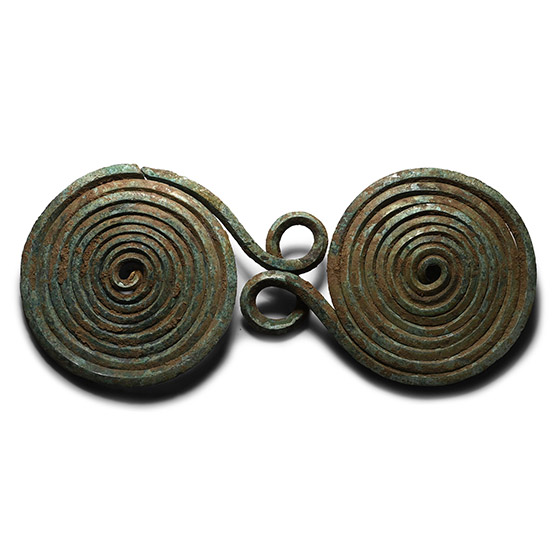
Large Greek Bronze Spiral Fibula
Geometric, 7th-6th century B.C.Estimate: £400 - 600 (‡+bp*)
Opening Bid: £200
Formed from a single square-section filament rolled into two 'spectacle' discs; one of the spirals terminating in a long pin, the other in a hook serving as the catchplate; openwork figure-of-eight at the centre; pin broken, coils separated. 159 grams, 17 cm
Acquired in the mid 1980s-1990s. Private collection, Switzerland, thence by descent. Private collection, since the late 1990s. -
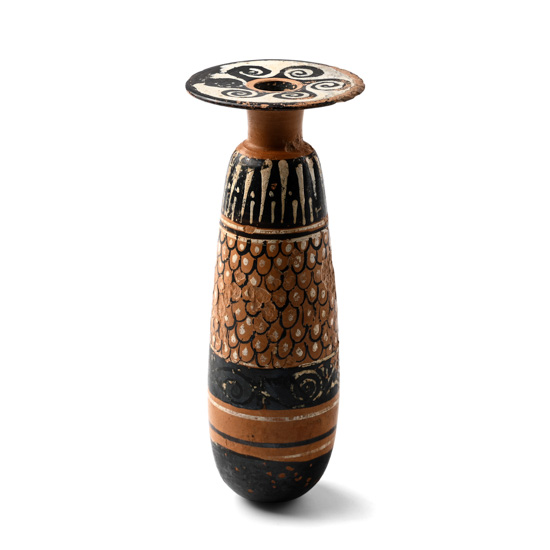
Greek Black-Figure Alabastron with Fish Scale Pattern, Possibly Attributed to the Bulas Group
Attic, early 4th century B.C.Sold for (Inc. bp): £2,340
Ovoid shape with short neck and expanded flat rim; painted with horizontal bands with vertical strokes on the shoulder, fish-scale pattern below and running scrolled tendrils; horizontal stripes below. 87 grams, 13 cm
partially repainted
Collection of M. Bouvier, Switzerland (1901-1980), Switzerland. Bouvier was a law professor in Alexandria prior to 1930. with Christie's, London, 7 October 2010, no.117. Private collection, 2010. Accompanied by an original thermoluminescence analysis report no.N125q42 by Oxford Authentication. Accompanied by copies of the Christie's catalogue pages. Accompanied by an academic report by Dr Raffaele D’Amato. This lot has been checked against the Interpol Database of stolen works of art and is accompanied by a search certificate number no.13008-246447.
The alabastra of the Bulas Group display scale-like patterns. They were painted with slip, a liquid clay which vitrifies when fired. This group is usually dated to the late 5th – early 4th century B.C. It was named after Kazimierz Bulas, who was the first to study them in depth in the 1930s. He characterised various shapes according to their decorative techniques (nets and floral patterns) and their functions.
