
Loading, please wait...
_900x900.jpg "Large Greek Attic Red Figure Skyphos")
_200x200.jpg "Large Greek Attic Red Figure Skyphos")
.jpg "Large Greek Attic Red Figure Skyphos")
LOT 0073
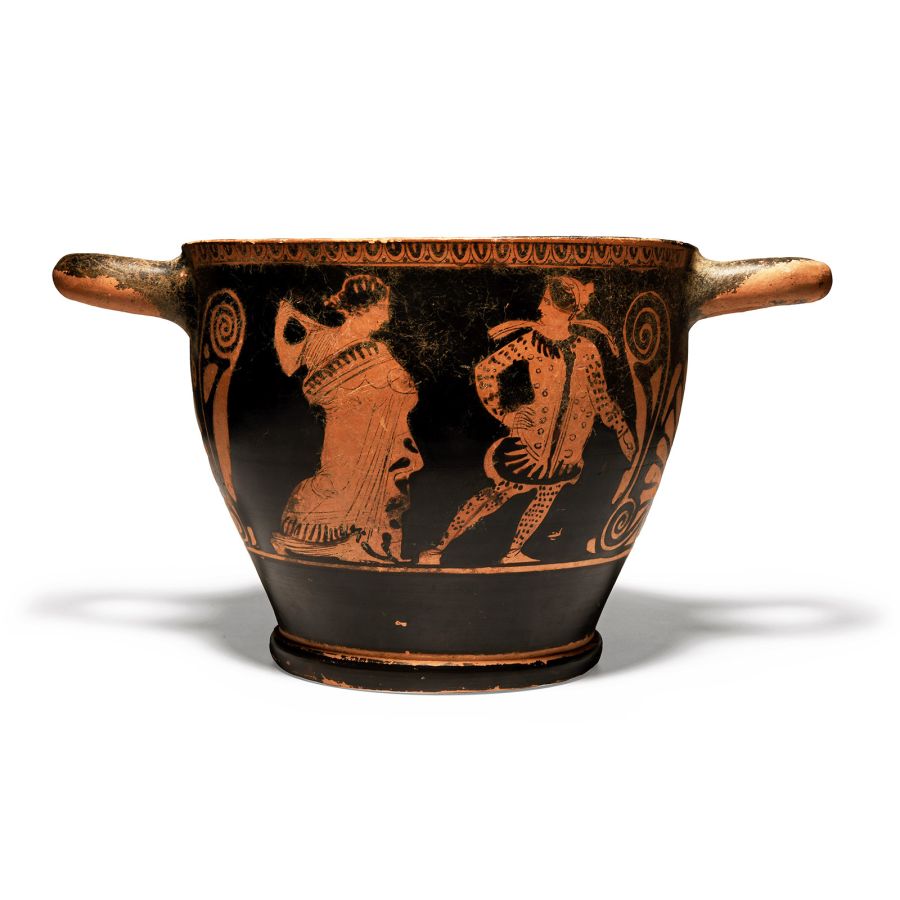
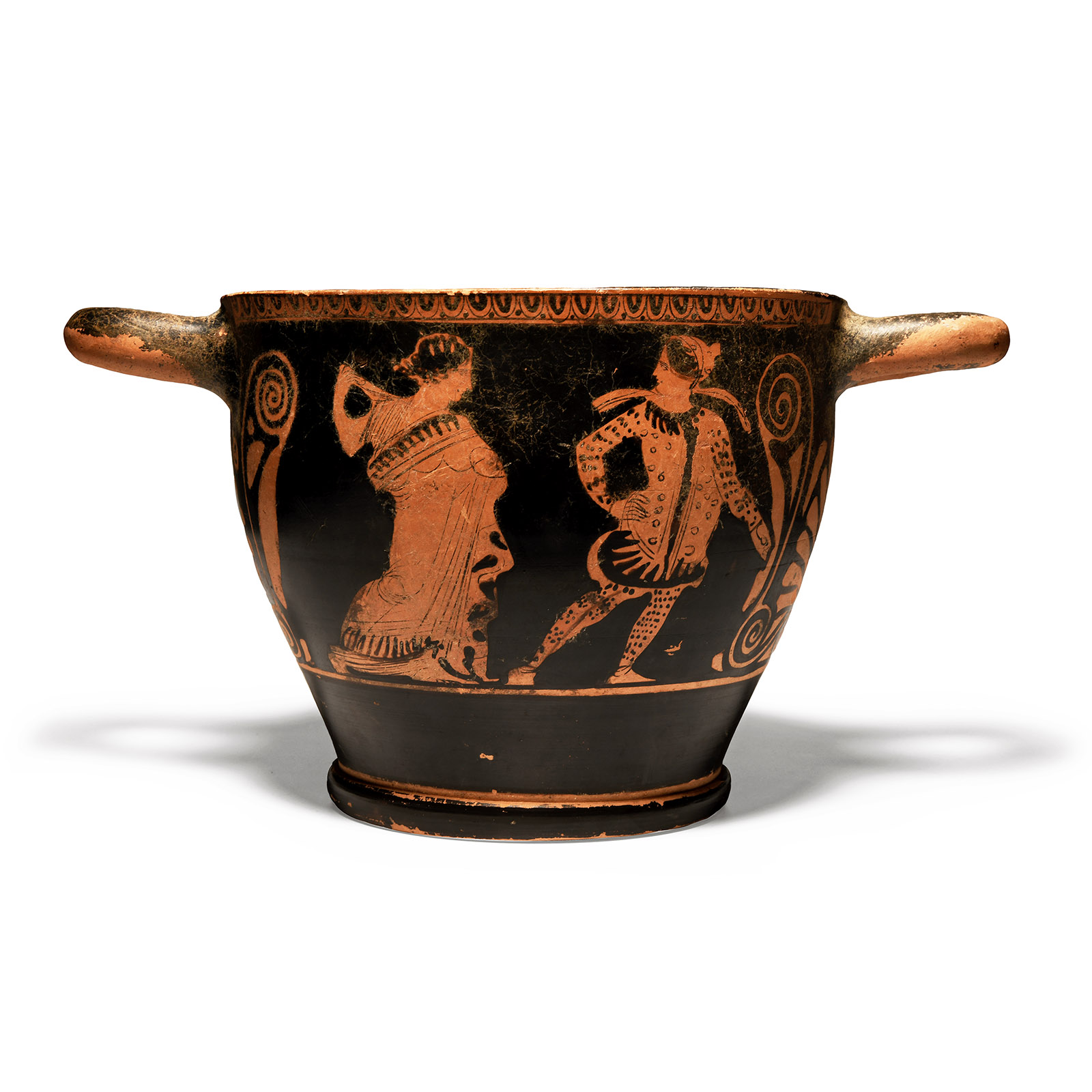
Large Greek Attic Red Figure Skyphos
CIRCA 6TH-4TH CENTURY B.C.
12 in. (1.02 kg, 30.5 cm wide).
With stepped foot and two loop handles to the rim, egg-and-dart border; Side A: female in loosely draped robe with fringe borders holding one corner of her robe in her raised left hand and advancing towards a male wearing a tight-fitting jacket and flared skirt, cap with straps flung wide; Side B: similar scene with the female standing with one hand on her hip, the male in the act of dancing; volute scroll beneath each handle.
ProvenanceEx P.A., Hertfordshire, UK, specialist collection of Greek art, 1980-1990s.
Accompanied by an original thermoluminescence analysis report no.N123n52 from Oxford Authentication.
This lot has been checked against the Interpol Database of stolen works of art and is accompanied by search certificate no.11952-210225.
Cf. similar vessel with different subject matter in the Metropolitan Museum of Art, New York, under accession number 06.1021.181.
CONDITIONTimeLine Auctions follows a vetting process to ensure the authenticity and legality of all items, reinforcing our commitment to integrity and responsible trading. Each antiquity, antique, and coin lot undergoes thorough examination by a vetting committee of at least ten external specialists, professional trade association members, scientists, and archaeologists: Our Vetting Process
AUCTIONS:
TimeLine is a leading auction house specialising in antiquities, ancient art, collectables, natural history, coins, medals, and books. Our auctions offer museums, collectors, historians, and enthusiasts the opportunity to acquire unique and historically significant pieces.
-
.jpg)
Eastern Greek Bronze Standing Bull Statuette
Circa 11th-9th century B.C.Sold for (Inc. bp): £780
With thick ribbed neck, crescent horns and prominent genitals; mounted on a custom-made stand. 141 grams total, 86 mm wide including stand
From the collection of D. Smith, Sussex, UK, 1990s.
Like dozens of similar statuettes depicting animals or human figures, this bronze bull was probably offered by a worshipper during a sacrifice. A large number of statuettes were found in a thick layer of ash from the altar of Zeus at Olympia. In 2021, a similar statuette, with protruding horns, was found in the sanctuary. Bulls and horses were the favourite cultic animals in the Cretan, Achaean and Archaic Greek civilisations. The model of the long and narrow body was borrowed from the Near East. -
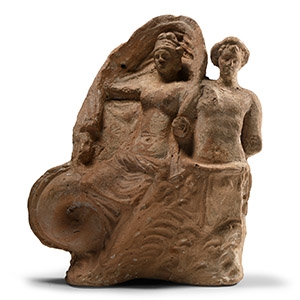
Greek Terracotta Venus and Triton Group
1st century B.C.Sold for (Inc. bp): £910
Both figures represented facing with bare chests, Aphrodite sitting next to the triton and holding himation over her head with her right hand, her right leg raised and the left extended, the lower part of her himation covering the lower half of her body; the lower part of Triton’s body covered by marine foliage, from which the long serpentine tail emerges on the opposite side next to Aphrodite's right leg; possibly from Asia Minor; repaired. 688 grams, 18 cm high
Ex French Sorbonne archaeology professor (deceased); 1960s-2000s. Accompanied by an original thermoluminescence analysis report no.QED2323/FG-0201 from the QED Laboratory, Marseille, France.
Many of the Smyrna and Myrina figures are feminine, the heads modelled in late Hellenistic style. The bodies are often either draped in Tanagra-style robes, or represented as figures of Aphrodite, draped, semi-nude or naked. The association with Triton is linked with the Greek myth of Aphrodite born from sea foam. -
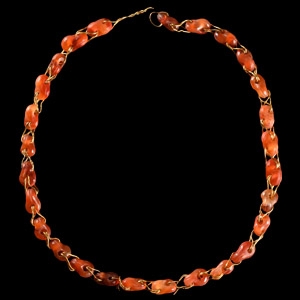
Greek Gold and Carnelian Necklace
1st century B.C.-1st century A.D.Estimate: £2,000 - 3,000 (‡+bp*)
Opening Bid: £1,000
A section of a necklace of carnelian drop-shaped beads, each pierced in two planes and linked loop-in-loop with thin twisted gold wires, possibly later. 8.16 grams, 26 cm long
The Gans collection, Hebling Dec, Berlin, 1929. with Christie's, New York, 8 December 1999, lot 51. Accompanied by a copy of the relevant Christie's catalogue pages. This lot has been checked against the Interpol Database of stolen works of art and is accompanied by search certificate no.11608-198969.
