
Loading, please wait...
LOT 0072
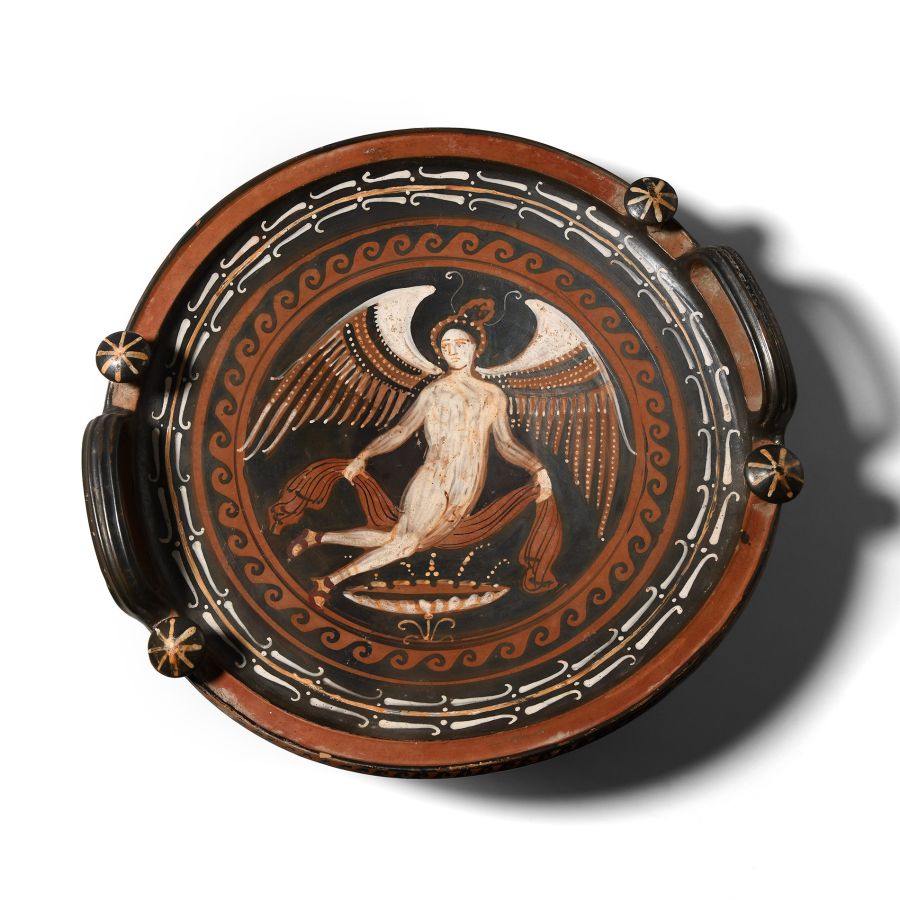
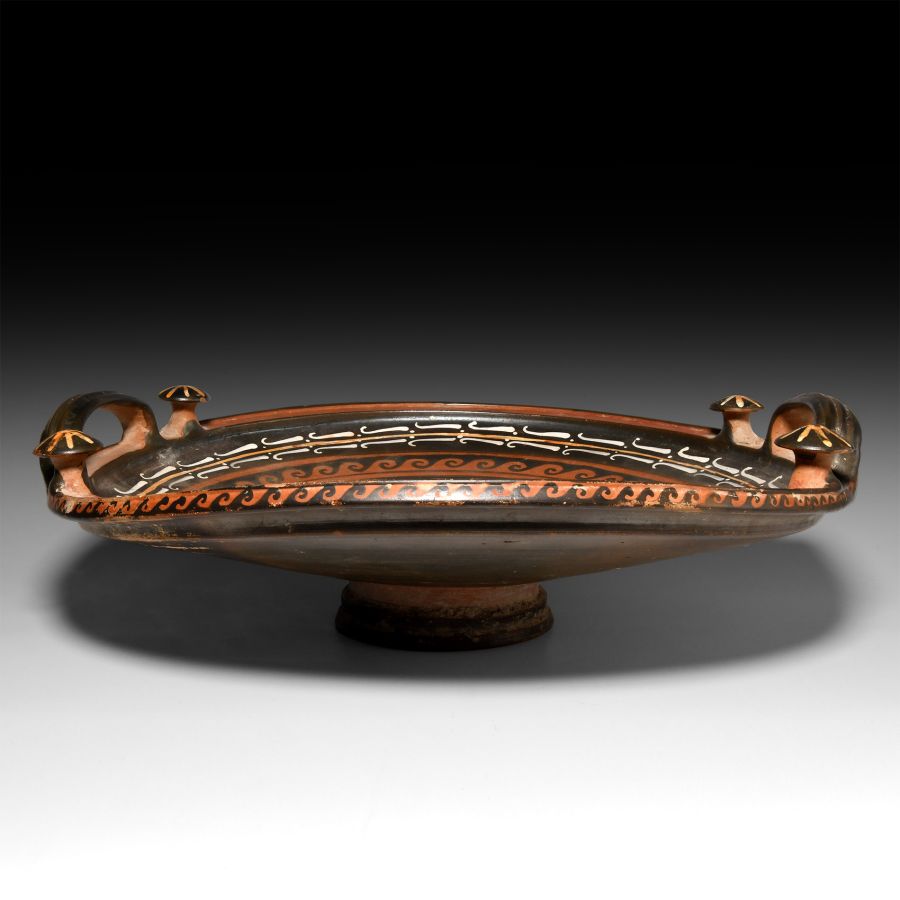
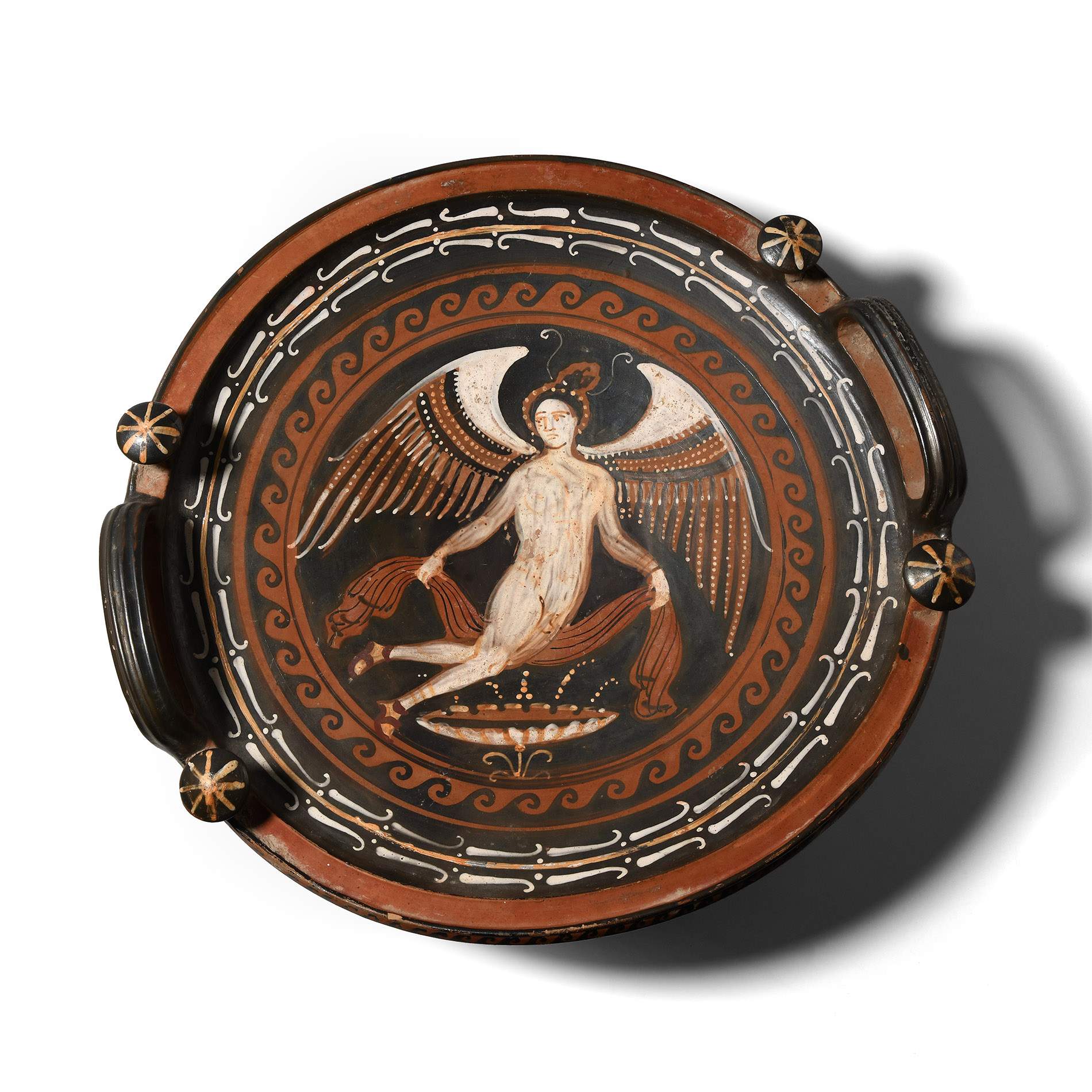
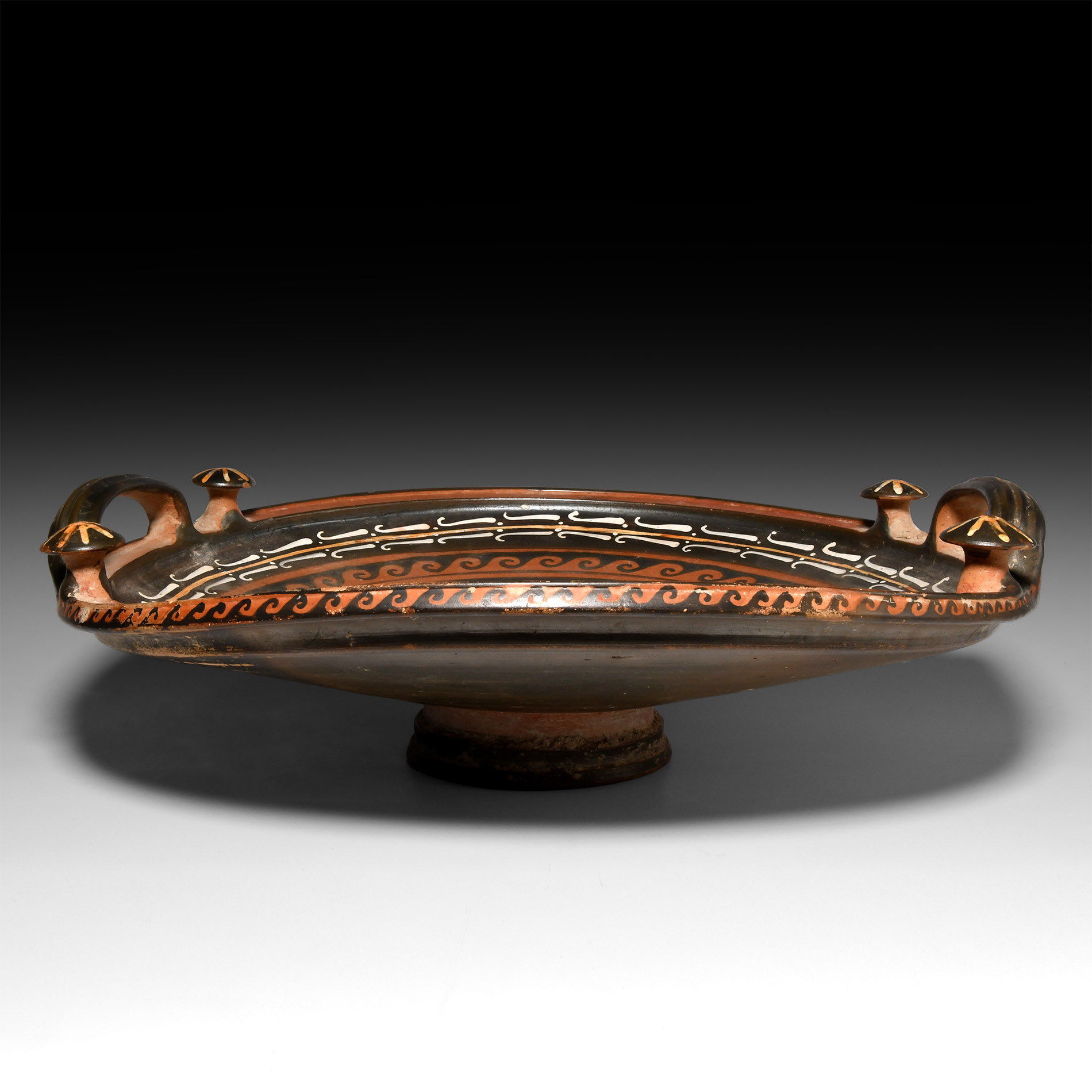
Large Greek Apulian Platter with Eros
4TH CENTURY B.C.
16 1/8 in. (2.76 kg, 41 cm wide).
A broad ceramic patera with raised rim and stepped foot, two strap handles to the rim each flanked by two domed studs; rim with reserved wave pattern band, studs with starburst motif; painted central scene with outer foliate bands and reserved wave pattern framing the tondo displaying Eros in flight with wings spread, holding a red cloth over an inverted shield; some repainting.
ProvenanceFrench collection, 1990s-early 2000s.
Formerly in Patrick Declerck Auction, Douai, France, 2014, lot 72.
From an important Paris gallery, France.
Ex private Parisian collection.
Accompanied by an original thermoluminescence analysis report no.N122j42 from Oxford Authentication.
This lot has been checked against the Interpol Database of stolen works of art and is accompanied by search certificate no.11616-196567.
Cf. Trendall, A.D. & Cambitoglou, A., The Red-Figured Vases of Apulia, vol.1, Oxford, 1978, p.354, no.171.
CONDITIONTimeLine Auctions follows a vetting process to ensure the authenticity and legality of all items, reinforcing our commitment to integrity and responsible trading. Each antiquity, antique, and coin lot undergoes thorough examination by a vetting committee of at least ten external specialists, professional trade association members, scientists, and archaeologists: Our Vetting Process
AUCTIONS:
TimeLine is a leading auction house specialising in antiquities, ancient art, collectables, natural history, coins, medals, and books. Our auctions offer museums, collectors, historians, and enthusiasts the opportunity to acquire unique and historically significant pieces.
LOT 0072
Large Greek Apulian Platter with Eros
Estimate £5,000 - 7,000€5,800 - 8,120 (for guidance only)$6,750 - 9,450 (for guidance only)
-
Greek Heavy Bronze Bracelet with Central Bar
1st millennium B.C.Sold for (Inc. bp): £72
A penannular bronze bracelet with a facetted convex hoop, the arms tapering to an expanded bezel with raised vertical bar. 27.7 grams, 64 mm
Acquired 1990s. English private collection. Property of an Essex gentleman. -
Villanovan Two-Handled Jar
7th century B.C.Sold for (Inc. bp): £1,820
A terracotta amphora composed of a squat bulbous body and rounded shoulder, waisted neck, integral loop handles and integral foot, decorated with scrolling S-motifs, clusters of dots and combed chevrons. 145 grams, 10.5 cm wide
Ex collection of P. Linders, Herrliberg, Zurich, Switzerland. with Galleria Serodine SA, Ascona, Switzerland, 12 November 2008. -
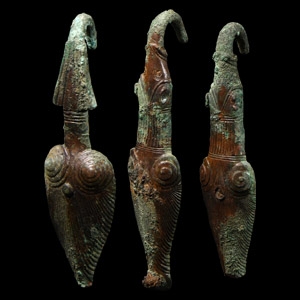
Etruscan Bronze Appliqué Collection
6th century B.C. or laterEstimate: £2,000 - 3,000 (‡+bp*)
Opening Bid: £1,000
A group of three bronze clasp mounts from a girdle, each comprising a slightly domed palmette-shaped body with fixing lug to the underside, spirals flanking a narrow neck and triangular hooked finial, two with zoomorphic detailing and one with convergent lines. 59 grams total, 81-88 mm
One with Bonham's, London, Knightsbridge, UK, 22 September 1998, lot 405. Two acquired early 1990s. Ex private American collection; thence by descent. Private collection since 1998. Accompanied by a copy of the relevant Bonhams catalogue pages. This lot has been checked against the Interpol Database of stolen works of art and is accompanied by search certificate no.11610-198948.
