
Loading, please wait...
LOT 0334
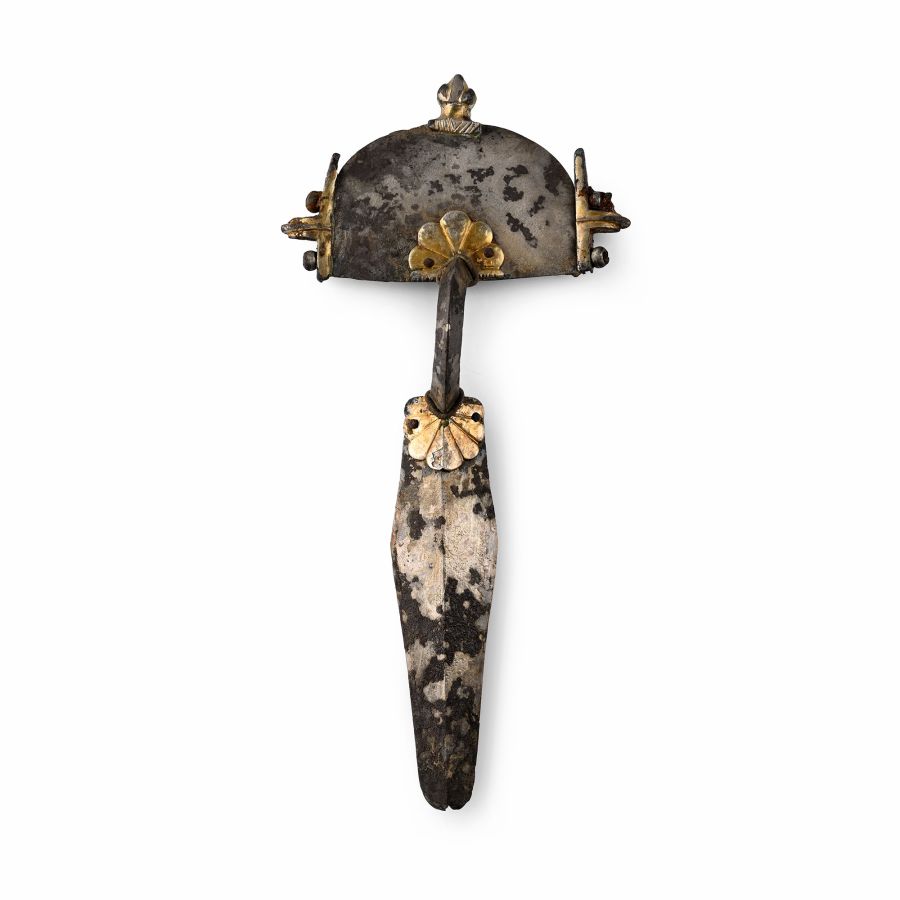
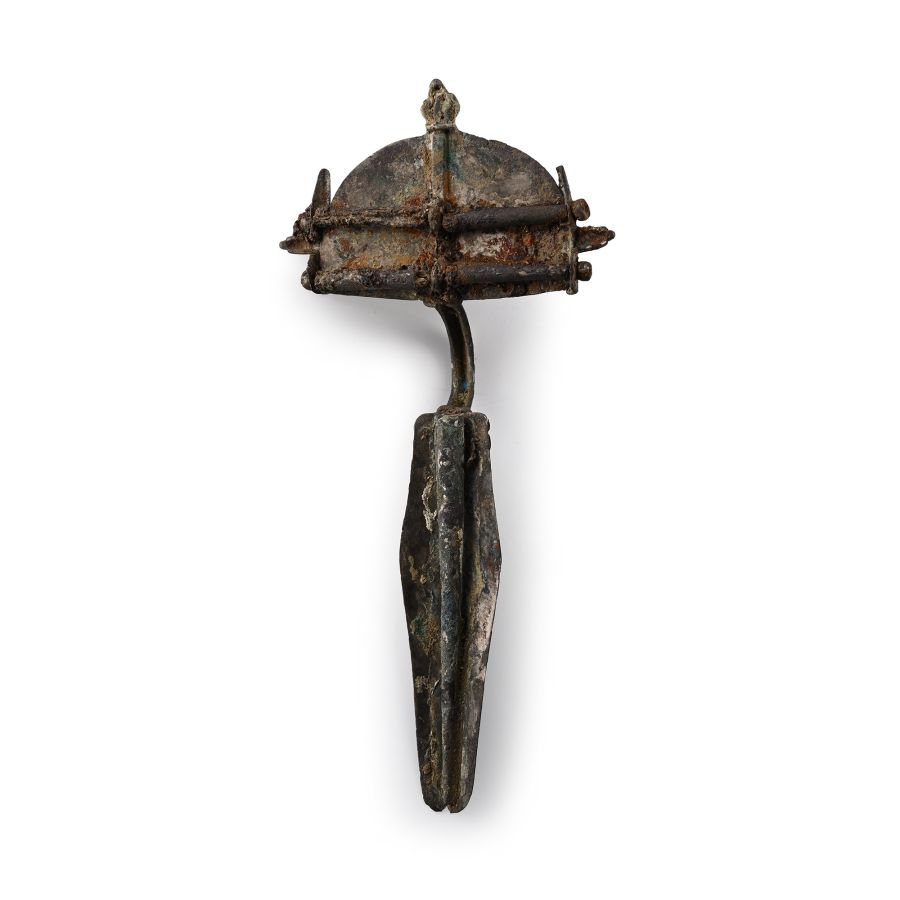
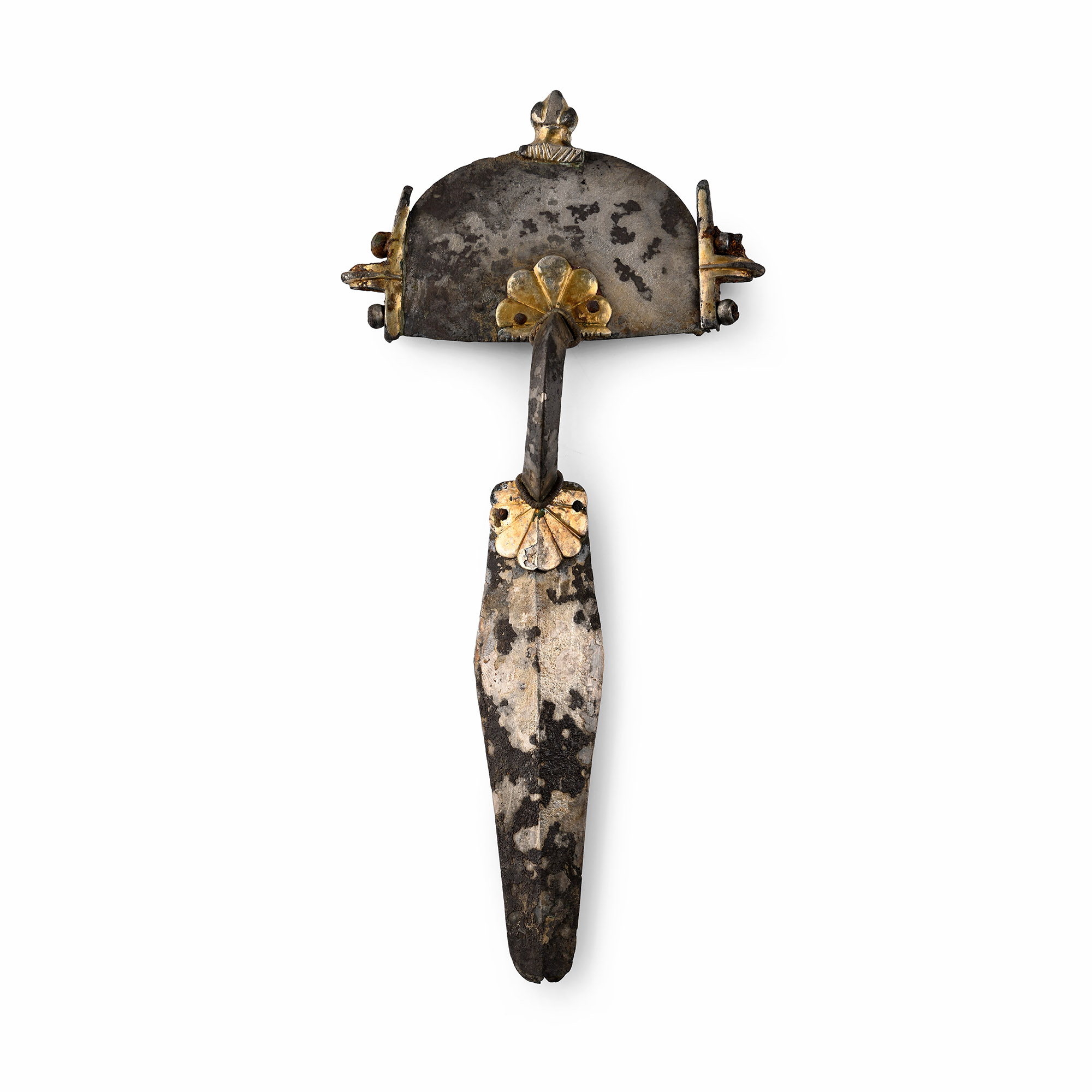
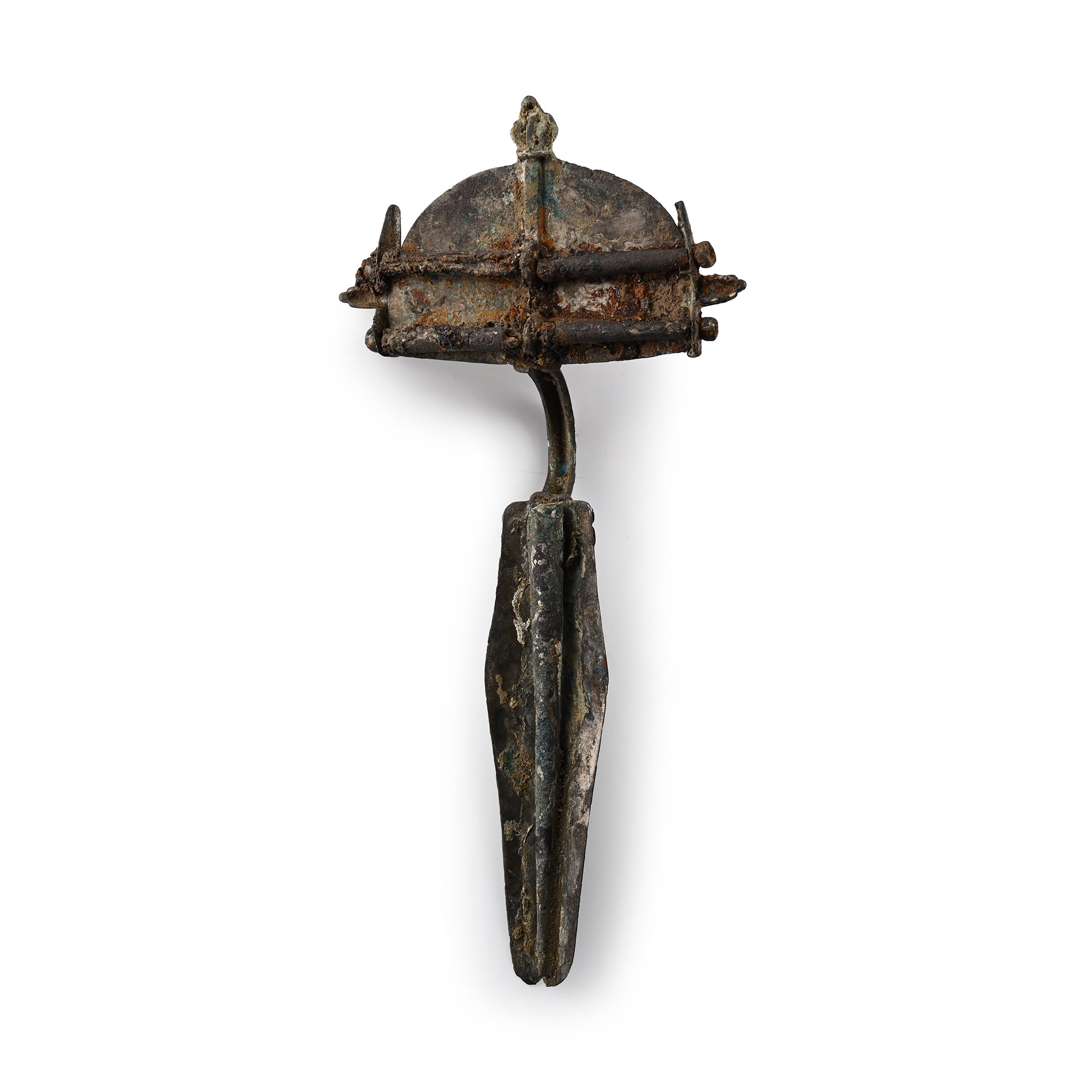
Large Gothic Silver-Gilt Fibula
BOSPHOREAN CULTURE, 5TH CENTURY A.D.
8 1/8 in. (67 grams, 20.7 cm).
Comprising: a semi-circular headplate with a ram-head knop at the apex and applied gilt projections at the sides forming part of the spring mechanism; deep keeled bow with a petalled finials; keeled subrectangular footplate with a rounded finial and a tapering catchplate below.
ProvenanceL. De Clercq collection, Belgium, 1980s.
Ex private European collection.
Accompanied by an academic report by Dr Raffaele D’Amato.
This lot has been checked against the Interpol Database of stolen works of art and is accompanied by search certificate number no. 13013-246783.
Cf. Ambrose, A.K., ‘Problems of Early Medieval Chronology in Eastern Europe. Part I (in Russian),’ in SA, 1971, no. 2, pp. 96-123, fig.3 (5), for the type of fibula; ‘Ajbabin A., ‘I Goti in Crimea (secoli V-VII) [The Goths in Crimea (5th-7th centuries)’ in I Goti (The Goths), Milano Palazzo Reale 28 gennaio- 8 maggio 1994, (Milan Palazzo Reale 28 January-8 May 1994), Milano, 1994, pp.110-135, figs.II.28 (p.25), II.35.
FootnotesThese types of fibulae were mainly found in female burials and were placed on the right side of the chest and on the left shoulder. It was from this period that the custom of wearing wide belts with buckles and a pair of brooches on the shoulders spread along the south-western Black Sea coast, having originated among the Germanic tribes of the western Roman provinces.
CONDITIONTimeLine Auctions follows a vetting process to ensure the authenticity and legality of all items, reinforcing our commitment to integrity and responsible trading. Each antiquity, antique, and coin lot undergoes thorough examination by a vetting committee of at least ten external specialists, professional trade association members, scientists, and archaeologists: Our Vetting Process
AUCTIONS:
TimeLine is a leading auction house specialising in antiquities, ancient art, collectables, natural history, coins, medals, and books. Our auctions offer museums, collectors, historians, and enthusiasts the opportunity to acquire unique and historically significant pieces.
LOT 0334
Large Gothic Silver-Gilt Fibula
Estimate £3,500 - 4,500€4,060 - 5,220 (for guidance only)$4,730 - 6,080 (for guidance only)
-
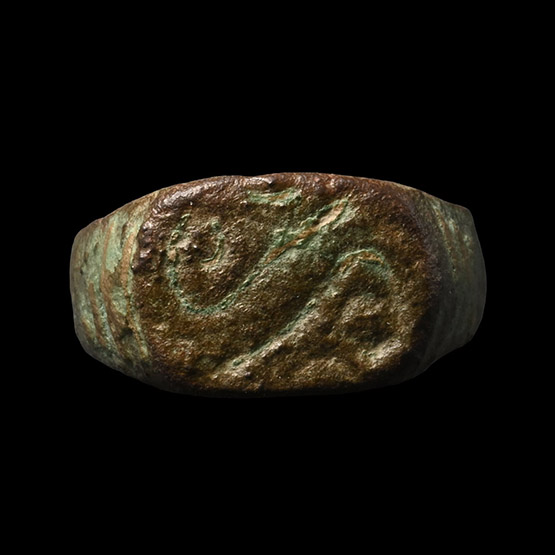
Merovingian Bronze Ring with Scrolls
6th-7th century A.D.Sold for (Inc. bp): £85
Wide hoop with a raised boss at the base of the hoop, wide bezel with incuse scrolls. 6.36 grams, 23.31 mm overall, 17.40 mm internal diameter (approximate size British O, USA 7, Europe 14.98, Japan 14)
Found Oxfordshire, UK. Acquired on the UK and EU art market before 2000. From the private collection of a Surrey, UK, gentleman.
The ring belongs to the Type 1d of Hadjadj classification, with wide shoulders and a ribbon-like bend to form a bezel engraved with a simple monogram with a pattern borrowed from the Celtic and Germanic iconography. The lateral decoration with vertical lines was arranged in symmetrical parts. -
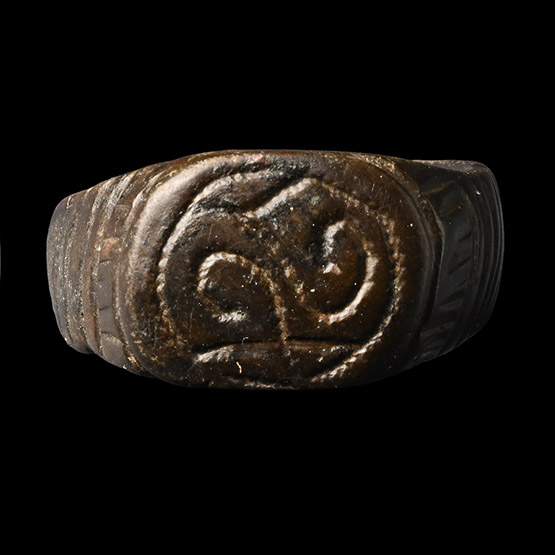
Merovingian Ring with Scrolls
Circa 640-680 A.D.Sold for (Inc. bp): £130
Comprising a wide hoop with linear decoration on the shoulders, an oval bezel with incuse scrolls. 10.53 grams, 26.37 mm overall, 19.40 mm internal diameter (approximate size British S 1/2, USA 9 1/4, Europe 20.63, Japan 19)
Acquired on the UK and EU art market before 2000. From the private collection of a Surrey, UK, gentleman.
The image on the bezel is reminiscent of the spiral motifs connected to Celto-Germanic mythology. They were associated with life force, energy, the seed of life, and cycles of existence.’ -
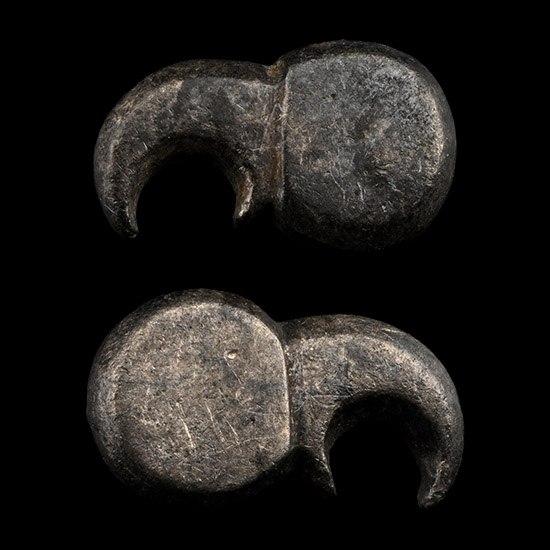
Ostrogothic Silver Raven-Headed Stud Pair
Circa 6th century A.D.Sold for (Inc. bp): £117
Matched pair, each a hollow-formed disc with hooked beak, two mounting studs to reverse. 5.11 grams total, 20-21 mm
London, UK, collection, 1990s.
