
Loading, please wait...


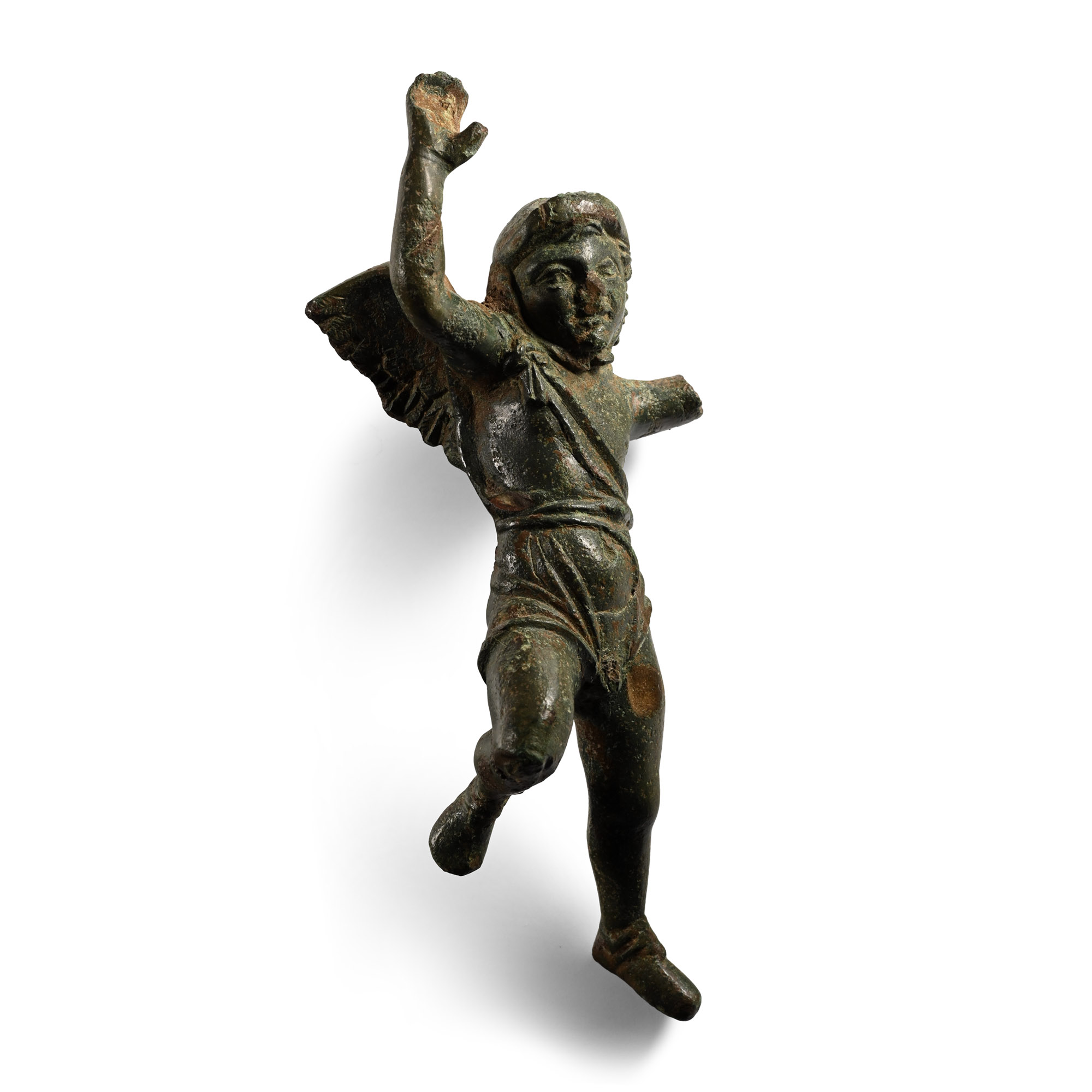
LOT 0115
Large Gallo-Roman Bronze Statuette of Cupid, God of Love
1ST-3RD CENTURY A.D.
6 1/4 in. (403 grams, 16 cm high).
Modelled in the round leaping and winged, his right hand reaching above his head seemingly gesturing to retrieve arrows from a quiver once carried on his back, dressed in an exomis tunic leaving him naked below the torso, wearing a helmet or cap and ankle boots.
ProvenanceAcquired in Europe before 1994.
Private collection, Europe.
Accompanied by an academic report by Dr Raffaele D’Amato.
This lot has been checked against the Interpol Database of stolen works of art and is accompanied by search certificate no.11808-206795.
This lot has been cleared against the Art Loss Register database, and is accompanied by an illustrated lot declaration signed by the Head of the Antiquities Department, Dr Raffaele D’Amato.
Cf. Daremberg - Saglio, Dictionnaire des Antiquités Grecques et Romaines, Paris, 1873-1917; Rolland, H., Bronzes Antiques De Haute Provence, Paris, 1965, items 112-118, and especially 116bis, for similar Gallo-Roman examples; Boucher, S. and Tassinari, S., Bronzes Antiques I, Inscriptions, Statuaire, Vaisselle, Paris, 1976, p.31, no.23, for similar; Jashemski, W.J., The gardens of Pompeii: Herculaneum and the villas destroyed by Vesuvius, II volumes, New York, 1979.
FootnotesOften the statues of puttos or amorini (small loves) depicting personifications of Eros were covered with gold leaf. This was a frequent practice and the figures, when represented with wings, were known as chrysopteroi, meaning 'with golden wings'.
CONDITIONTimeLine Auctions follows a vetting process to ensure the authenticity and legality of all items, reinforcing our commitment to integrity and responsible trading. Each antiquity, antique, and coin lot undergoes thorough examination by a vetting committee of at least ten external specialists, professional trade association members, scientists, and archaeologists: Our Vetting Process
AUCTIONS:
TimeLine is a leading auction house specialising in antiquities, ancient art, collectables, natural history, coins, medals, and books. Our auctions offer museums, collectors, historians, and enthusiasts the opportunity to acquire unique and historically significant pieces.
LOT 0115
Large Gallo-Roman Bronze Statuette of Cupid, God of Love
Estimate £3,000 - 4,000€3,480 - 4,640 (for guidance only)$4,050 - 5,400 (for guidance only)
-
.jpg)
Roman Silver Votive Figure of the God Mercury
1st-3rd century A.D.Sold for (Inc. bp): £182
Modelled in the round, wearing a tightly-wrapped toga, his left arm bent and hand gripping the marsupium bag of coins; with full beard and hair parted neatly at the rear. 4.7 grams, 29 mm
Acquired in the 1980s. From the collection of a London antiquarian. This lot is accompanied by an illustrated lot declaration signed by the Head of the Antiquities Department, Dr Raffaele D’Amato. -
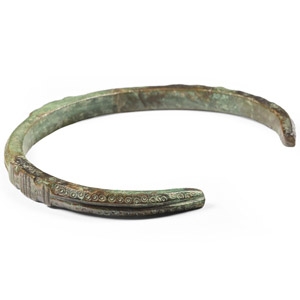
Roman Bronze Decorated Bracelet
1st-4th century A.D.Sold for (Inc. bp): £182
The upper face divided into decorative segments with punched ring-and-dot motifs divided by horizontal and vertical lines. 34.3 grams, 73 mm
Ex German art market, 2000s. Acquired from an EU collector living in London. From the collection of Surrey, UK, gentleman. This lot is accompanied by an illustrated lot declaration signed by the Head of the Antiquities Department, Dr Raffaele D’Amato. -
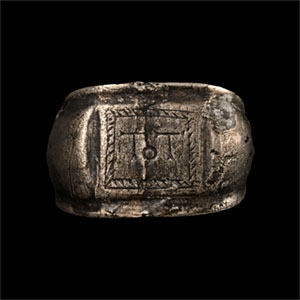
Roman Silver 'TOT' Toutatis Ring
1st-2nd century A.D.Sold for (Inc. bp): £624
With a wide, grooved hoop expanding at the shoulders, rectangular plaque with ropework border enclosing amuletic inscription 'ToT, an abbreviation for the name of the Celtic god Toutatis. 5.02 grams, 23.37 mm overall, 19.65 mm internal diameter (approximate size British P, USA 7 1/2, Europe 16.23, Japan 15)
Ex private collection, 1970s. Property of a Nottinghamshire gentleman. This lot is accompanied by an illustrated lot declaration signed by the Head of the Antiquities Department, Dr Raffaele D’Amato.
A number of rings have been found in eastern Roman Britain inscribed with the word TOT. It is thought that they refer to the Celtic deity Toutatis, later associated by the Romans with Mars and Mercury. The rings have been found mainly in the area corresponding to the native British tribe of the Corieltauvi who may have worshipped Toutatis as their primary tribal deity. The likelihood of the presence of his cult is strengthened by several inscriptions found in Britain mentioning this deity. However, his origin may be sought in the religion of the Continental Celtae, as the Roman writer Lucan in the 1st century AD mentioned the worship of 'Teutatis' together with two other deities, Esus and Taranis.
