
Loading, please wait...
_900x900.jpg "Large Etruscan Statue of a Priest with Patera")
_200x200.jpg "Large Etruscan Statue of a Priest with Patera")
_900x900.jpg "Large Etruscan Statue of a Priest with Patera")
_200x200.jpg "Large Etruscan Statue of a Priest with Patera")
_900x900.jpg "Large Etruscan Statue of a Priest with Patera")
_200x200.jpg "Large Etruscan Statue of a Priest with Patera")
.jpg "Large Etruscan Statue of a Priest with Patera")
.jpg "Large Etruscan Statue of a Priest with Patera")
.jpg "Large Etruscan Statue of a Priest with Patera")
LOT 0053
Large Etruscan Statue of a Priest with Patera
2ND CENTURY B.C.
11 1/4 in. (1.23 kg, 28.4 cm high).
Modelled in the round standing figure with palla draped over the left shoulder and from the hips, extending to calf-length; the head with aquiline nose and dimpled chin modelled with a wreath of large leaves around the brow forming a corona; exaggerated eyes left blank to accept silver inserts; left arm bent, hand holding an incense-holder with cruciform design; right arm extended at shoulder-height with phiale mesomphalos offering dish; socket beneath left foot and screw-threaded post beneath right, repairs to both lower legs.
ProvenanceSotheby's, New York, 17 December 1996, no.79.
Private collection, New York, USA.
Accompanied by copies of the relevant Sotheby's catalogue pages.
This lot has been checked against the Interpol Database of stolen works of art and is accompanied by search certificate number no.13355-255463.
Cf. Walters Art Museum, Baltimore, under accession no.54.1088, for similar; see Haynes, S., Etruscan Bronzes, London, 1985, for discussion.
FootnotesThe figure is probably a devotee or priest of Diana preparing to make ritual observances with the offering plate and incense burner.
A group of similar figures was recovered from the shallows of Lake Nemi south of Rome, close to the site of the Temple of Diana.
TimeLine Auctions follows a vetting process to ensure the authenticity and legality of all items, reinforcing our commitment to integrity and responsible trading. Each antiquity, antique, and coin lot undergoes thorough examination by a vetting committee of at least ten external specialists, professional trade association members, scientists, and archaeologists: Our Vetting Process
AUCTIONS:
TimeLine is a leading auction house specialising in antiquities, ancient art, collectables, natural history, coins, medals, and books. Our auctions offer museums, collectors, historians, and enthusiasts the opportunity to acquire unique and historically significant pieces.
-
.jpg)
Etruscan Bronze Handle Pair with Heads of Medusa
6th-5th century B.C.Estimate: £10,000 - 14,000 (+bp*)
Opening Bid: £5,000
Each formed as a D-shaped fluted bar with the finials formed as grotesque Medusa heads (gorgoneia) in Archaic Greek style with protruding tongue and a pair of bearded snakes framing her forehead; mounted on custom-made display stands. 683 grams total including stand, handle: 10.9-11 cm wide
Ex private collection of Athos Moretti, Bellinzona, Switzerland, in the 1960s. with Christie's, London, 14 June 1978, lot 344. with Sotheby's, New York, 29 May 1987, lot 154. Accompanied by an academic report by Dr Raffaele D’Amato. This lot has been checked against the Interpol Database of stolen works of art and is accompanied by search certificate number no.11773-204596. -
.jpg)
Etruscan Carnelian Scarab with Bust of a Warrior in Later Victorian Gold Brooch
5th-4th century B.C. and laterSold for (Inc. bp): £2,860
The scarab with anatomical detailing on the carapace, underside with a profile bust of a helmetted warrior; set in a later brooch frame with swivel mount for the scarab. 10.35 grams, 55 mm
Acquired on the European art market. This lot has been checked against the Interpol Database of stolen works of art and is accompanied by search certificate number no.13358- 257891.
Egyptian-style scarabs and scaraboids were characteristic of Etruscan art from the 8th century B.C. Originally made in Phoenicia, Cyprus or Rhodes, these objects were made of faience, blue paste, glass paste, bone, or semi-precious stones of varying hardness, from steatite to quartz, onyx and jasper. Mounted in settings on revolving pendants of precious metal, later imitated by Etruscan goldsmiths, these Egyptianising items performed prophylactic-religious functions. -
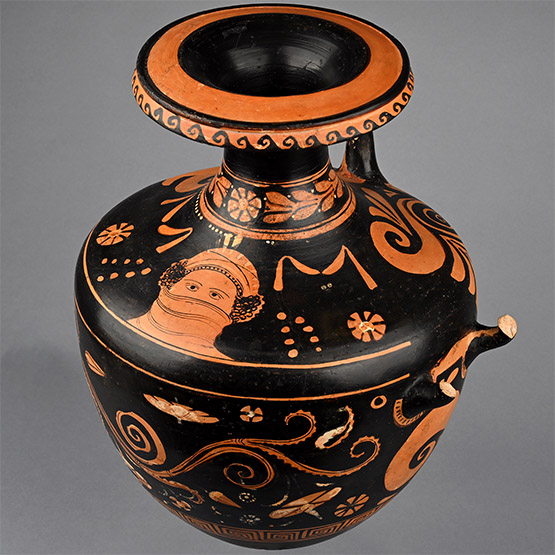
Greek Fragmentary Terracotta Red-Figure Hydria
Paestan or Apulian, 4th century B.C.Estimate: £4,000 - 6,000 (‡+bp*)
Opening Bid: £2,200
Comprising the upper two thirds of the vessel; on the shoulder a facing woman's head with diadem and half-veiled face; rosettes to left and right, with suspended ribbons and dots; vine motif around the body with floral ornaments; to the reverse, palmettes and vines; band of laurel with rosettes around the neck and wavy band at the mouth; reassembled from various fragments with three large areas of restoration, only the beginnings of the handles preserved; mounted on a custom-made stand. 1.95 kg, 31 cm (2.6 kg total, 47.5 cm high including stand)
Ex Herbert A. Cahn, Basel, 1990s. This lot has been checked against the Interpol Database of stolen works of art and is accompanied by search certificate number no.12475-228738.
The face-veiling gesture is a known marriage rite; the diadem may suggest that she is intended to represent Persephone. Alternatively, the veiled woman might be a dancer as many terracotta figurines of dancing women are shown with face-coverings. However, the floral ornaments could indicate a funeral or sepulchral context.
