
Loading, please wait...
_900x900.jpg "Large Egyptian Wooden Shabti with Hieroglyphs")
_200x200.jpg "Large Egyptian Wooden Shabti with Hieroglyphs")
.jpg "Large Egyptian Wooden Shabti with Hieroglyphs")
LOT 0035
Large Egyptian Wooden Shabti with Hieroglyphs
NEW KINGDOM, CIRCA 1300 B.C.
8 5/8 in. (107 grams, 22 cm high).
Finely modelled with gesso surface and painted detailing; wearing lappet wig and broad collar, crossed hands holding agricultural implements; frontal column of hieroglyphic text dedicating the shabti to 'The illuminated, the Osiris, Renpt-nefer, true of voice'.
ProvenancePart of an old collection dating back to the 19th century.
Ex property of a gentleman, acquired before the 1980s.
Private collection of Mr T.H., Norfolk, UK.
Cf. similar in the collection of the British Museum under accession no.EA34168.
CONDITIONTimeLine Auctions follows a vetting process to ensure the authenticity and legality of all items, reinforcing our commitment to integrity and responsible trading. Each antiquity, antique, and coin lot undergoes thorough examination by a vetting committee of at least ten external specialists, professional trade association members, scientists, and archaeologists: Our Vetting Process
AUCTIONS:
TimeLine is a leading auction house specialising in antiquities, ancient art, collectables, natural history, coins, medals, and books. Our auctions offer museums, collectors, historians, and enthusiasts the opportunity to acquire unique and historically significant pieces.
-
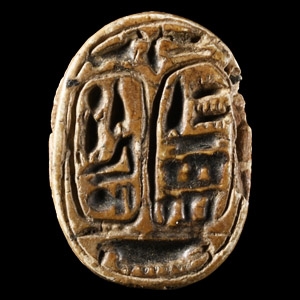
Egyptian Steatite Scarab with Hieroglyphs
Late Period, 664-332 B.C.Sold for (Inc. bp): £572
With detailed legs and mouth, two cartouches to the underside with hieroglyphic texts. 7.64 grams, 25 mm
Ex North London, UK, gentleman, 1990s. -
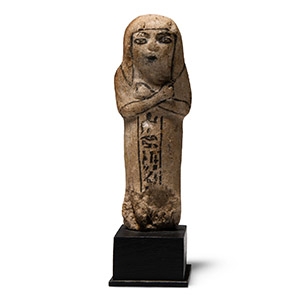
Egyptian Faience Shabti with Hieroglyphic Inscription
Late New Kingdom-Third Intermediate Period, 1186-715 B.C.Estimate: £1,000 - 1,400 (+bp*)
Opening Bid: £500
Pale grey glazed composition shabti with black outlining to the wig, eyes and facial features, arms, seed sack and a vertical panel of hieroglyphic text to the lower body dedicating the shabti to 'The illuminated, the Osiris, The God's Father (a priestly title) Pia[..]'; mounted on a custom-made stand. 249 grams total, 14 cm high including stand
Ex Marc Delorme, Antiquité Archéologie, France. From the private collection of Mr & Mrs Gent of Belgium, acquired June 2009. Accompanied by a handwritten illustrated invoice and two handwritten dealer's tags. -
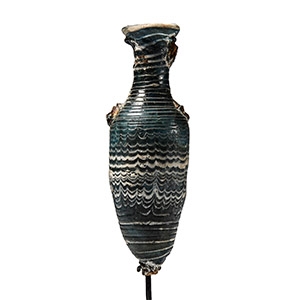
Phoenician Marvered Glass Amphoriskos
5th-4th century B.C.Sold for (Inc. bp): £169
Elegantly proportioned vessel with marvered trails to the body, neck and mouth; handles absent; mounted on a custom-made stand. 404 grams total, 18.5 cm including stand
Acquired from Arte Primitivo, New York City, U.S.A., circa 2010. Private collection of Professor Kenneth Graham, London, UK.
