
Loading, please wait...
_900x900.jpg "Large Egyptian Steatite Scarab of Thutmose III")
_200x200.jpg "Large Egyptian Steatite Scarab of Thutmose III")
.jpg "Large Egyptian Steatite Scarab of Thutmose III")
LOT 0407
Large Egyptian Steatite Scarab of Thutmose III
NEW KINGDOM, 1504-1450 B.C. OR LATER
1 1/8 in. (5.29 grams, 28 mm).
Pierced longitudinally with a detailed carapace, the underside is decorated with the image of a coiled cobra wearing the dual crown of Egypt facing the hieroglyphs giving the throne name of King Thutmose III (mn-ḫpr-RꜤ).
ProvenanceFrom the collection of Walter Thomas Gaze Cooper (1895-1980); thence by descent.
This lot is accompanied by an illustrated lot declaration signed by the Head of the Antiquities Department, Dr Raffaele D’Amato.
Cf. Petrie, W.M.F., Scarabs and Cylinders with Names, London, 1917, pl. XXVIII, no. 70, for a scarab of Thutmose III with a similar design.
FootnotesThe popularity of this great Egyptian pharaoh was such that his name appeared on scarabs during his reign and into the Late Period.
CONDITIONTimeLine Auctions follows a vetting process to ensure the authenticity and legality of all items, reinforcing our commitment to integrity and responsible trading. Each antiquity, antique, and coin lot undergoes thorough examination by a vetting committee of at least ten external specialists, professional trade association members, scientists, and archaeologists: Our Vetting Process
AUCTIONS:
TimeLine is a leading auction house specialising in antiquities, ancient art, collectables, natural history, coins, medals, and books. Our auctions offer museums, collectors, historians, and enthusiasts the opportunity to acquire unique and historically significant pieces.
-
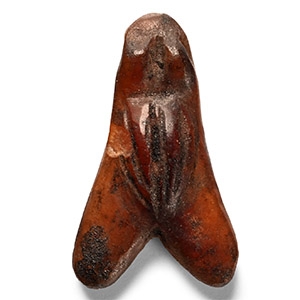
Egyptian Carnelian Fly Amulet
Late Period, 664-332 B.C.Sold for (Inc. bp): £182
Carved with simple body and eye detailing and polished; drilled through the eyes for suspension. 0.41 grams, 13 mm
From an early 20th century collection. This lot is accompanied by an illustrated lot declaration signed by the Head of the Antiquities Department, Dr Raffaele D’Amato.
Small fly amulets first appeared in burials during the Naqada II Period, c. 3200 B.C. These amulets grew in popularity and the materials used to make them expanded during the New Kingdom. They are crafted from a variety of materials such as gold, silver, lapis lazuli, carnelian, amethyst, faience, and bone. These amulets were thought to protect against insect bites and to ward off troublesome flying creatures through apotropaic magic. Some believe they may have even been intended to symbolise the fly’s fecundity. Additionally, pharaohs would bestow gold fly-shaped pendants as military awards to honour the bravery and fly-like persistence of soldiers in battle. -
.jpg)
Egyptian Wooden Cow Giving Birth Diorama with Two Figures
Middle Kingdom, 11th-12th Dynasty, 2023-1862 B.C.Sold for (Inc. bp): £3,380
Comprising three figures to represent a calving scene: a standing cow or other quadruped giving birth to its young, its head, neck and forelegs emerging from the mother's rear, both with a black and white speckled coat; a standing male figure with articulated arms and pierced hands, wearing a kilt and cropped wig and with stylised facial detailing; a kneeling figure also with articulated arms, open-palm hands, wearing a kilt and cropped wig, stylised facial features; extensive remains of polychrome pigment. 113 grams total, 9.5-16 cm
From an early 20th century Home Counties collection. This lot has been checked against the Interpol Database of stolen works of art and is accompanied by search certificate no.11597-199209. This lot has been cleared against the Art Loss Register database, and is accompanied by an illustrated lot declaration signed by the Head of the Antiquities Department, Dr Raffaele D’Amato.
Such models would have been deposited in tombs; the purpose of such a scene was probably to evoke the season of spring, when calves were born, and the floodplain where farmers lived and raised their livestock. -
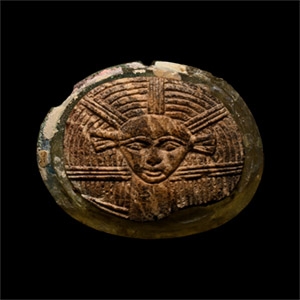
Egyptian Glass Ring with Hathor Cameo
Ptolemaic Period, circa 3rd century B.C.Sold for (Inc. bp): £3,900
Pale green transparent glass hoop with ellipsoid bezel, bevelled edge inlaid with a darker glass low-relief facing mask of the goddess Hathor with cow's ears and banded hairstyle. 17.65 grams, 39.43 mm overall, 20.51 mm internal diameter (approximate size British J, USA 4 3/4, Europe 8.69, Japan 8)
Acquired between 1965-2020. Private collection, London. This lot has been checked against the Interpol Database of stolen works of art and is accompanied by search certificate no.12484-229828. This lot has been cleared against the Art Loss Register database, and is accompanied by an illustrated lot declaration signed by the Head of the Antiquities Department, Dr Raffaele D’Amato.
Images of Hathor with a human face and cow ears combine her human and bovine aspects. She is shown with a serene human face, symbolising her nurturing nature, while the cow ears emphasise her roles in fertility and motherhood. Hathor was one of the most important deities in ancient Egypt, revered as the goddess of love, beauty, music, dance, fertility, and motherhood. She was also associated with joy, childbirth, and women’s health. Hathor was believed to protect and nurture, often depicted as a maternal figure. As such, she was closely linked with Isis. She was closely linked to the sun god Ra, acting as a cosmic force facilitating life. In funerary contexts, Hathor was also seen as a guide for the dead, helping them transition to the afterlife. Her multifaceted role made her one of Egypt's most widely worshipped goddesses.
