
Loading, please wait...


LOT 0600
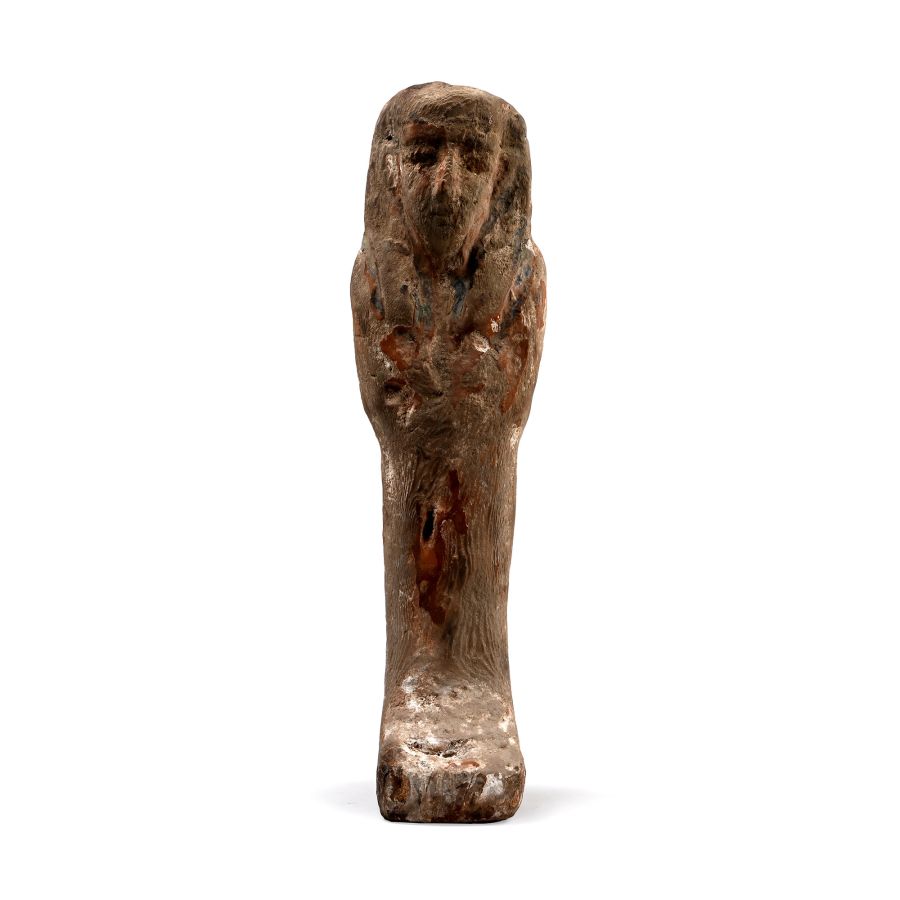
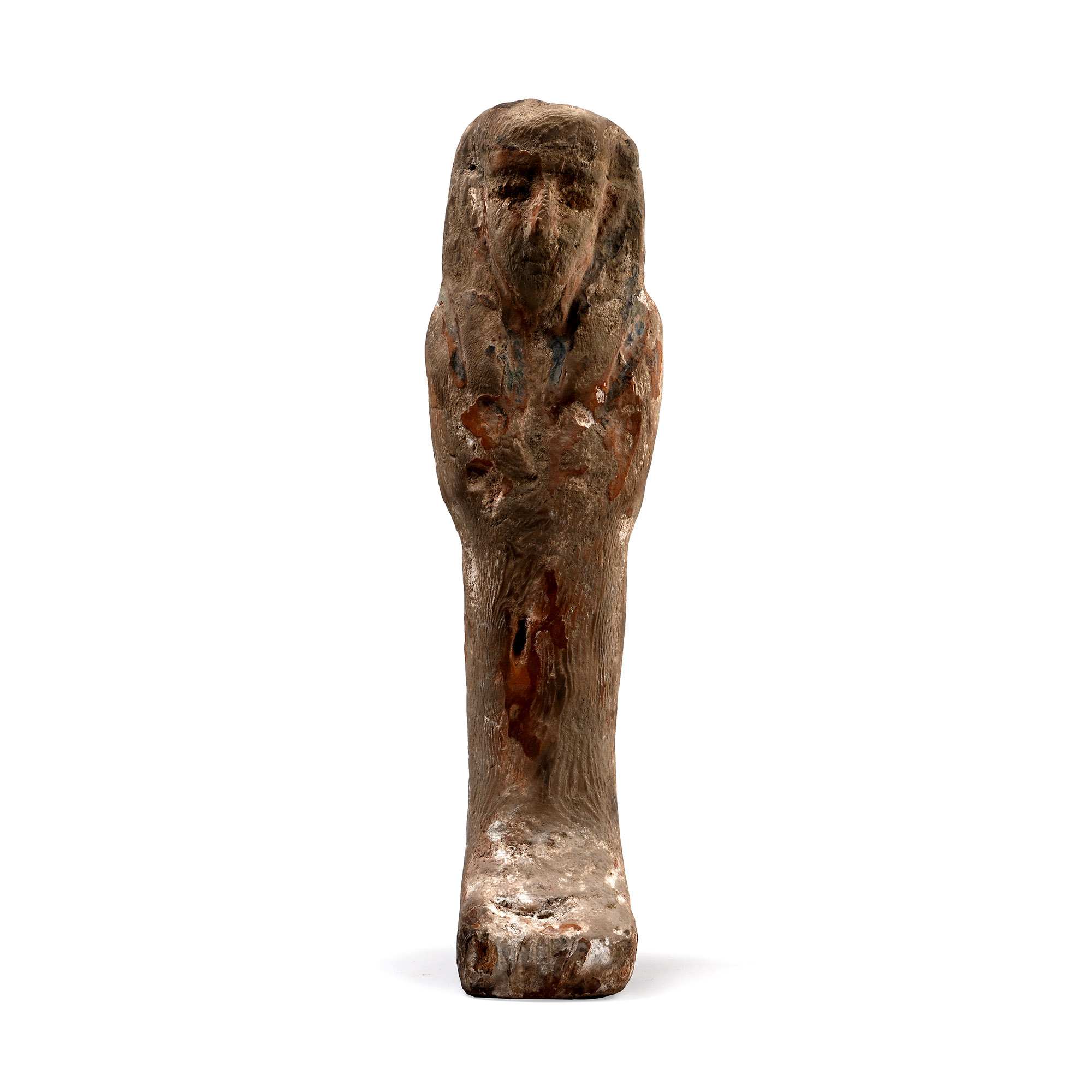
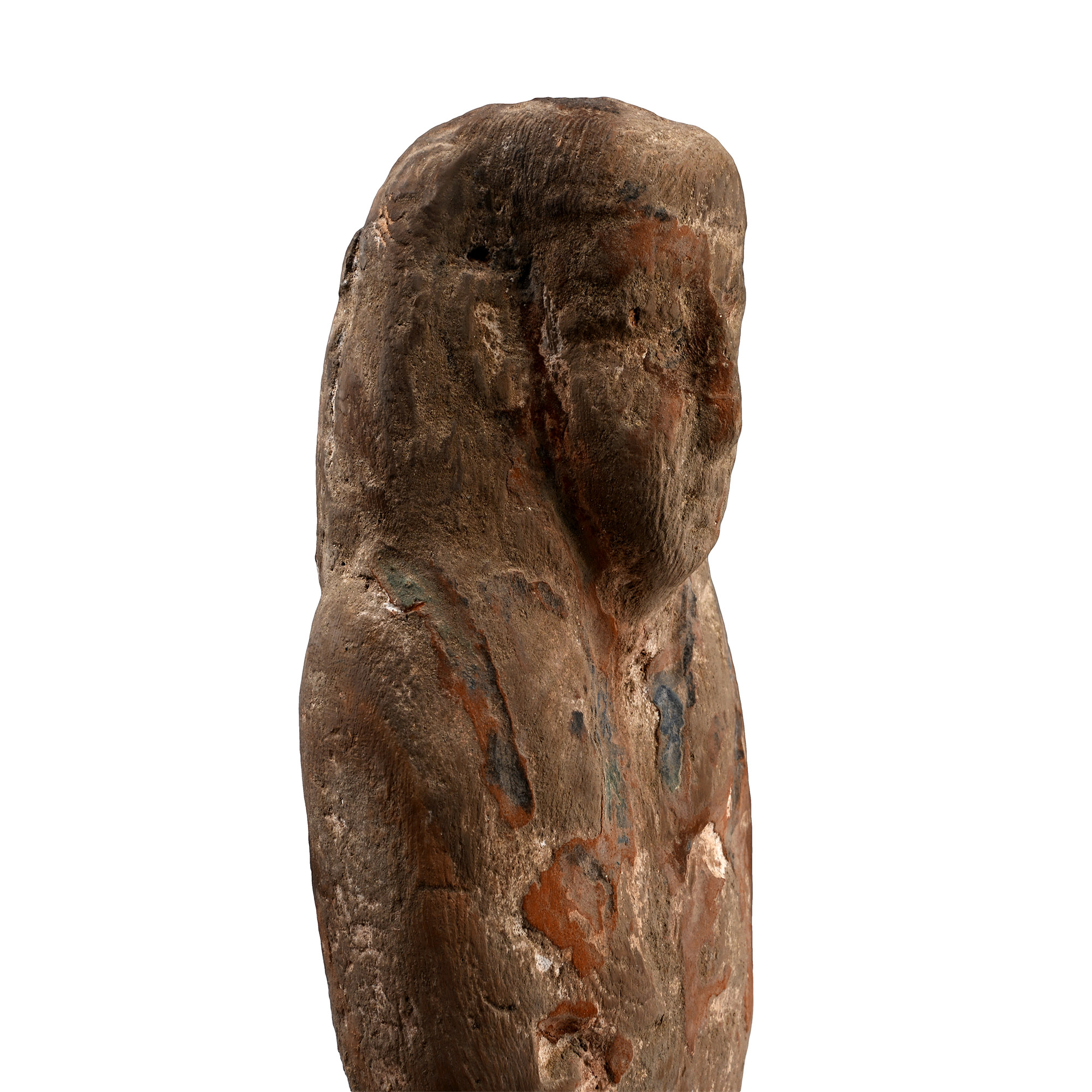
Large Egyptian Painted Wooden Ptah-Sokar-Osiris Figure
NEW KINGDOM, CIRCA 12TH CENTURY B.C. OR LATER
13 5/8 in. (460 grams, 34.5 cm).
Mummiform figure wearing a long lappet wig, with traces of blue and white pigment; a hole in the top of the head, likely to accept a separately fashioned headdress.
Provenancewith a privately curated collection, 1980s-early 2000s.
From the private collection and estate of Christine Simons (1943-2025), West Midlands, UK.
Cf. Seipel, W., Ägypten. Götter, Gräber und die Kunst – 4000 Jahre Jenseitsglaube, Linz, 1989, pp. 162-165, nos. 128-131, for examples of complete Ptah-Sokar-Osiris statuettes.
FootnotesInitially representing Osiris, this statuette type gradually merged with the Memphite deity Ptah-Sokar. It became a common grave good in the Late Period and the Graeco-Roman era. It was typically depicted standing on a long, rectangular base, wearing a tall, distinctive crown of two large, opposing feathers, with a sun disc on the lower front and ram's horns beneath. The recess in the crown of the present example was likely intended to accommodate this crown.
CONDITIONTimeLine Auctions follows a vetting process to ensure the authenticity and legality of all items, reinforcing our commitment to integrity and responsible trading. Each antiquity, antique, and coin lot undergoes thorough examination by a vetting committee of at least ten external specialists, professional trade association members, scientists, and archaeologists: Our Vetting Process
AUCTIONS:
TimeLine is a leading auction house specialising in antiquities, ancient art, collectables, natural history, coins, medals, and books. Our auctions offer museums, collectors, historians, and enthusiasts the opportunity to acquire unique and historically significant pieces.
LOT 0600
Large Egyptian Painted Wooden Ptah-Sokar-Osiris Figure
Estimate £800 - 1,000€930 - 1,160 (for guidance only)$1,080 - 1,350 (for guidance only)
Opening Bid
£400 (EUR 464; USD 540) +BP*
-
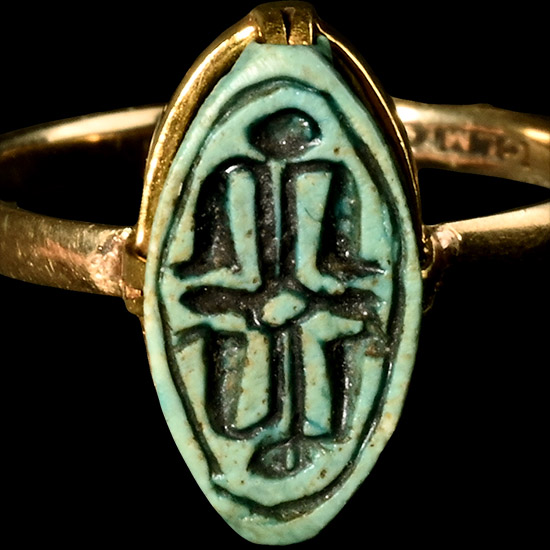
Egyptian Blue Faience Cowroid with Uraei in Gold Ring
Third Intermediate Period, 1069-860 B.C.Estimate: £500 - 700 (+bp*)
Opening Bid: £250
Slender, lentoid form with a finely striated edge design; the main motif comprises four outward-facing uraei, one in each quadrant, with a sun disc at each end, mounted in a modern gold ring. 2.33 grams, 22.62 mm overall, 16.76 mm internal diameter (approximate size British M, USA 6, Europe 12.46, Japan 12)
Private collection, London. -
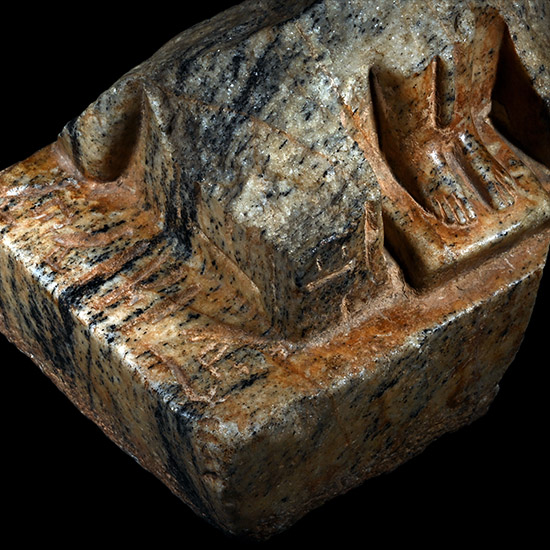
Egyptian Fragment of a Naophorus Statue
New Kingdom, 18th-20th Dynasty, 1540-1069 B.C.Estimate: £1,800 - 2,400 (+bp*)
Opening Bid: £900
Fragment of a kneeling figure offering a naos (shrine) before him, on a substantial plinth; preserving both knees of the main figure, a lower portion of the naos containing the lower legs of a seated deity holding a staff or sceptre, with traces of hieroglyphic inscription on the naos front and sides, and on the preserved top edge of the plinth. 5.75 kg total including stand, 16.5 cm wide
UK collection, acquired 1970s-1990s. Accompanied by an Art Loss Register certificate, no.S00016743 This lot has been checked against the Interpol Database of stolen works of art and is accompanied by search certificate no.13520-263439. -
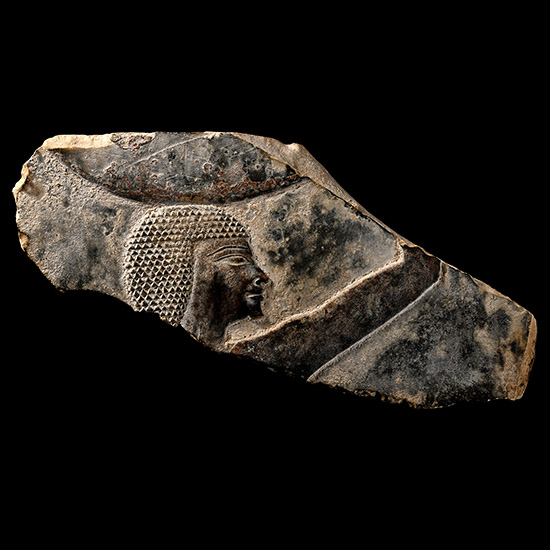
Egyptian Limestone Relief Fragment of a Man
26th Dynasty, 664-525 B.C.Estimate: £1,000 - 1,400 (+bp*)
Bids: 10 | Current Bid: £550
An irregular, elongated limestone fragment intricately carved in low, raised relief, depicting the head and neck of a male figure facing right, wearing a tightly curled wig and a short beard, his arm extended upwards, likely to support the large basket resting on his head. 180 grams total including stand, fragment: 14.5 cm wide
From the private collection of Peter Clayton, FCILIP, Dip, Arch, FSA, FRNS, Hemel Hempstead, Hertfordshire, UK; formed since the late 1950s.
The downturned eyebrow above an almond-shaped eye with a sharply defined eyelid and a long, thin cosmetic line, the small, fairly rounded nose with a lightly drilled nostril above rather thick lips, and the chin below obscured by the short beard are characteristic of the archaising style of the early 26th Dynasty. Artisans of that period adapted and refined earlier Old Kingdom artistic traditions, most apparent in the tomb scenes of high officials at Thebes, particularly those of Montuemhat (see the discussion: der Manuelian, P., 'Two Fragments of Relief and a New Model for the Tomb of Montuemhet at Thebes', Journal of Egyptian Archaeology 71 (1985), pp. 98–121).
