
Loading, please wait...
LOT 0043
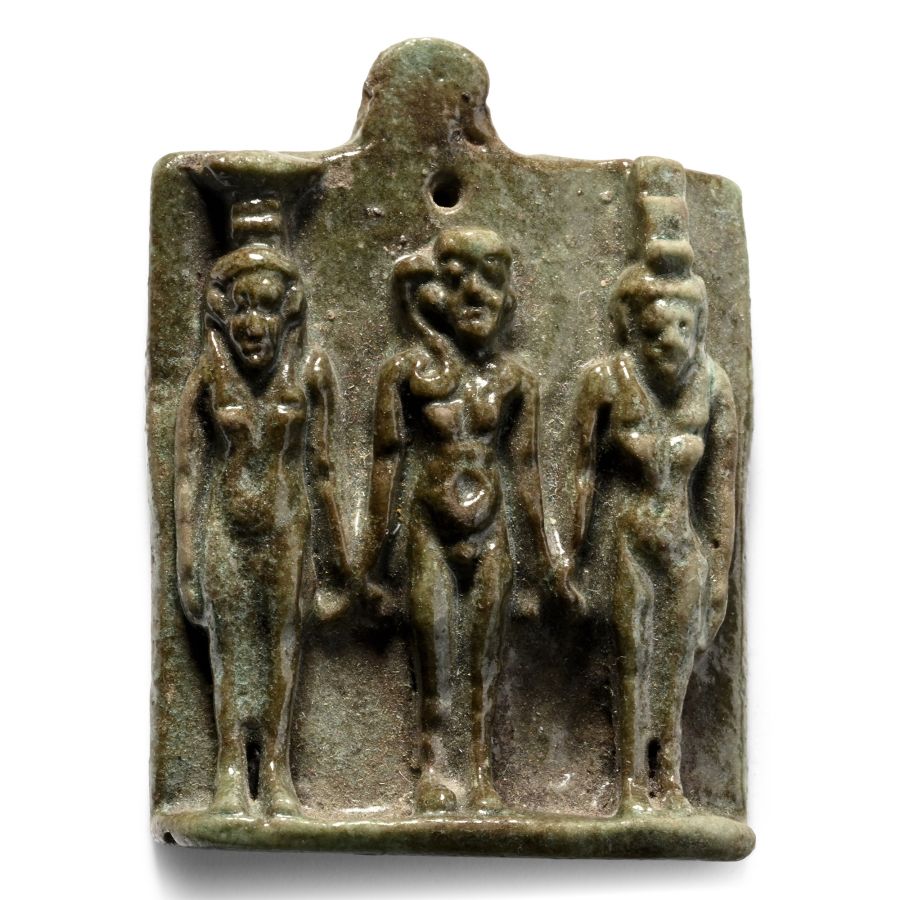
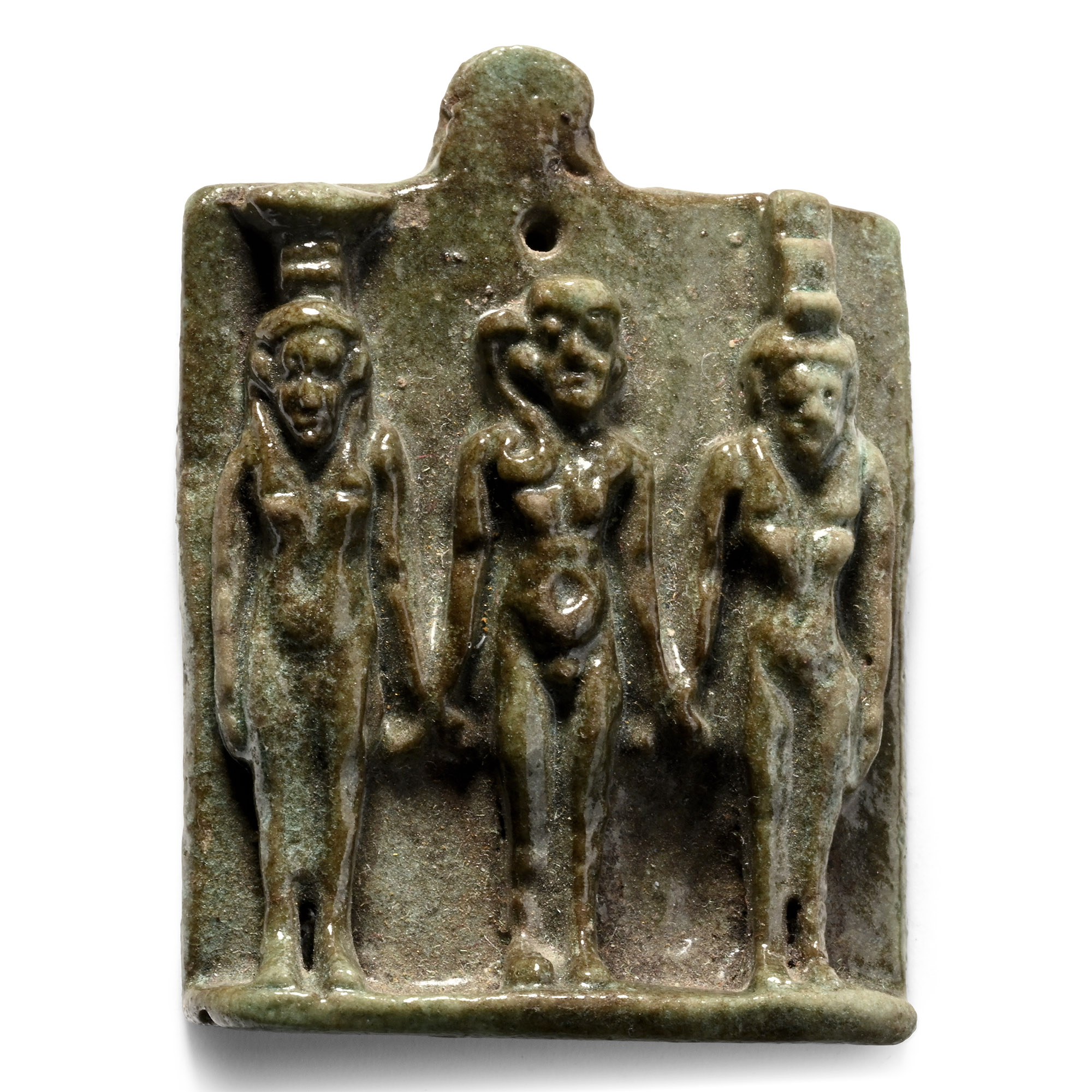
Large Egyptian Green Glazed Faience Triad Amulet
LATE PERIOD-PTOLEMAIC PERIOD, 664-30 B.C.
2 in. (19.7 grams, 52 mm).
Depicting the youthful Horus with a long, curling sidelock, flanked by the goddess Nephthys on the left and Isis on the right, standing on an integral plinth against a flat back slab with a suspension loop above; Isis wearing a stepped throne headdress, and Nephthys and Isis wearing headdresses comprising the hieroglyphs spelling their names, the trio clasping hands demonstrating the women's protection and guardianship.
ProvenanceEx mid-20th-century collection.
Ex London, UK, collection.
From a Cambridgeshire, UK, dealership.
Accompanied by a previous catalogue information page.
Cf. Tinius, I., Altägypten in Braunschweig. Die Sammlungen des Herzog Anton Ulrich-Museums und des Städtischen Museums, Wiesbaden, 2011, p. 143, nos. 257 and 258, for similarly themed triad amulets.
FootnotesNephthys and Isis were sisters, while Horus is the son of Isis and Osiris, making Nephthys his aunt and the secondary maternal figure in this triad.
CONDITIONTimeLine Auctions follows a vetting process to ensure the authenticity and legality of all items, reinforcing our commitment to integrity and responsible trading. Each antiquity, antique, and coin lot undergoes thorough examination by a vetting committee of at least ten external specialists, professional trade association members, scientists, and archaeologists: Our Vetting Process
AUCTIONS:
TimeLine is a leading auction house specialising in antiquities, ancient art, collectables, natural history, coins, medals, and books. Our auctions offer museums, collectors, historians, and enthusiasts the opportunity to acquire unique and historically significant pieces.
LOT 0043
Large Egyptian Green Glazed Faience Triad Amulet
Estimate £1,500 - 2,000€1,740 - 2,320 (for guidance only)$2,030 - 2,700 (for guidance only)
Opening Bid
£750 (EUR 870; USD 1,013) +BP*
-
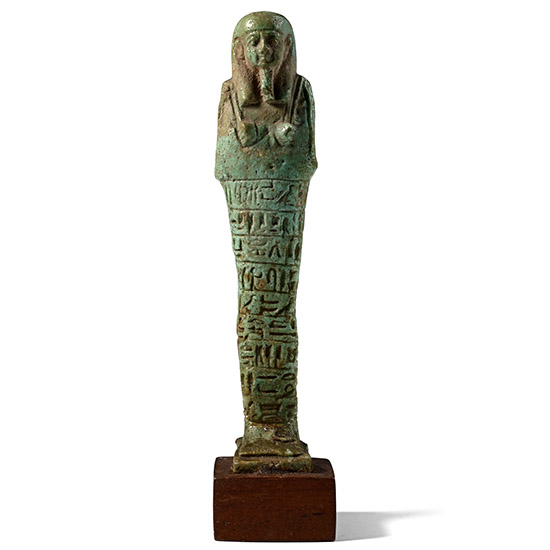
Egyptian Blue-Glazed Faience Shabti for Hornakht, Born of Nefertyti
Late Period, 664-332 B.C.Estimate: £600 - 800 (+bp*)
Bids: 7 | Current Bid: £55
Slender olive-green mummiform shabti wearing a lappet wig and a false beard, with arms crossed, the left hand holding a pick and the right a hoe and the cord of a seed bag, which hangs from the back shoulder; with nine horizontal bands of deeply incised hieroglyphs on the lower body, giving the Book of the Dead spell and the names of the owner, Hornakht, and his mother, Nefertyti; mounted on a custom-made stand with an old 'Ancient Egyptian B.C.900' label. 80.9 grams total, 16 cm high including stand
From the estate of a deceased Sussex private collector since the early 20th century. Accompanied by a copy of an illustrated academic report with translation by Simone Musso. -
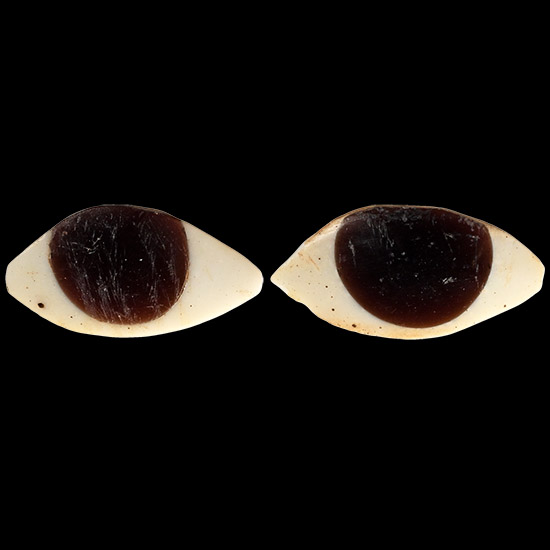
Egyptian Glass Eye Inlays
Ptolemaic Period, 332-30 B.C.Estimate: £200 - 300 (+bp*)
Bids: 3 | Current Bid: £24
Almond-shaped with large black irises and white sclerae. 4.12 grams total, 27-29 mm
Acquired on the UK art market, 1977-1979. Private collection, London.
Egyptian coffin eye inlays were both decorative and symbolic, designed to make the coffin appear more lifelike and to assist the deceased in the afterlife. Typically, they featured a white sclera (glass, travertine, alabaster, or quartz), a dark iris (glass or, more often, obsidian), and sometimes red paint at the inner corner. The eyes were often set in bronze or copper frames, occasionally with faience or bronze eyebrows. -
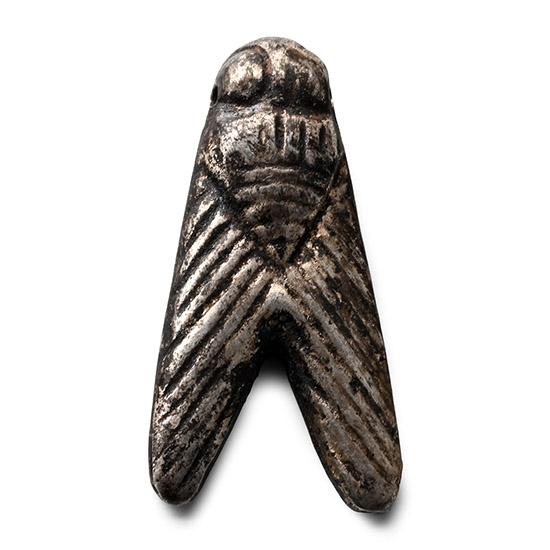
Egyptian Silver Fly Amulet
Late Period, 664-332 B.C.Estimate: £80 - 100 (+bp*)
Bids: 1 | Current Bid: £5
With detailing to the body and head, ribbed suspension loop above the head. 1.09 grams, 17 mm
London, UK, gentleman, 1990s.
Fly amulets were believed to protect against insect bites and to ward off troublesome flying creatures through apotropaic magic. Some believe they may have even symbolised the fly’s fecundity. Additionally, pharaohs bestowed gold fly-shaped pendants as military awards to honour soldiers' bravery and persistence in battle.
