
Loading, please wait...


LOT 0049
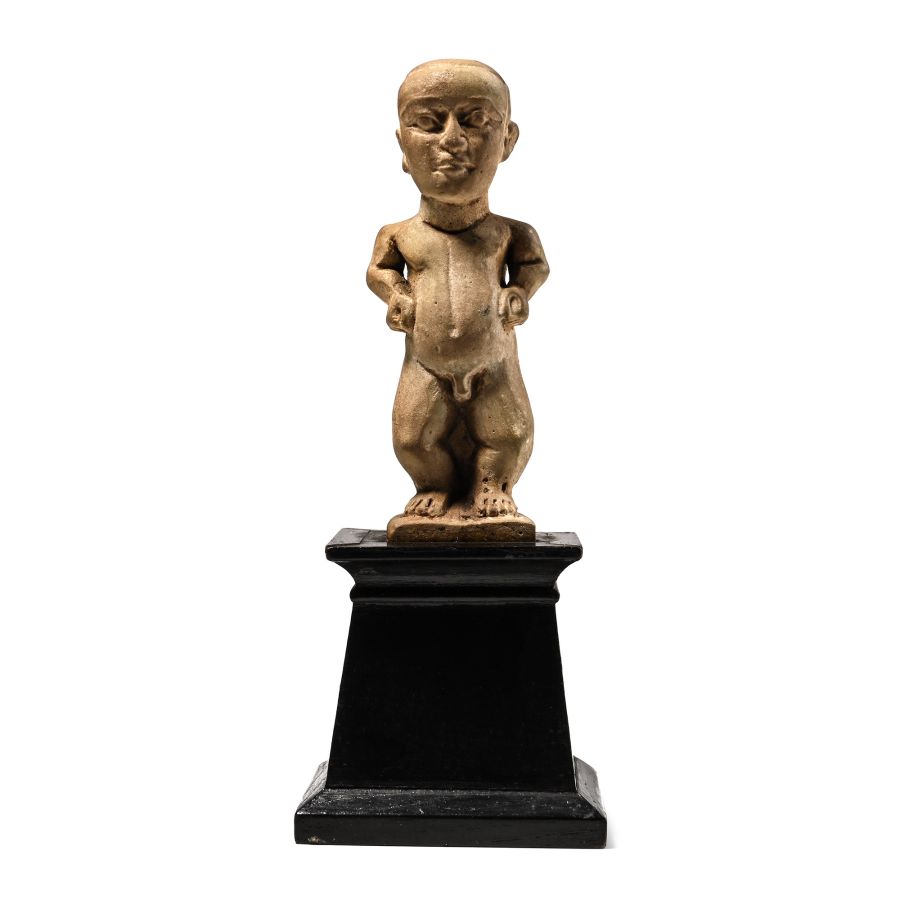
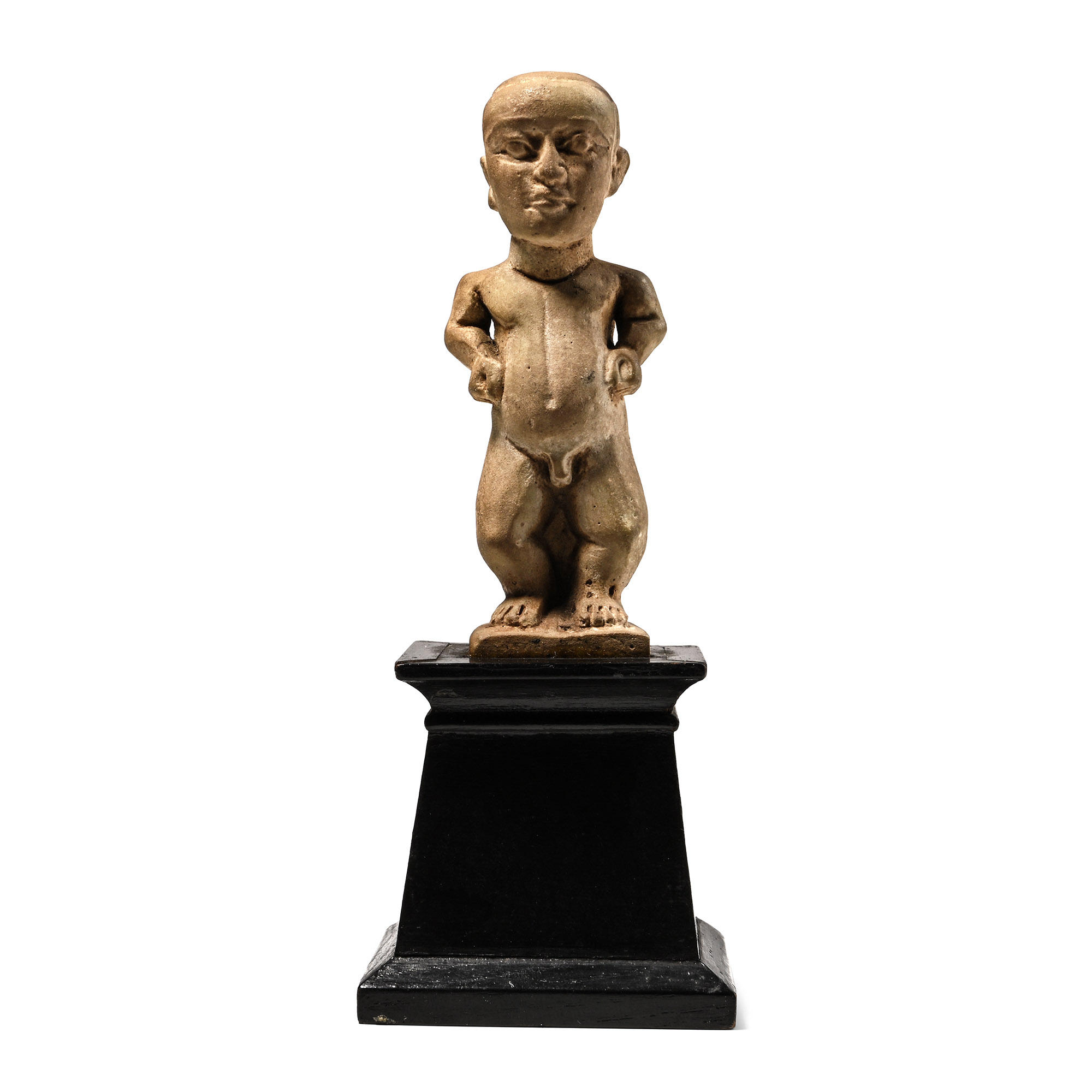
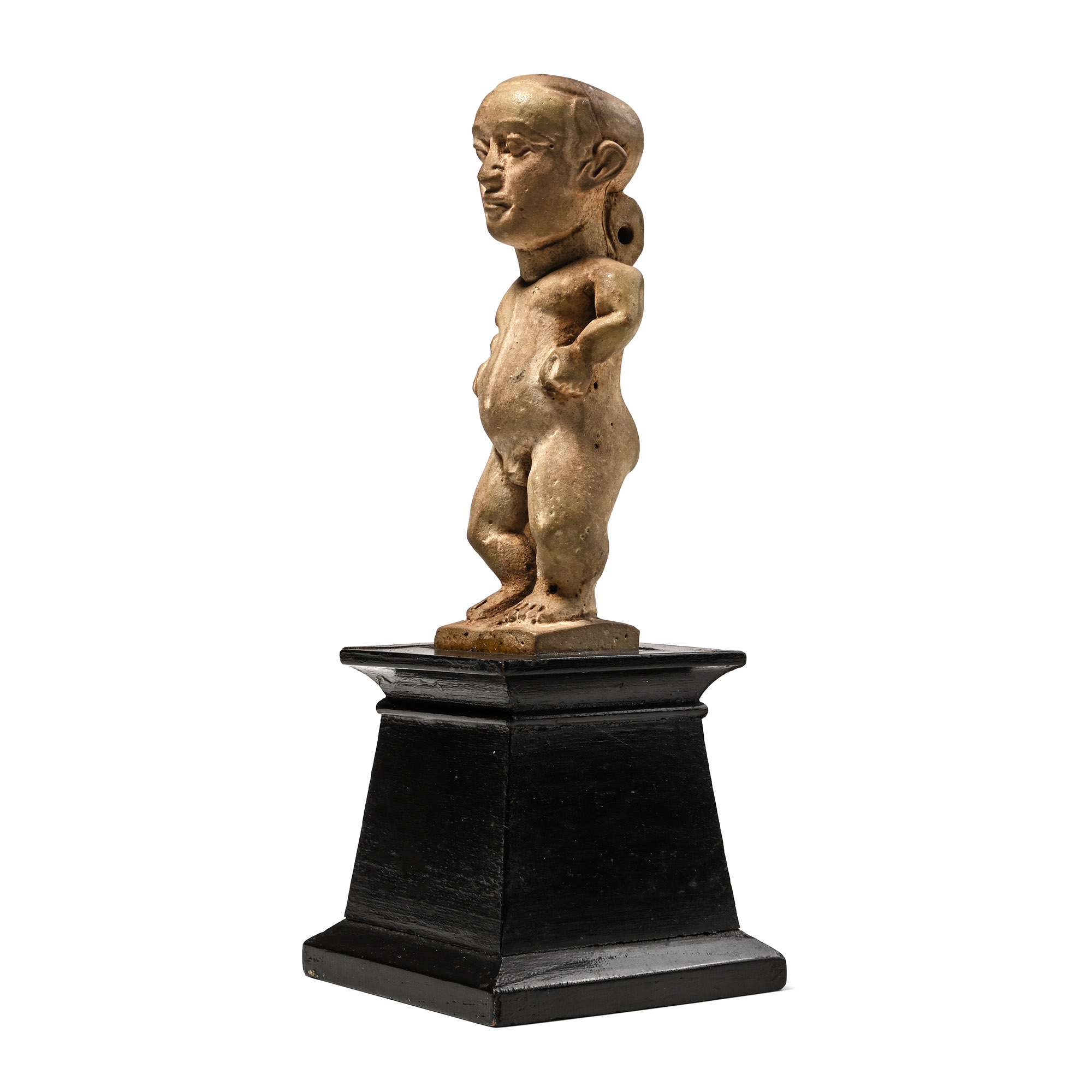
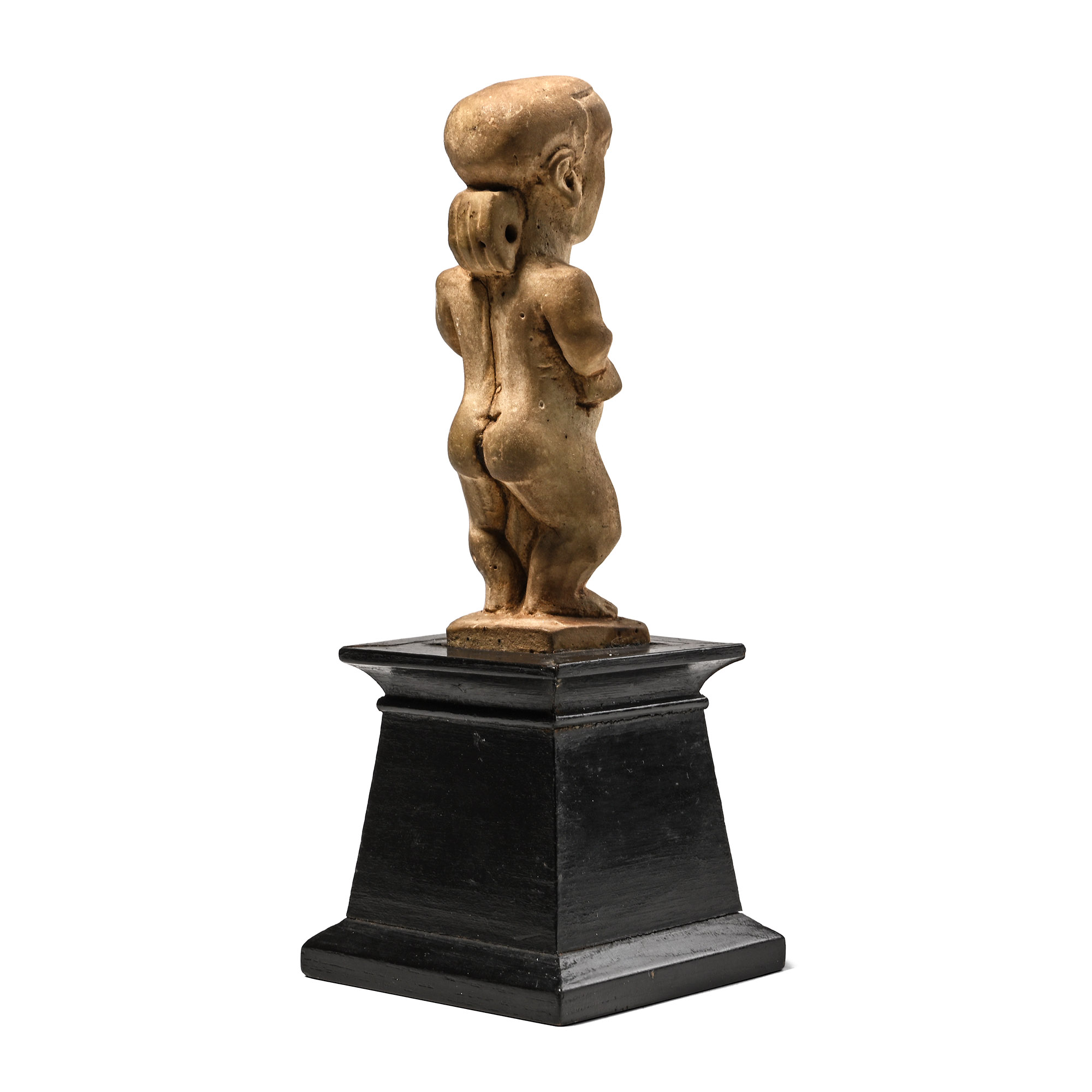
Large Egyptian Faience Pataikos Amulet
LATE PERIOD, 664-332 B.C.
4 7/8 in. (80 grams total, 12.5 cm including stand).
Standing nude with slightly bent legs on an integral trapezoidal base; short arms bent and clenched fists resting at the sides of his slightly protruding belly; finely modelled eyes, nose, mouth and ears; flat, close-fitting cap indicating the hair; suspension loop at the nape of the neck for use as an amulet.
ProvenanceEx Ms.E.C.(1923-2014), Israel.
Inherited by his son D.L., Switzerland.
Cf. Petrie, W.M.F., Amulets. Illustrated by the Egyptian Collection in University College, London, 1914, pl. XXXI, no. 176, for a Pataikos (feet missing) of similar quality.
FootnotesHerodotus mentions Pataikos as a dwarf-like depiction of Ptah, though the god's ancient Egyptian name remains unclear. These small amulets symbolise Ptah’s immense magical power, which helps protect the wearer from dangerous creatures such as snakes and crocodiles. The deity’s role in the funerary sphere is explained in Spell 164 of the Book of the Dead, where Pataikos is used to safeguard the deceased’s heart from attacks by enemies and from bodily decay.
CONDITIONTimeLine Auctions follows a vetting process to ensure the authenticity and legality of all items, reinforcing our commitment to integrity and responsible trading. Each antiquity, antique, and coin lot undergoes thorough examination by a vetting committee of at least ten external specialists, professional trade association members, scientists, and archaeologists: Our Vetting Process
AUCTIONS:
TimeLine is a leading auction house specialising in antiquities, ancient art, collectables, natural history, coins, medals, and books. Our auctions offer museums, collectors, historians, and enthusiasts the opportunity to acquire unique and historically significant pieces.
LOT 0049
Large Egyptian Faience Pataikos Amulet
Estimate £1,200 - 1,700€1,390 - 1,970 (for guidance only)$1,620 - 2,300 (for guidance only)
Opening Bid
£675 (EUR 783; USD 911) ‡+BP*
-
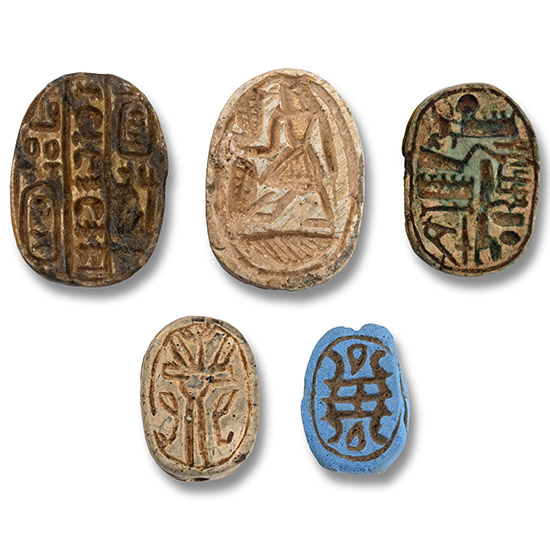
Egyptian Steatite and Faience Scarab Group
Mainly Second Intermediate Period–New Kingdom, circa 1660-1069 B.C.Estimate: £150 - 200 (‡+bp*)
Opening Bid: £75
Designs include: a tripartite design with ankh, water, nwb, and men signs, with indistinct cartouches possibly of Thutmose III, and signs spelling the phrase 'powerful is the justice of Re' (user-Maat-Re); a line border enclosing the stylised depiction of a striding figure grasping a crocodile, with a neb sign below; a line border enclosing a multitude of signs, including Thutmose III’s throne name (men-kheper-Re), and that of Amun; a line border enclosing central Hathoric sistrum; a line border enclosing a symmetrical motif in contrasting black glaze. 10.6 grams total, 13-19 mm
Acquired on the European art market in the early 2000s. With Galerie Rhéa, Zurich, Switzerland. -
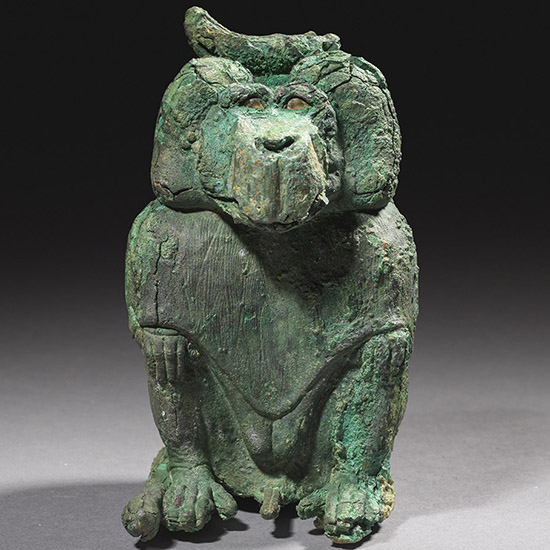
Large Egyptian Bronze Figure of Thoth
Late Period, 26th-30th Dynasty, 664-343 B.C.Estimate: £8,000 - 10,000 (+bp*)
Opening Bid: £4,000
Hollow-cast depiction of the baboon manifestation of the god Thoth, seated on its haunches, front paws resting on the knees of its back legs, genitalia exposed, a thick cowl of fur around its shoulders, and a long tail curling from the back; remains of a crescent moon sit on the crown of its head, preserving traces of gilding (this may originally have been surmounted by a full moon disc); the animal’s coat is rendered naturalistically with fine incised detailing, and the hands and feet are delicately portrayed, with knuckles and nails accurately defined; facial features are strongly modelled; the eye inlays, most likely glass or quartz, survive, with pupil and white differentiated; stabilised. 810 grams, 11.8 cm (1.59 kg total, 22.1 cm high including stand)
Condition: Some cracking of the original metal, particularly around the head, shoulders, and tail; much of the crown now lost; heavy corrosion and oxidisation, now stabilised.
Collection of Max Willborg (1933-2001), Stockholm, Sweden, acquired 1981. This lot has been checked against the Interpol Database of stolen works of art and is accompanied by search certificate no.13521-263440.
Because of its curious behaviour at dawn, when it sits upright on its hind legs, waves its front paws in the air, and screeches, the baboon was regarded as a creature of the sun god, as if it had foreknowledge of the sun’s arrival. More commonly, however, it was associated with the moon, under whose light this performance takes place. As a result, the baboon (both Papio cynocephalus, the dog-headed baboon, and P. hamadryas) was the form adopted by the Egyptian lunar gods Khonsu of Thebes and Thoth of Hermopolis in Middle Egypt. Images such as this are assumed to represent Thoth unless an inscription specifically names Khonsu. Thoth was Lord of Time, inventor of writing, and patron of scribes. The original animal manifestation associated with Thoth may have been the ibis, and his baboon form may have been adopted only when the cult of the god was extended to Hermopolis, where a baboon known as the Great White was already adored. -
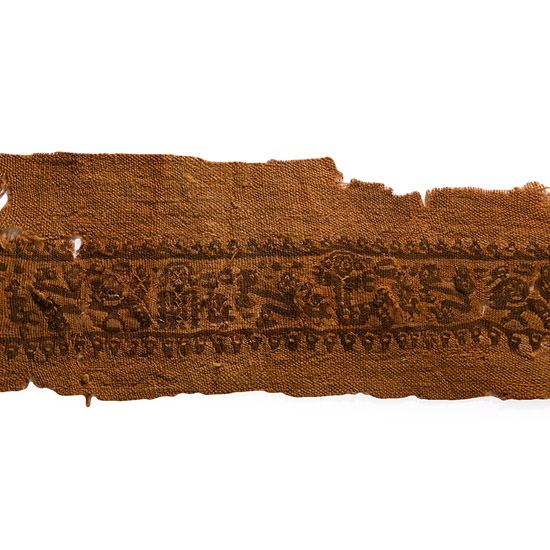
Egyptian Coptic Textile Fragment of a Clavus from a Tunic with Triton, Male Figure and Birds
Circa 5th-6th century A.D.Estimate: £60 - 80 (+bp*)
Opening Bid: £5
Comprising a decorative tunic stripe (clavus) in purple wool over coarse linen, S-twist tapestry, embroidered with stylised plants, male figures, tritons and birds, borders decorated with meanders. 14.5 grams, 44 cm
Acquired 1970s-1996. Property of a North American collector. London collection, 2016.
Among the many fragments from wool tunics are several long strips that match to form nearly full-length central pectoral clavi. They are patterned with a profusion of small figures or interlaced abstract designs, birds, plants, and animals, with a contrasting border filled with geometric motifs.
