Loading, please wait...

Large Egyptian Expedition Lithograph Print Large Egyptian Expedition Lithograph Print Large Egyptian Expedition Lithograph Print
Use mousewheel to zoom in and out, click to enlarge
Details

LOT 0450

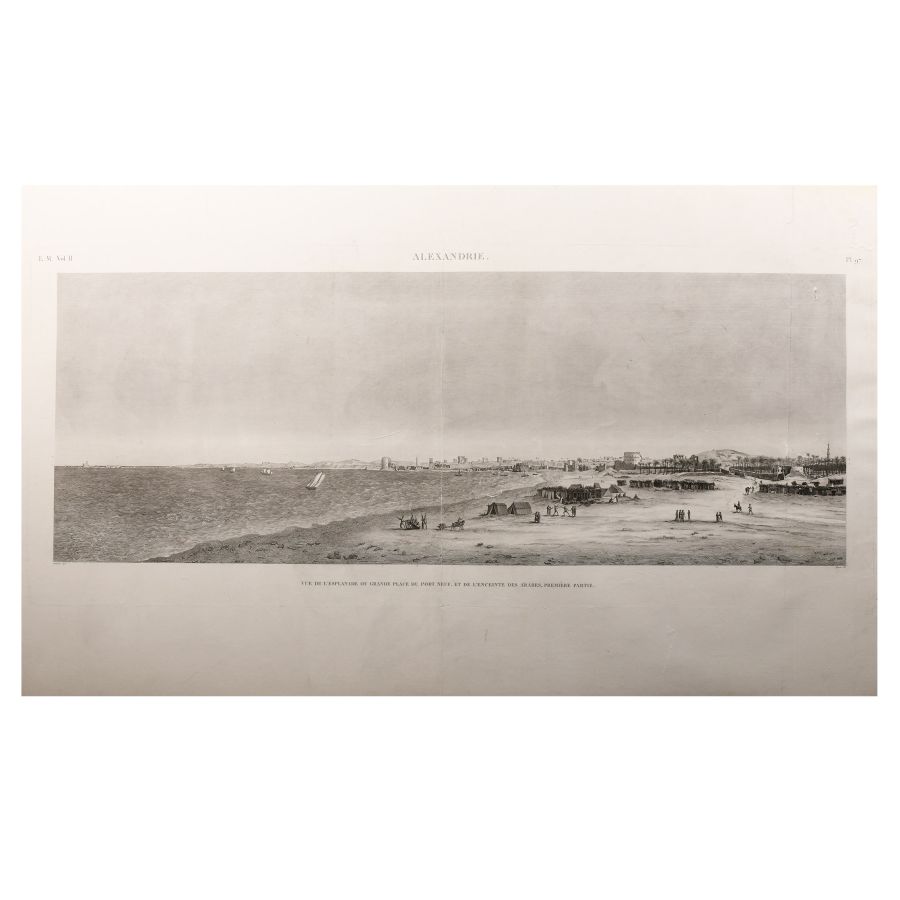
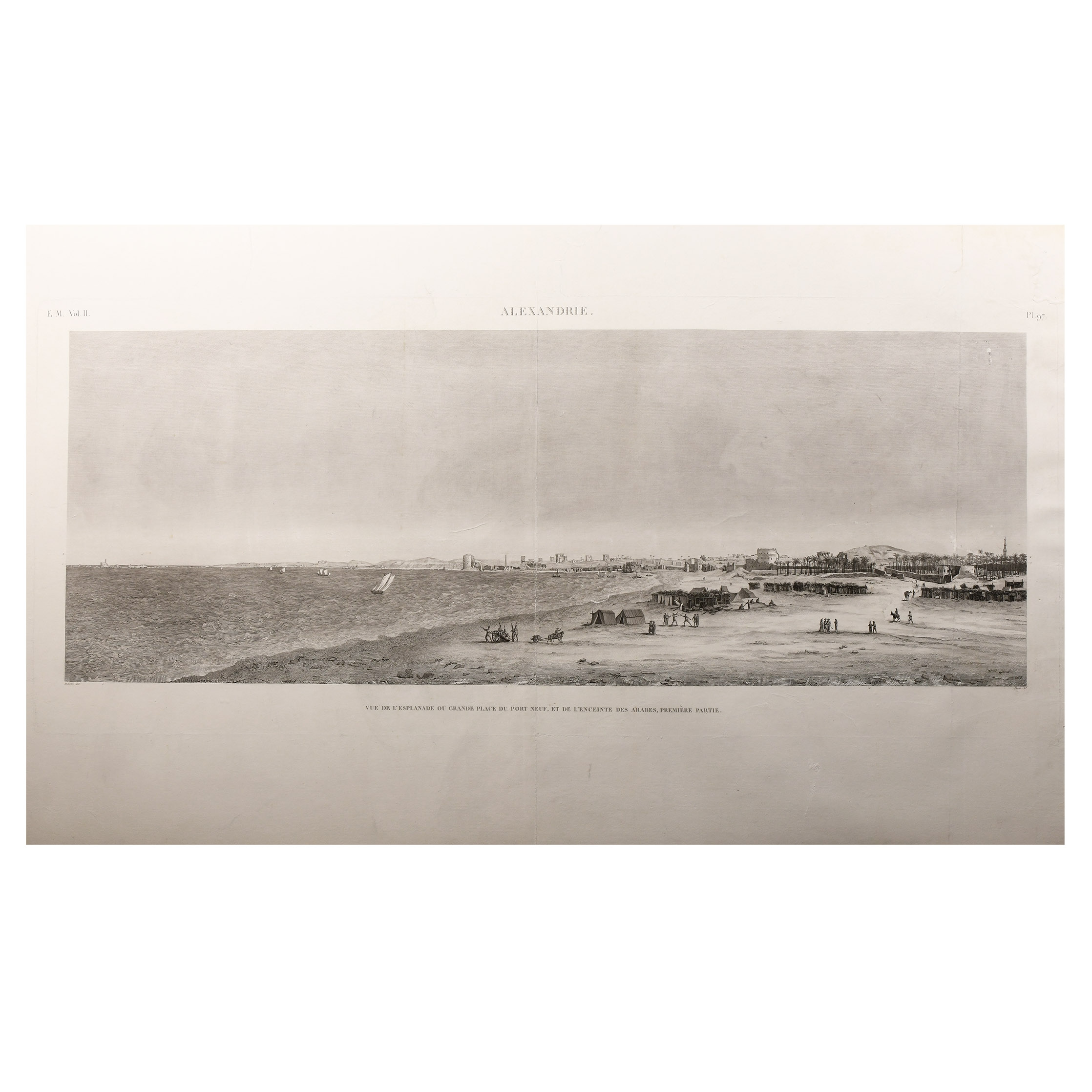
Large Egyptian Expedition Lithograph Print

1817 A.D.

43 1/2 x 26 1/4 in. (220 grams, 110.5 x 66.5 cm (sheet)).

Charles-Louis Balzac & Berthault - Alexandrie. Vue de l'esplanade ou grande place du Port Neuf, et de l'enceinte des arabes, première partie - Proof etching on laid paper of plate 97 from Description de l'Égypte: ou, Recueil des Observations et des Recherches qui ont été Faites en Égypte Pendant l'Expédition de l'Armée Française with later backing sheet.

Provenance

From the collection of a North American priest.
Acquired between 1981-1996.
Property of a North American collector.

Literature

Cf. similar print in the New York Public Library collection - IMAGE ID 1268810.

Footnotes

Produced between February 1802 and 1830 on the orders of Napoleon Bonaparte; published between 1809 and 1828. Just 1,000 copies were distributed to various institutions, printed on laid paper with an 'Égypte ancienne et moderne' watermark.

CONDITION
VETTING:

TimeLine Auctions follows a vetting process to ensure the authenticity and legality of all items, reinforcing our commitment to integrity and responsible trading. Each antiquity, antique, and coin lot undergoes thorough examination by a vetting committee of at least ten external specialists, professional trade association members, scientists, and archaeologists: Our Vetting Process


AUCTIONS:

TimeLine is a leading auction house specialising in antiquities, ancient art, collectables, natural history, coins, medals, and books. Our auctions offer museums, collectors, historians, and enthusiasts the opportunity to acquire unique and historically significant pieces.

Live Bidding

LOT 0450

Large Egyptian Expedition Lithograph Print

Sold for (Inc. bp): £117

Print page

RELATED LOTS
  • Egyptian Wooden Djed Pillar Amulet
    Egyptian Wooden Djed Pillar Amulet
    Saite Period, 7th-5th century B.C.

    Estimate: £1,500 - 2,000 (‡+bp*)

    Opening Bid: £750

    Finely-made amuletic djed pillar; old collector's accession number 'E.436' to underside; mounted on a custom-made display stand. 106 grams, 17 cm high


    with ink inscribed 'E.436' to base. Acquired in 1970. Ex private European collection. This lot has been checked against the Interpol Database of stolen works of art and is accompanied by search certificate no.11602-199041.

    The djed pillar symbolises stability and is usually understood to be the spine of the god Ptah although its origins are more probably in cult practices involving sheaves of reeds which were revered due to the general absence of trees from the Egyptian landscape. The djed later came to be symbolise Seker, the falcon god of Memphis and Ptah, the Memphite god of craftsmen, who carried a sceptre formed as a combination of the djed and the ankh. The cult of Ptah waned and gave way to that of Osiris so that by the New Kingdom (16th century B.C.), the djed had become associated with Osiris, part of whose cult included a ceremony for raising the djed representing Osiris's triumph over Seth.

    Lot Details

  • Egyptian Gold God Bastet Cat Amulet
    Egyptian Gold God Bastet Cat Amulet
    Late New Kingdom, 1070-900 B.C.

    Sold for (Inc. bp): £650

    Modelled seated on a tongue-shaped base, with simple facial detailing and suspension loop to the back. 0.52 grams, 8 mm


    From an early 20th century French collection.

    The goddess Bastet was believed to be the daughter of the sun god and was shown with the features of a lion up until about 1000 B.C. when she was portrayed as a cat or human with a cat head. As the daughter of Ra she was associated with the rage inherent in the sun god's eye which was considered to be his instrument of vengeance. Her development into a cat goddess occurred during the New Kingdom but did not fully develop until the Late Period. She was still associated with the destructive power of the sun and was shown on the prow of the solar boat, decapitating the evil serpent Apophis in the Book of the Dead. The maternal, protective and hunting characteristics of the cat are obvious in Bastet and she was seen as a protector of pregnant women and young children. In the Pyramid Texts she is invoked by the deceased king to act as his protector and to help him reach the sky to join the sun god; the king proclaims that Bastet is his mother and nurse. Like her counterpart, Sekhmet, Bastet has an aggressive side and, in a text from Karnak, Amenhotep II described his enemies being slaughtered like the victims of Bastet. The goddess had a shrine at Karnak, where she is known as the 'Lady of Asheru' which aligns her closely with the goddess Mut, the consort of Amun-Ra. Her most famous shrine was in the north-east Delta region, at Bubastis, and was known as Per-Bastet or 'the House of Bastet.' Herodotus describes the festival of Bastet as one of the most elaborate in all of Egypt and identifies her with the Greek Artemis. Cemeteries of cats have been excavated at Bubastis and at Saqqara and Memphis.

    Lot Details

  • Egyptian Bronze Sistrum Handle Finial
    Egyptian Bronze Sistrum Handle Finial
    Late Period, 664-332 B.C.

    Estimate: £1,000 - 1,400 (+bp*)

    Opening Bid: £500

    The bifacial upper part of a handle featuring Hathor, depicted with cow ears and wearing a heavy wig with characteristically curled lappet ends and a broad collar; on either side a uraeus, one of which is wearing the crown of Lower Egypt, the other the Upper Egyptian crown; remains of the sistrum cradle above. 146 grams total, 10.7 cm including stand


    with Galerie Gunter Phuze, Kunst der Antike 4, Freiburg, 1982, no.335. German private collection H. W. (1931-2018), acquired 1982. Accompanied by a copy of an IADAA Interpol search certificate. Accompanied by copies of the relevant Galerie Gunter catalogue pages.

    The sistrum was a rattle-like instrument played exclusively by women in religious ceremonies. The sound produced by the sistrum was believed to drive away evil and soothe a god's anger. Hathor is the daughter of the sun god Re, and in her role as a mother goddess is often depicted as a cow or with bovine characteristics as here. Hathor is also associated with love, music and dancing, and the sistrum is one of her sacred symbols.

    Lot Details

Stay up-to-date with the latest from TimeLine Auctions by joining our mailing list