
Loading, please wait...
LOT 0458
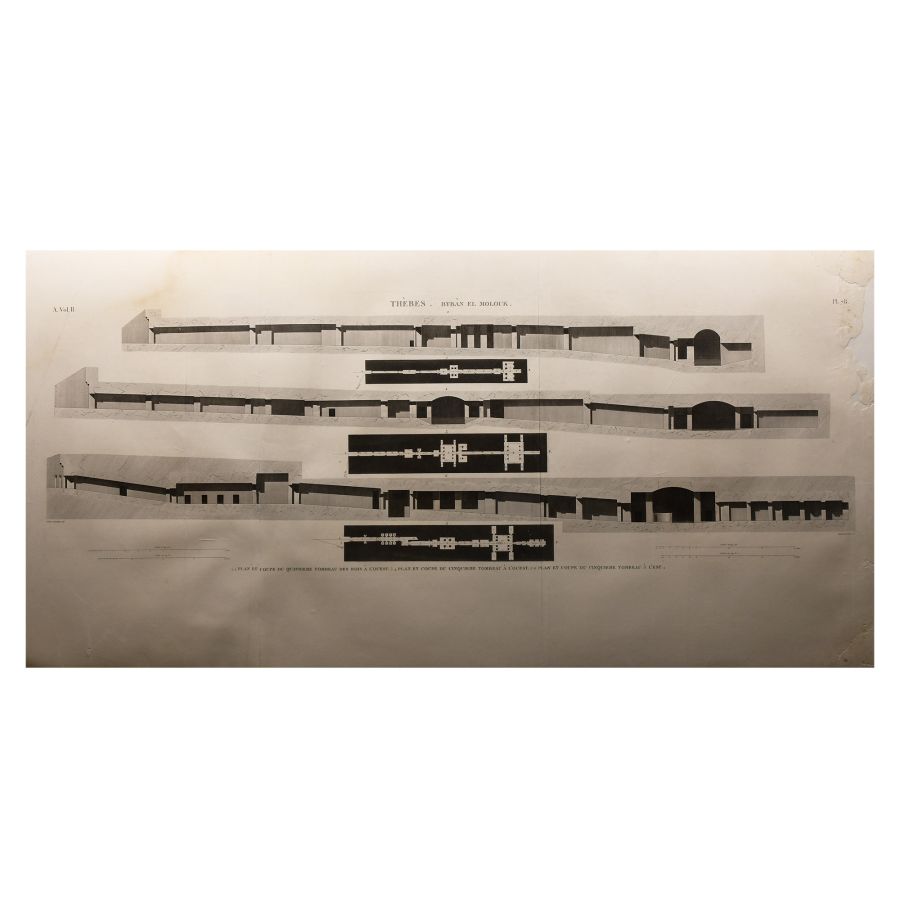
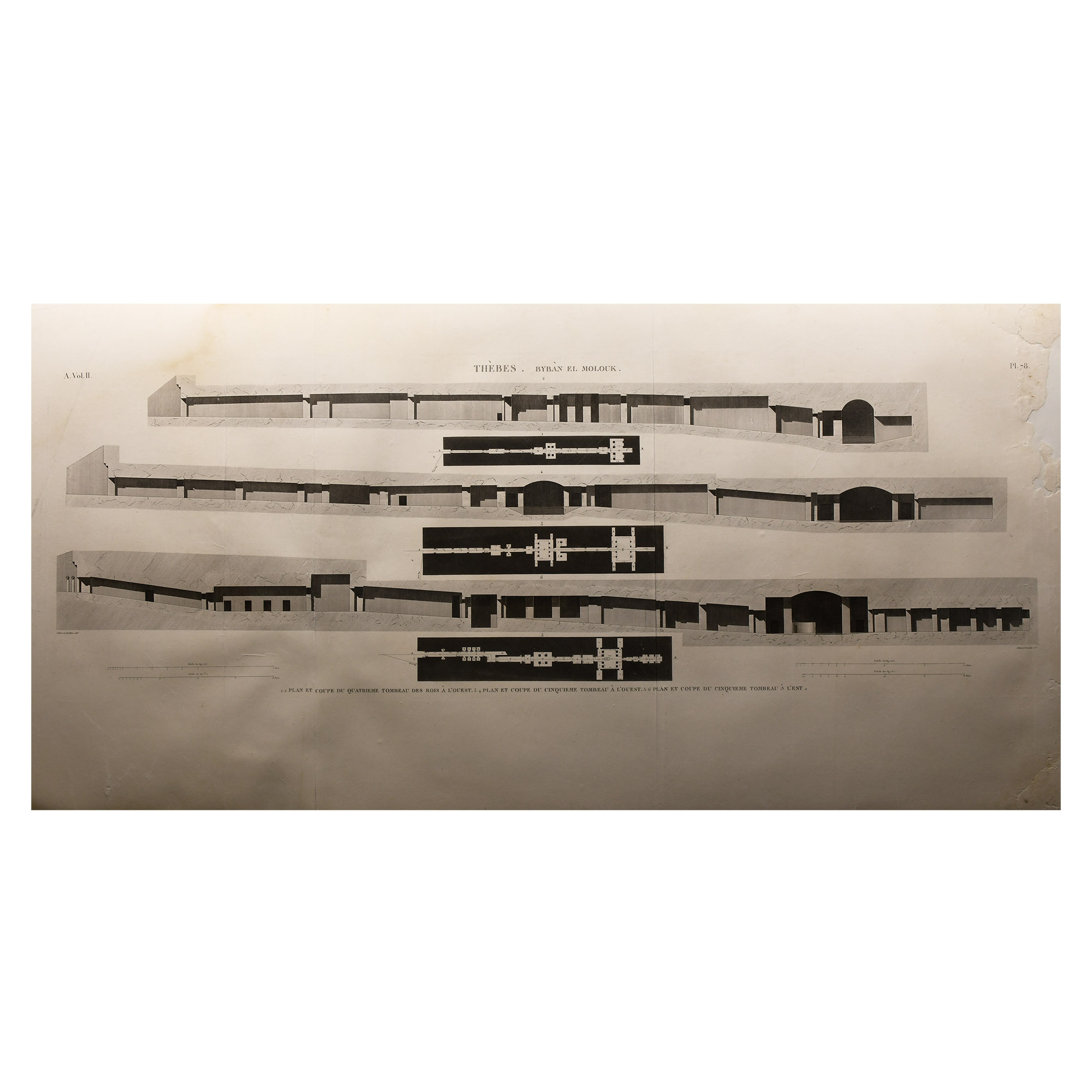
Large Egyptian Expedition Lithograph Print of Thebes
1820 A.D.
52 3/4 x 26 in. (360 grams, 134 x 66 cm (sheet)).
Adam et Leisnier - Thèbes - Byban el Molouk - 1.2. Plan et coupe du quatrième tombeau des rois à l'ouest 3.4. Plan et coupe du cinquième tombeau à l'ouest 5.6. Plan et coupe du cinquième tombeau à l'est - Proof etching on laid paper of plate 78 from La Description de l’Égypte: Antiquités, Volume II: Commission des sciences et arts d’Égypte with later backing sheet.
ProvenanceFrom the collection of a North American priest.
Acquired between 1981-1996.
Property of a North American collector.
Produced between February 1802 and 1830 on the orders of Napoleon Bonaparte; published between 1809 and 1828. Just 1,000 copies were distributed to various institutions, printed on laid paper with an 'Égypte ancienne et moderne' watermark. The book is subtitled Recueil des observations et des recherches qui ont été faites en Égypte pendant l’expédition de l’Armée française, publié par les ordres de Sa Majesté l’Empereur Napoléon le Grand (Gathering of observations and discoveries which were made in Egypt during the expedition of the French army, published on the orders of His Majesty the Emperor Napoleon the Great). It was the world's first encyclopedia devoted exclusively to the remains of ancient Egypt. The plates of this book are the first to present the archaeological sites of Thebes (Luxor).
The plans are of royal tombs in the Valley of the Kings (Byban el Molouk). Top: Ramesses VI (KV 9); Middle: Tawosret and Sethnakhte (KV 14); Bottom: a son of Ramesses III (KV 3).
TimeLine Auctions follows a vetting process to ensure the authenticity and legality of all items, reinforcing our commitment to integrity and responsible trading. Each antiquity, antique, and coin lot undergoes thorough examination by a vetting committee of at least ten external specialists, professional trade association members, scientists, and archaeologists: Our Vetting Process
AUCTIONS:
TimeLine is a leading auction house specialising in antiquities, ancient art, collectables, natural history, coins, medals, and books. Our auctions offer museums, collectors, historians, and enthusiasts the opportunity to acquire unique and historically significant pieces.
-
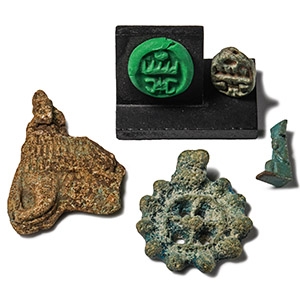
Egyptian Faience Amulet Group
Late Period, 664-332 B.C.Estimate: £200 - 300 (+bp*)
Opening Bid: £80
Comprising: pierced rosette pendant; Isis suckling Horus pendant; winged serpent plaque; scaraboid with high-relief Horus to the domed face and 'Men-Kheper-Ra' for Thutmose III to the underside, mounted on a stand with an impression. 38.5 grams total, 23-56 mm
Acquired from a private UK collection in the late 1990s. Private collection of Mr T.H., Norfolk, UK. -
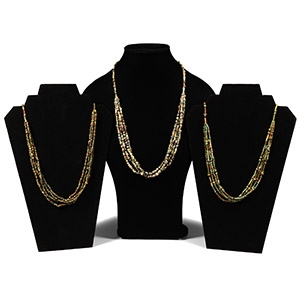
Egyptian Multi-Stranded Mummy Bead Necklace Collection
Late Period, 664-525 B.C.Sold for (Inc. bp): £468
Comprising three restrung composition necklaces, each composed of multiple strands of polychrome beads of mainly annular and tubular types. 75 grams total, 68-76 cm long
Acquired before 1979. From the private collection of Mr F. A., South Kensington, London, UK; thence by descent 2014.
Red and yellow faience were among the new colours appeared in the XVIIIth Dynasty, but they were in use until the Late Period. It was ideally formed from a core of sand and quartz and a vitreous alkaline glaze. It was the preferred medium of Egyptian jewellers even before the Fist Dynasty, because of its malleability and its ability to imitate other more expensive materials thanks to the colour of the glaze. -
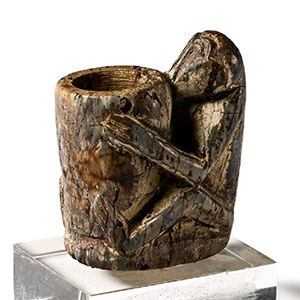
Egyptian Glazed Steatite Seated Monkey Holding a Kohl Pot
New Kingdom, 1225-1070 B.C.Estimate: £1,200 - 1,700 (‡+bp*)
Opening Bid: £600
The monkey holding a kohl pot of roughly cylindrical form; set on an integral oval base; rim of kohl perforated twice; mounted on a custom-made display base. 21.2 grams total, 37 mm high including stand
with François de Riqules, Archéologie, 11-12 November 2001, lot 198.
