
Loading, please wait...
LOT 0695
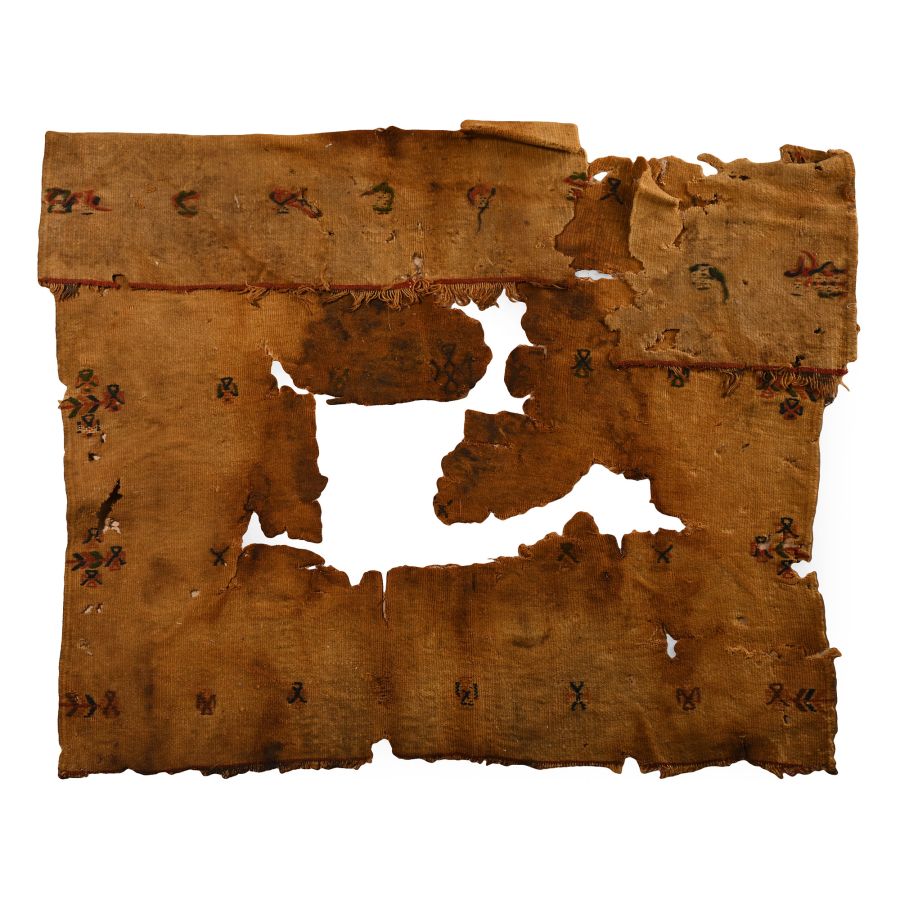
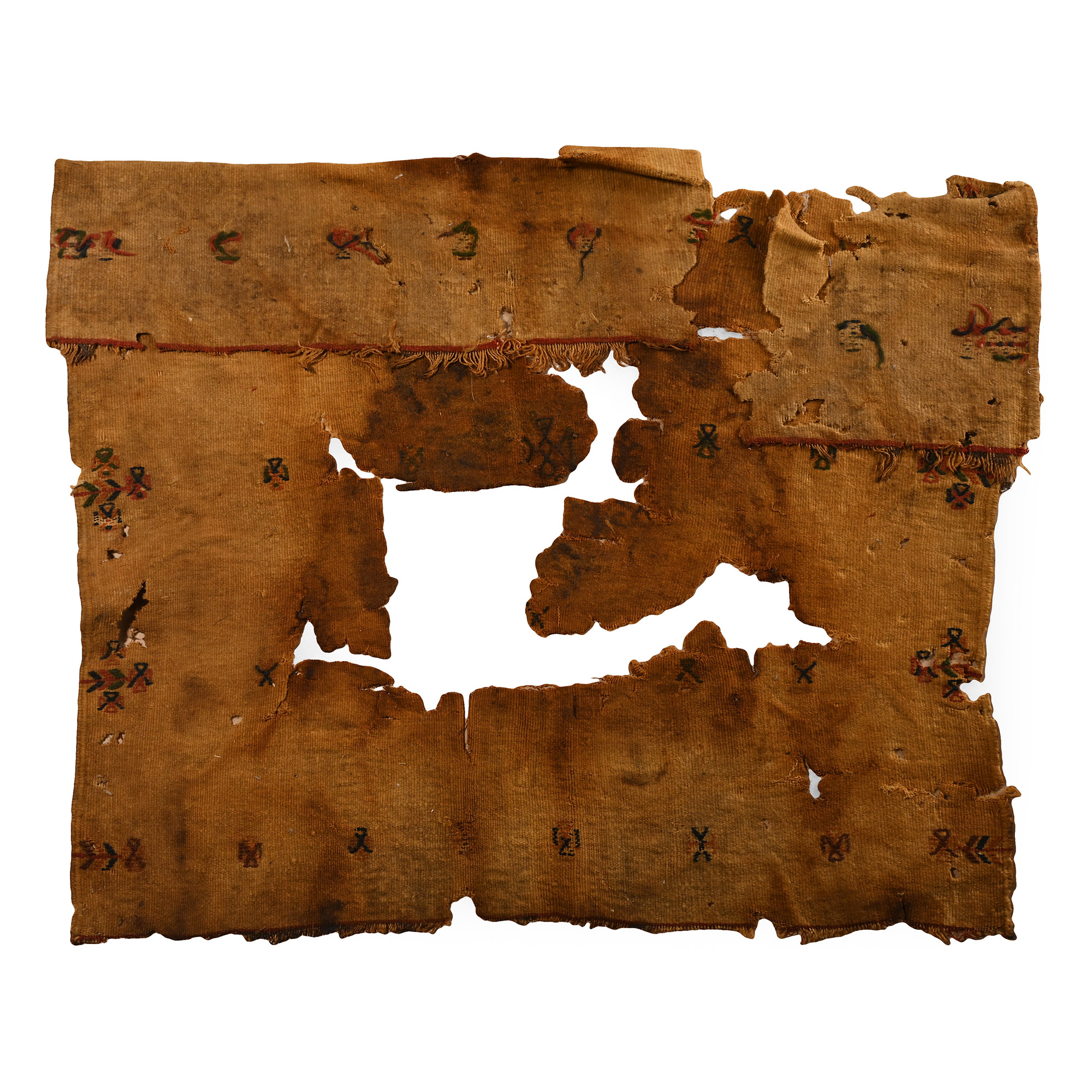
Large Egyptian Coptic Wall Tapestry Textile Fragment with Geometric Ornaments
CIRCA 7TH CENTURY A.D.
21 5/8 in. (236 grams total including paper folder, 55 cm wide).
Fragment from a tapestry or a cloak in light fabric, S-twist tapestry, embroidered with red, green, yellow, and blue geometric ornaments in wool and linen. [No Reserve]
ProvenanceAcquired 1970s-1996.
Property of a North American collector.
London collection, 2016.
Cf. Calament, F., Durand, M., Antinoé, á la vie, á la mode, visions d’élégance dans les solitudes, Lyon, 2013, cat.25, for similar.
FootnotesMost of the linen or wool garments found by A. Gayet in the Antinoe necropolis were woven in a specific pattern, in a single piece, on a horizontal warp. Another relatively common pattern for linen garments consisted of assembling three pieces woven on a single warp and forming the upper part of the garment, with the collar and sleeves.
CONDITIONTimeLine Auctions follows a vetting process to ensure the authenticity and legality of all items, reinforcing our commitment to integrity and responsible trading. Each antiquity, antique, and coin lot undergoes thorough examination by a vetting committee of at least ten external specialists, professional trade association members, scientists, and archaeologists: Our Vetting Process
AUCTIONS:
TimeLine is a leading auction house specialising in antiquities, ancient art, collectables, natural history, coins, medals, and books. Our auctions offer museums, collectors, historians, and enthusiasts the opportunity to acquire unique and historically significant pieces.
LOT 0695
Large Egyptian Coptic Wall Tapestry Textile Fragment with Geometric Ornaments
Estimate £150 - 200€170 - 230 (for guidance only)$200 - 270 (for guidance only)
-
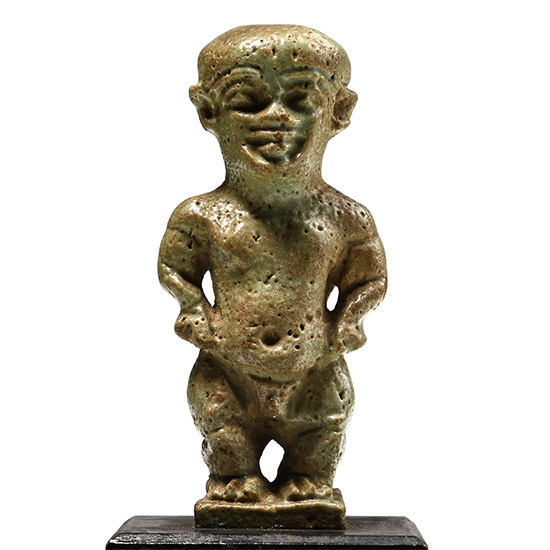
Large Egyptian Green Glazed Faience Bifacial Pataikos Amulet
Late Period, 664-332 B.C.Estimate: £500 - 700 (‡+bp*)
Opening Bid: £275
Nude Pataikos standing with slightly bent legs on a rectangular base; his short arms bent, and his clenched fists resting at the sides of his slightly protruding belly; janiform head topped with a smooth, closely fitting cap similar to the one worn by the god Ptah; loop at the nape of the neck for use as an amulet; mounted on a custom-made stand. 54.3 grams total, 95 mm including stand
Ex Mr E.C.(1923-2014), Israel. Inherited by his son D.L., Switzerland.
Amulets had a diverse range of functions: they were either worn by the living or used as small votive offerings in private and official cult contexts. They also played an important role in funerary practices, as they were either wrapped into the mummy, placed on it (mummy amulets), or given to the deceased as grave goods. In the Late Period, dwarfs were venerated as popular protective deities, in analogy to Bes and Harpocrates. Moreover, since the Late Period, the creator god Ptah, who was worshipped in Memphis, was also represented as a childlike dwarf. -
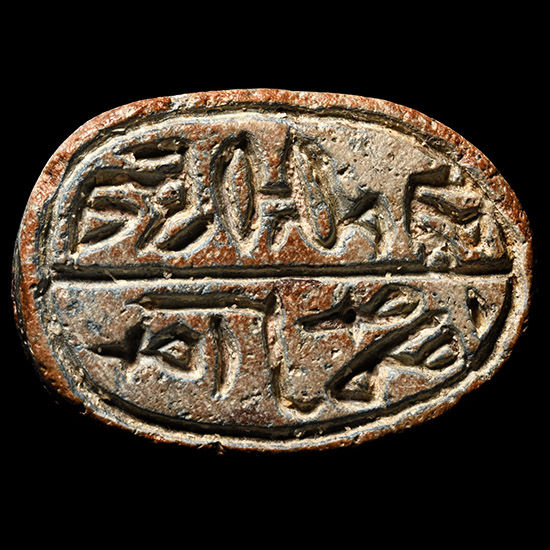
Large Egyptian Scarab for the Overseer of the Treasury Har
Second Intermediate Period, circa 1650–1530 B.C.Estimate: £100 - 140 (‡+bp*)
Bids: 2 | Current Bid: £60
Stylised scarab body with low-relief clypeus and head, two notches marking the division between prothorax and elytra, and legs modelled along the sides; underside divided vertically into two panels with incised hieroglyphs reading: 'Seal-bearer of the King of Lower Egypt, Overseer of the Treasury, Har'. 4.54 grams, 22 mm
Private collection of Kal Noselson, New York, acquired between 1976 and the late 1990s; thence by descent. Accompanied by the collector's original inked images. -
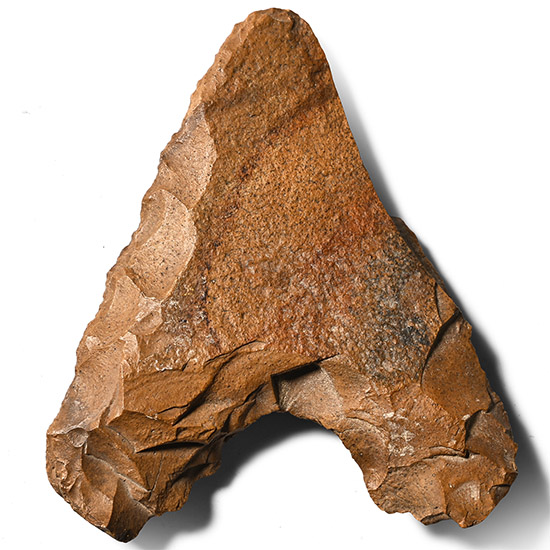
'Saqqara' Egyptian Stone Age Knapped Spearhead
Neolithic Period, circa 6,000 B.P.Estimate: £50 - 70 (+bp*)
Bids: 1 | Current Bid: £5
Triangular in plan with swept barbs to the rear edge; marked 'Near Great Pyramid 1912' and 'G[.]RRA'. 59.5 grams, 84 mm
Found near the Great Pyramid, Saqqara, Egypt, 1912. Acquired from Sotheby's, 16 June 1959 (part), £4.10. From the private collection of Peter Clayton, FCILIP, Dip, Arch, FSA, FRNS, Hemel Hempstead, Hertfordshire, UK; formed since the late 1950s. Accompanied by a copy of an old handwritten identification card written by Peter Clayton.
