
Loading, please wait...

LOT 0538
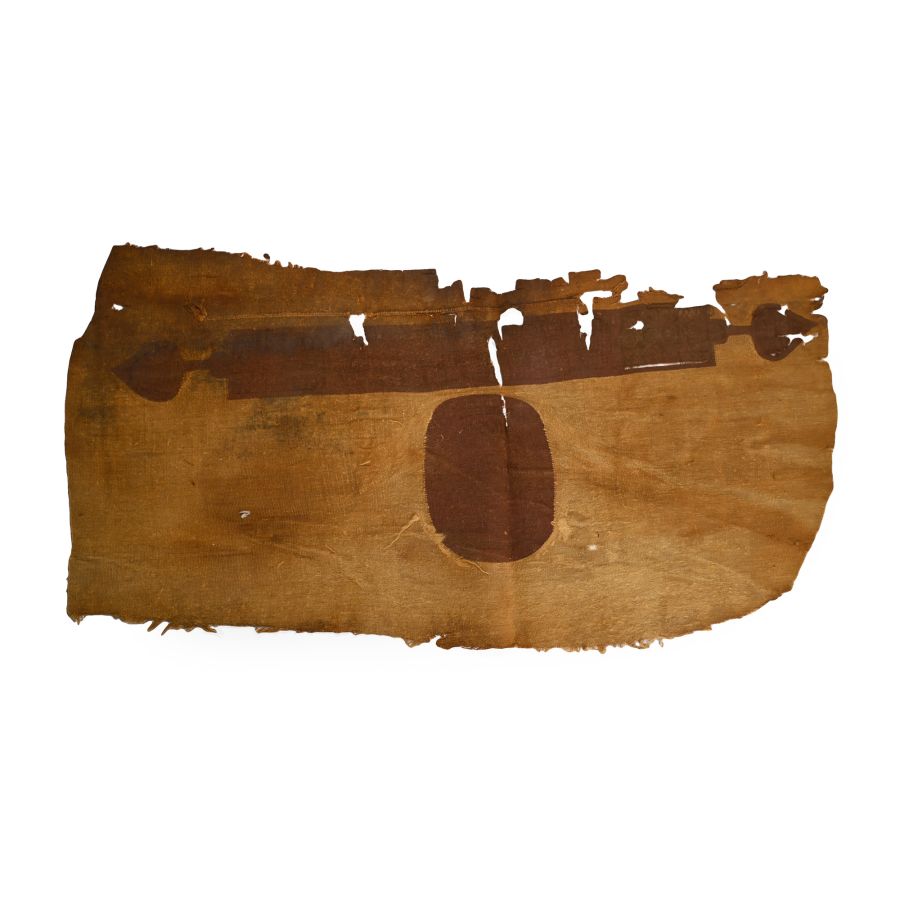
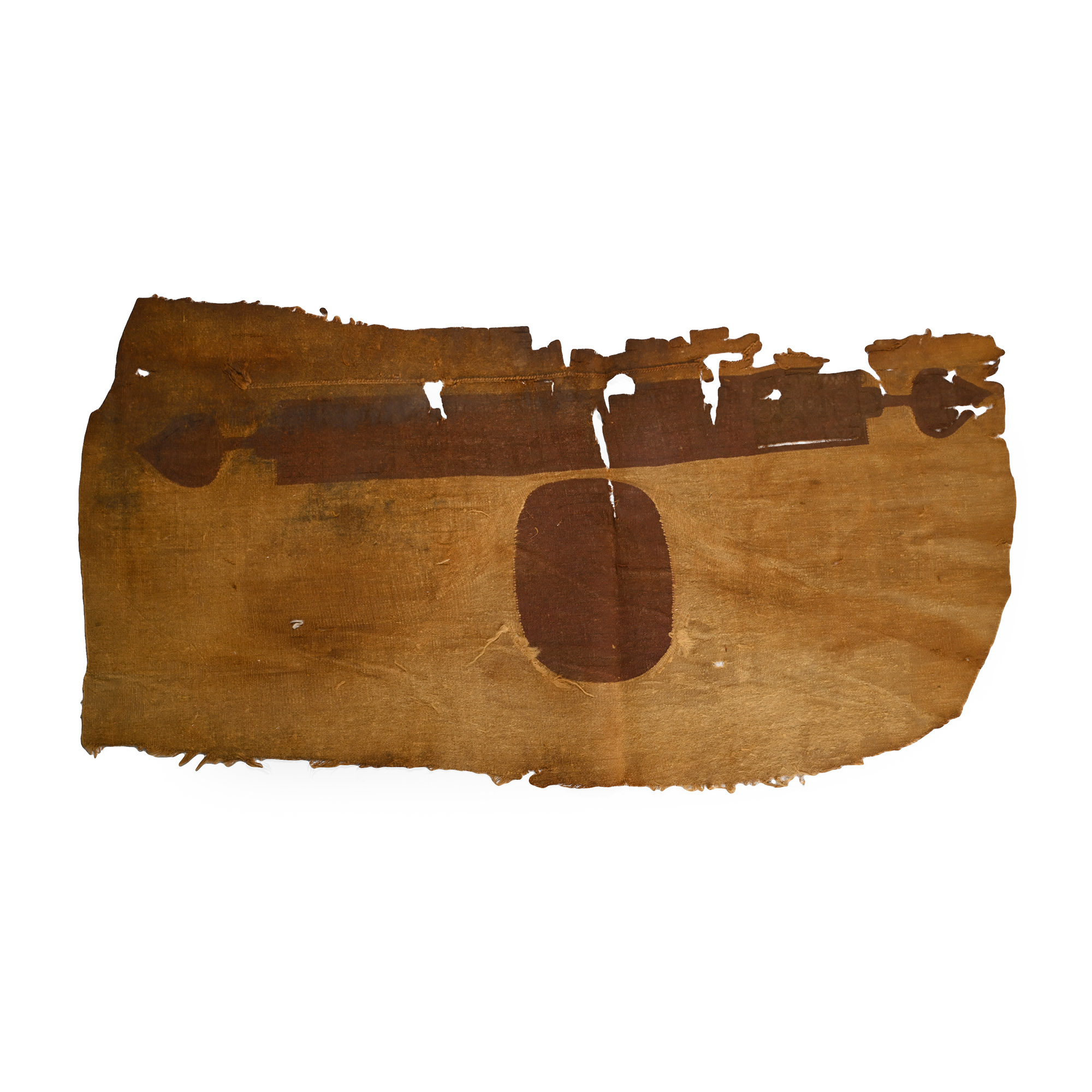
Large Egyptian Coptic Textile Shoulder Fragment of a Man's Military Tunic with Clavus and Orbiculus
CIRCA 5TH-6TH CENTURY A.D.
32 1/4 in. (233 grams total including paper folder, 82 cm).
Large section of a shoulder from a man's tunic in wool on linen, decorated with a long purple clavus featuring geometric squares and a purple orbiculus on the shoulder; tapestry, weave braids with right-angled borders. [No Reserve]
ProvenanceAcquired 1970s-1996.
Property of a North American collector.
London collection, 2016.
Cf. Rutschowscaya, M.H., Tissus Coptes, Paris, 1990, p.52, for a complete example of such tunics, in Louvre inv.no.E 26738 A, dated to 398- 641 A.D.; for Roman military tunics cf. D'Amato, R., Roman Military Clothing (3), AD 400-640, Oxford, 2005, pp.7ff.
FootnotesThe tunic was decorated in purple with opus phrygium embroidery. This corresponds to the iconography of military tunics for 5th-7th century Roman soldiers. The archaeological evidence from the desert cemeteries of Egypt offers striking confirmation of pictorial sources on late Roman clothing around the empire.
CONDITIONTimeLine Auctions follows a vetting process to ensure the authenticity and legality of all items, reinforcing our commitment to integrity and responsible trading. Each antiquity, antique, and coin lot undergoes thorough examination by a vetting committee of at least ten external specialists, professional trade association members, scientists, and archaeologists: Our Vetting Process
AUCTIONS:
TimeLine is a leading auction house specialising in antiquities, ancient art, collectables, natural history, coins, medals, and books. Our auctions offer museums, collectors, historians, and enthusiasts the opportunity to acquire unique and historically significant pieces.
LOT 0538
Large Egyptian Coptic Textile Shoulder Fragment of a Man's Military Tunic with Clavus and Orbiculus
Estimate £200 - 300€230 - 350 (for guidance only)$270 - 410 (for guidance only)
Opening Bid
£5 (EUR 6; USD 7) +BP*
-
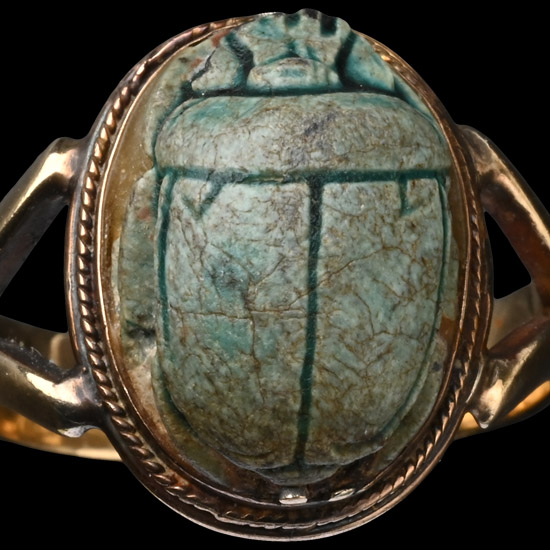
Egyptian Glazed Faience Scarab in Victorian Gold Ring
New Kingdom, circa 13th–11th century B.C. and laterEstimate: £300 - 400 (+bp*)
Opening Bid: £150
The scarab modelled with a stylised head, delineated pronotum and wing cases, a longitudinal division and angular markings at the shoulders, the underside with the seated figure of a pharaoh or god, facing a vertical cartouche bearing the throne name of Thutmose III, Men-kheper-re; set in a Victorian gold mount with an open-backed oval setting, with a fine beaded or twisted-wire border and pierced, divided shoulders. 5.69 grams, 26.90 mm overall, 18.79 x 18.00 mm internal diameter (approximate size British R, USA 8 1/2, Europe 18 3/4, Japan 18)
Acquired on the European art market. UK, private collection. -
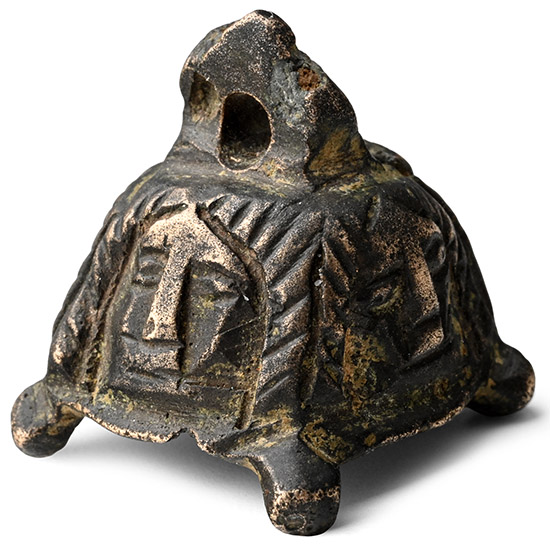
Egyptian Bronze Bell with Faces
Late-Ptolemaic Period, 664-30 B.C.Estimate: £100 - 140 (+bp*)
Opening Bid: £50
Hollow-formed miniature bell with integral loop handle, four radiating female faces to the sidewall - possibly depicting the goddess Hathor. 14 grams, 20 mm
London gentleman's collection, 1970-1990s, by descent.
The bell may have been part of a musical instrument. Many musical rituals centred on Hathor, often accompanied by musicians playing sistrums. -
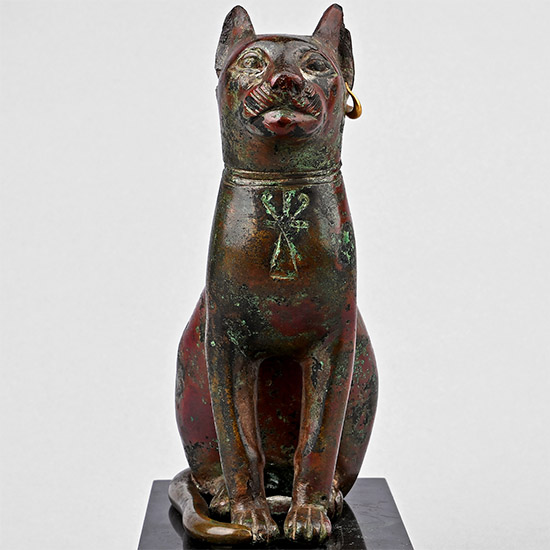
'The Clayton' Large Egyptian Bronze Seated Cat Statue of the Goddess Bastet
Late Period, 26th Dynasty, circa 664-525 B.C.Estimate: £20,000 - 30,000 (+bp*)
Opening Bid: £10,000
Naturalistically modelled in the round, hollow-formed in a seated pose with an incuse collar and Hathor-symbol pendant on its chest, both ears pierced to accept gold earrings (one absent); with a custom-made stand adapted to accommodate the sizeable tang on the statue's underside. 932 grams, 16 cm (1.99 kg total, 19.5 cm high including stand)
Acquired by Norman Davis from Spinks in 1956. Received as a gift from an American friend, Norman Davis of Seattle, circa 1972. From the private collection of Peter Clayton, FCILIP, Dip, Arch, FSA, FRNS, Hemel Hempstead, Hertfordshire, UK; formed since the late 1950s. This lot has been checked against the Interpol Database of stolen works of art and is accompanied by search certificate no.13471-262917.
In ancient times, the cat was revered as the sacred animal of the goddess Bastet, whose principal cult centre was at Bubastis in the Nile Delta. Her cult expanded throughout Egypt during the Late Period, when many votive bronze statuettes were produced. To the Egyptians, the cat symbolised protection, motherhood, and, later, gentleness and domesticity, qualities associated with Bastet, especially as she evolved from a fierce lioness into a more benevolent feline goddess. The symbol on the chest of the present statuette is associated with another protective goddess, Hathor. Standing figurines of Bastet are sometimes shown holding a Hathoric sistrum, a ritual musical instrument linked to joy, music, and divine protection, particularly for mothers and children. The symbol on this bronze statuette would have served the same purpose.
