
Loading, please wait...
LOT 0674
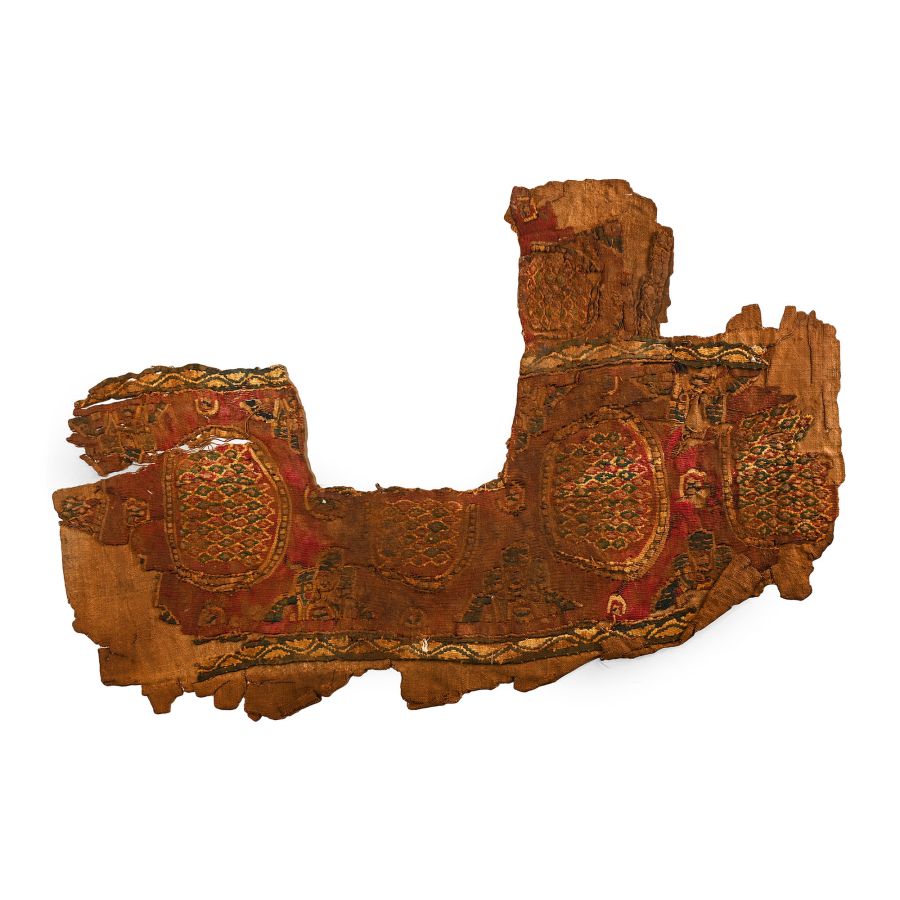
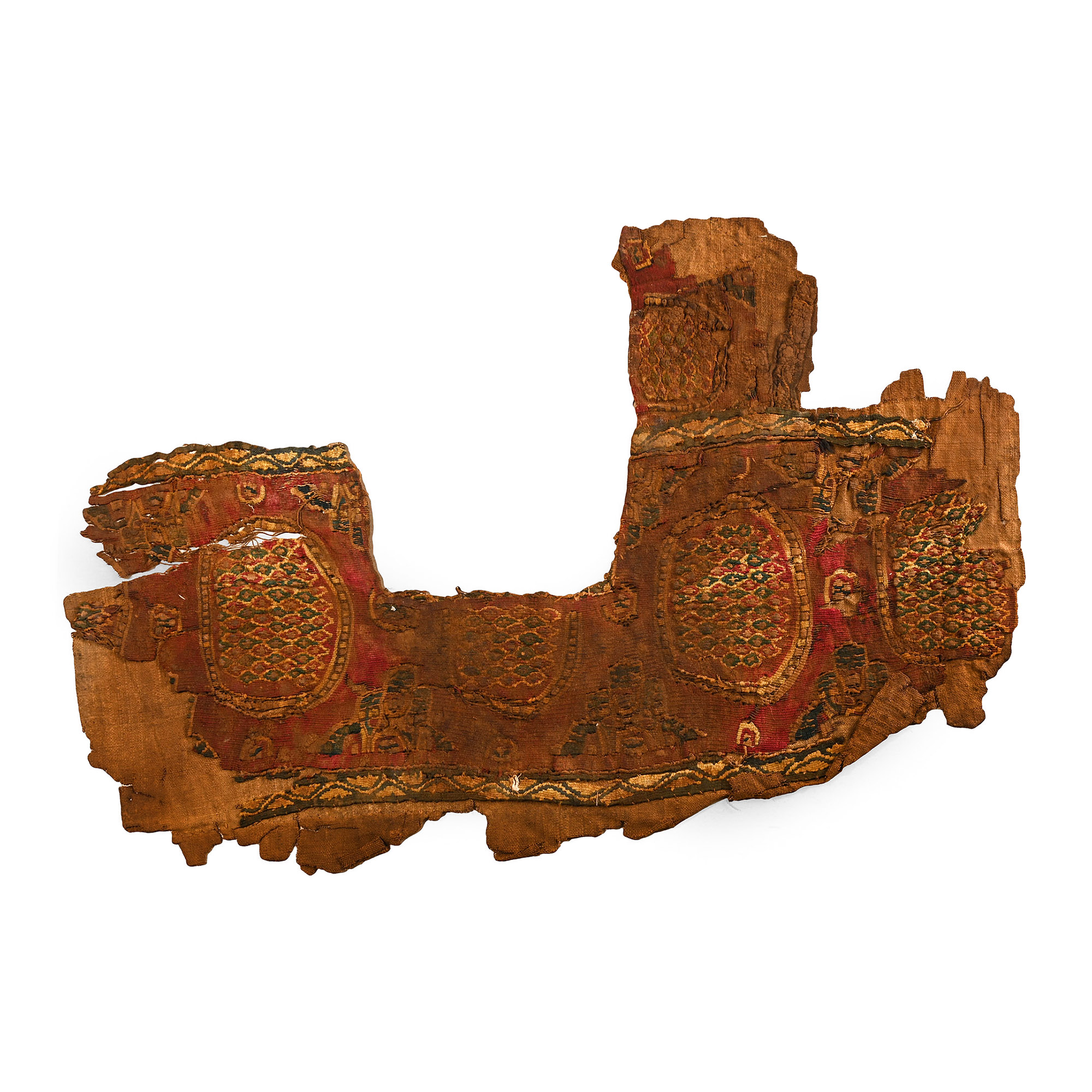
Large Egyptian Coptic Textile Fragment of a Tunic Collar Embroidered with Geometric Patterns
CIRCA 5TH CENTURY A.D.
19 1/4 in. (142 grams total including paper folder, 49 cm).
The complete collar section (maniakion) ornamented with decorative circular bands, filled with geometric patterns of floral elements, bordered with stripes of interlaced vegetal motifs in yellow-orange, green, red, yellow and purple wool warp on linen; a part of the right clavus still preserved, decorated in the same manner. [No Reserve]
ProvenanceAcquired 1970s-1996.
Property of a North American collector.
London collection, 2016.
Cf. De Moor, A., 'Radiocarbon dating of ancient textiles. State of research' in De Moor, A., Fluck, C., Methods of dating ancient textiles of the 1st Millennium AD from Egypt and neighbouring countries, Tielt, 2007, pp.99-111, p.107, for a similar textile (Louvre Inv.No.AF5983).
FootnotesIn Late Roman Egypt, this type of tunic, with wide decorative collars around the neck, was worn by rich aristocratic women and was part of the decoration of rich garments like the tunica talaris.
CONDITIONTimeLine Auctions follows a vetting process to ensure the authenticity and legality of all items, reinforcing our commitment to integrity and responsible trading. Each antiquity, antique, and coin lot undergoes thorough examination by a vetting committee of at least ten external specialists, professional trade association members, scientists, and archaeologists: Our Vetting Process
AUCTIONS:
TimeLine is a leading auction house specialising in antiquities, ancient art, collectables, natural history, coins, medals, and books. Our auctions offer museums, collectors, historians, and enthusiasts the opportunity to acquire unique and historically significant pieces.
LOT 0674
Large Egyptian Coptic Textile Fragment of a Tunic Collar Embroidered with Geometric Patterns
Estimate £80 - 100€93 - 116 (for guidance only)$108 - 135 (for guidance only)
-
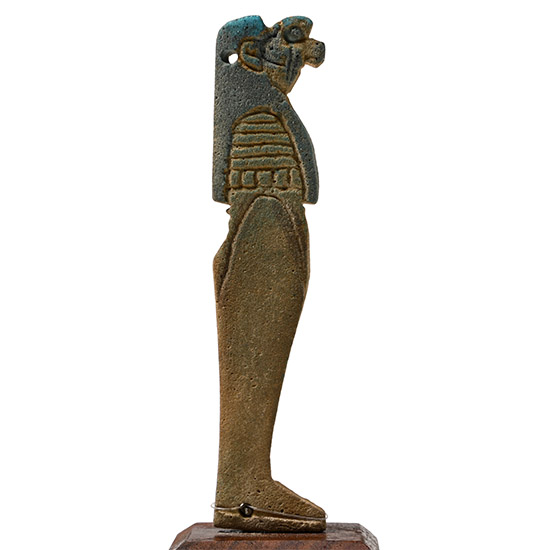
Egyptian Blue Glazed Faiance Qebehsenuef Appliqué
Late Period, 664-332 B.C.Estimate: £500 - 700 (‡+bp*)
Opening Bid: £275
Flat appliqué of the mummiform, falcon-headed Qebehsenuef, one of the Four Sons of Horus in profile, with a human ear, wearing a tripartite wig and multi-row collar around the shoulders, and hanging straps on lower body; face, decorative collar and belt indicated by fine incisions; mounted on a stand. 6.91 grams total, 80 mm high including stand
Ex Roger Liechti (1934-2010), Petit-Lancy, Switzerland (inv. no.E.494, written on the underside of the wooden mount); acquired in 1973 from the art dealer Mr. Wagner Terrassière, Geneva. Thence by descent in the family, Switzerland.
The applique belonged to a set of four depicting the Four Sons of Horus with their differently shaped heads (human, baboon, jackal and falcon). These four gods, Imsety, Hapy, Duamutef, and Qebehsenuef, were already mentioned in the Pyramid Texts of the Old Kingdom and were believed to accompany and protect the deceased from the time he or she was embalmed and buried up to the judgment of the dead. Their main function was to guard the viscera during and after mummification. The group of four objects was part of a mummy's elaborate jewellery, which also included a mummy net, a winged scarab and a broad shoulder collar. Two small holes through the back of the head and feet, which were used to sew the figure onto a textile base. Traces of yellow and blue paint. Intact. -
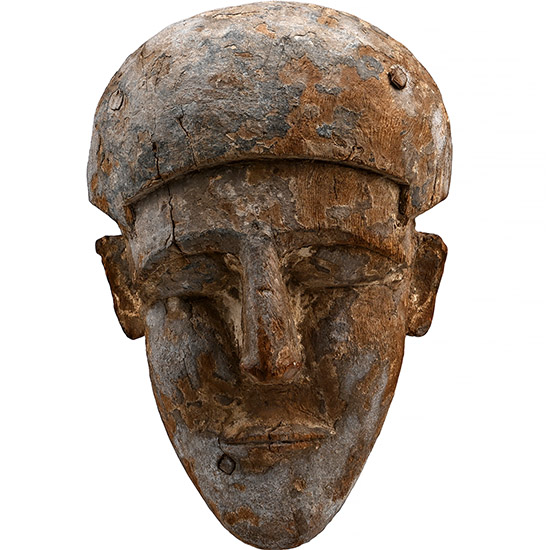
Egyptian Carved Cedar Wood Sarcophagus Mask
Ptolemaic-Roman Period, 332 B.C.-100 A.D.Estimate: £1,000 - 1,400 (+bp*)
Opening Bid: £500
From the lid of an anthropoid coffin, representing the idealised features of the deceased beneath a broad, rounded wig, the elongated face modelled with large almond-shaped eyes beneath extended brows, a prominent nose, delineated lips and projecting ears, the chin tapering to a rounded point; a curved incision separates the headdress from the forehead, the broadly flattened reverse preserving sockets and wooden plugs from the original pegged attachment to the coffin lid; preparatory gesso and traces of polychrome decoration remaining across the face and headdress; mounted on a modern metal display stand. 1.43 kg total, 32.5 cm including stand
Private collection, Yorkshire, UK, acquired in the mid-20th century.
Wooden coffins were mostly manufactured from multiple elements, often with the face and front portion of the headdress carved separately and attached to the lid using dowels. -
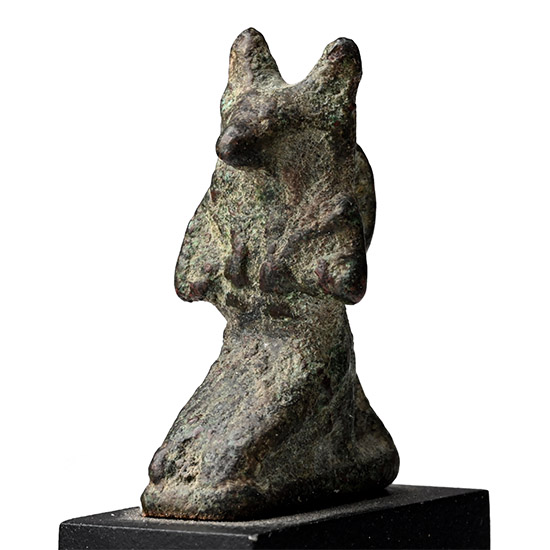
Egyptian Bronze Jackal Amulet
Late Period-Ptolemaic Period, 664-30 B.C.Estimate: £80 - 100 (+bp*)
Bids: 3 | Current Bid: £22
Kneeling jackal-headed figure wearing a pleated shendyt - kilt and holding regalia in its hands; on an integral, tongue-shaped base with a suspension loop at the back. 13.6 grams total, 34 mm including stand
From the private collection of Peter Clayton, FCILIP, Dip, Arch, FSA, FRNS, Hemel Hempstead, Hertfordshire, UK; formed since the late 1950s.
An interesting amulet. The jackal-headed figure is likely Anubis, the prominent funerary deity, though it could also be Wepwawet or Duamutef, one of the Four Sons of Horus.
