
Loading, please wait...

LOT 0473
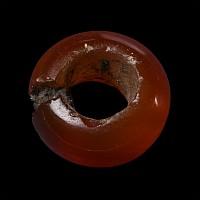
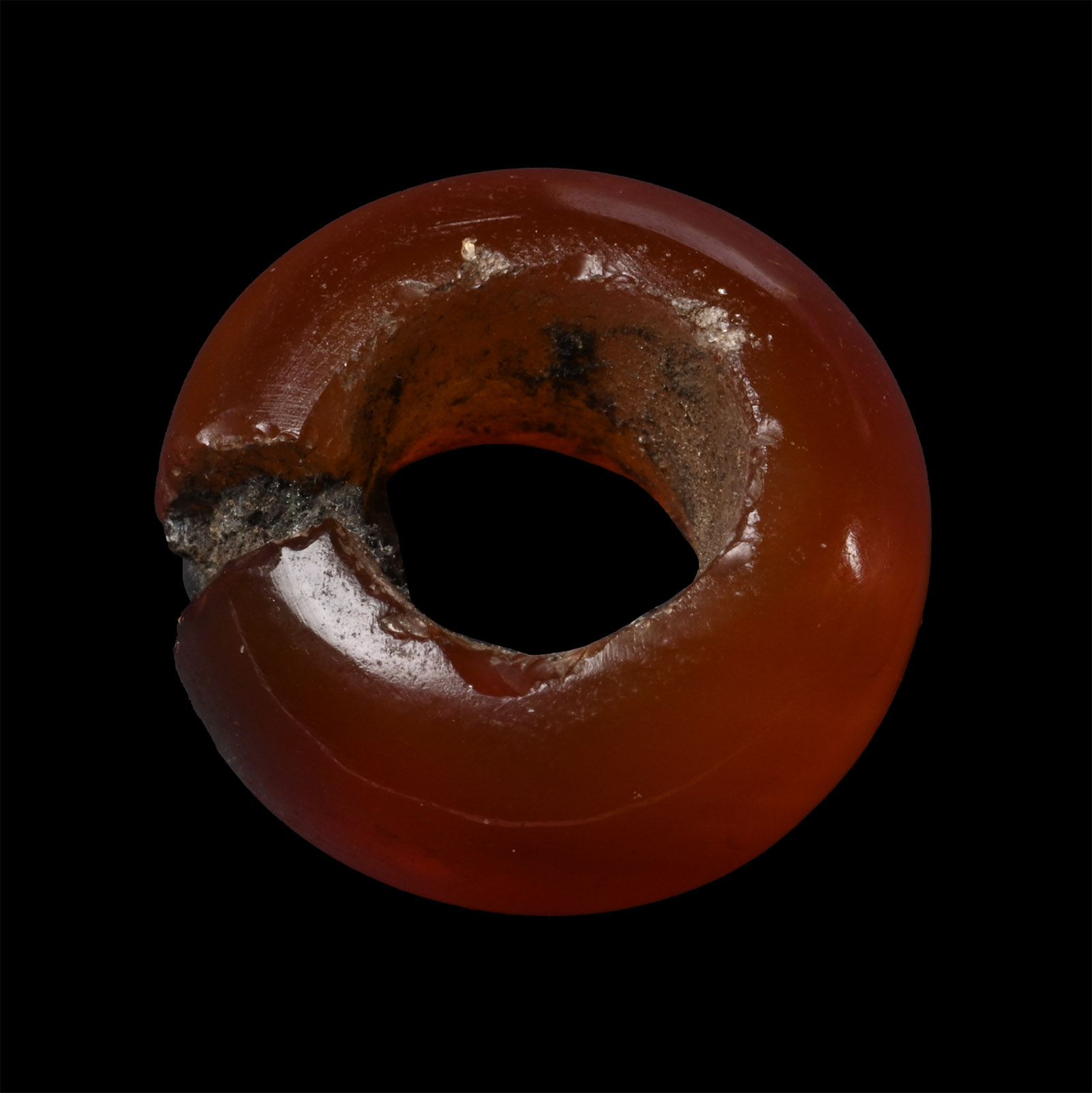
Large Egyptian Carnelian Hair Ring
NEW KINGDOM, CIRCA 1550-1070 B.C.
5/8 in. (3.2 grams, 17 mm).
Circular with a semi-circular profile and an opening on one side.
ProvenanceFrom an early 20th century collection.
LiteratureCf. Andrews, C., Ancient Egyptian Jewellery, London, 1990, p.116, no.96k, for the style.
CONDITIONTimeLine Auctions follows a vetting process to ensure the authenticity and legality of all items, reinforcing our commitment to integrity and responsible trading. Each antiquity, antique, and coin lot undergoes thorough examination by a vetting committee of at least ten external specialists, professional trade association members, scientists, and archaeologists: Our Vetting Process
AUCTIONS:
TimeLine is a leading auction house specialising in antiquities, ancient art, collectables, natural history, coins, medals, and books. Our auctions offer museums, collectors, historians, and enthusiasts the opportunity to acquire unique and historically significant pieces.
-
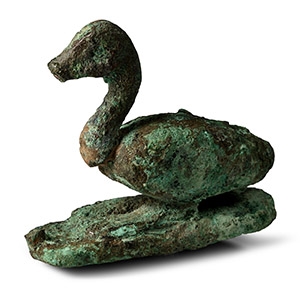
Egyptian Bronze Ibis Attachment
Late Period, 664-332 B.C. or laterEstimate: £200 - 300 (+bp*)
Opening Bid: £100
Modelled in the round squatting on an ellipsoid base, lug to the underside, repaired. 114 grams, 60 mm
From the collection of a gentleman, acquired on the London art market in the 1990s.
The ibis, particularly the sacred species known as the Egyptian ibis (Threskiornis aethiopicus), held a prominent place in ancient Egyptian religion and culture as a manifestation of the god Thoth. Revered as the deity of wisdom, writing, and knowledge, Thoth was often depicted in human form with the head of an ibis. During the Late Period onwards, the practice of mummifying ibises became widespread, leading to the creation of vast necropolises dedicated to these sacred birds. In places like Saqqara and Hermopolis, thousands of ibis mummies have been discovered in specially constructed catacombs. The mummification of these birds was not merely a ritual act; it was seen as a sacred offering to Thoth, meant to honour the god and seek his favour. Egyptians believed that by preserving the ibis through mummification, they could ensure its safe passage to the afterlife, establishing a direct connection between the earthly realm and the divine. These mummies were often accompanied by votive offerings, like this bronze figurine, further emphasising the relationship between the ibises and Thoth. -

Egyptian Bone Ram-Headed Boat with Two Deities
Late Period, 664-332 B.C.Sold for (Inc. bp): £624
Carved in the round reed boat with ram-headed prow, altar amidships surmounted by a horned sun disc and flanked by two baboons standing in adoration; repaired. 10.4 grams, 55 mm
From the collection of a gentleman, acquired on the London art market in the 1990s.
This represents a condensed version of a two-dimensional funerary scene of the sun god Re, here represented by the horned disc, in his solar barque, flanked by baboons in an attitude of praise. The boat's ram-headed prow possibly alludes to Re's transformation into a ram during his night-time journey through the Underworld. -
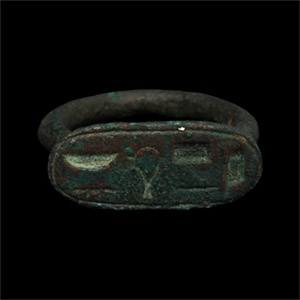
Egyptian Bronze Ring with Hieroglyphic Motto
Late Period, 664-332 B.C.Sold for (Inc. bp): £468
With slim loop and cartouche-shaped bezel inscribed with hieroglyphs ı͗mn-sꜢ-nb.s, 'Amun lord (of) her protection'. 4.30 grams, 21.48 mm overall, 14.60 mm internal diameter (approximate size British G, USA 3 1/4, Europe 4.92, Japan 4)
From an early 20th century collection.
