
Loading, please wait...

LOT 0044
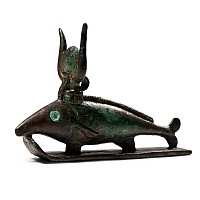
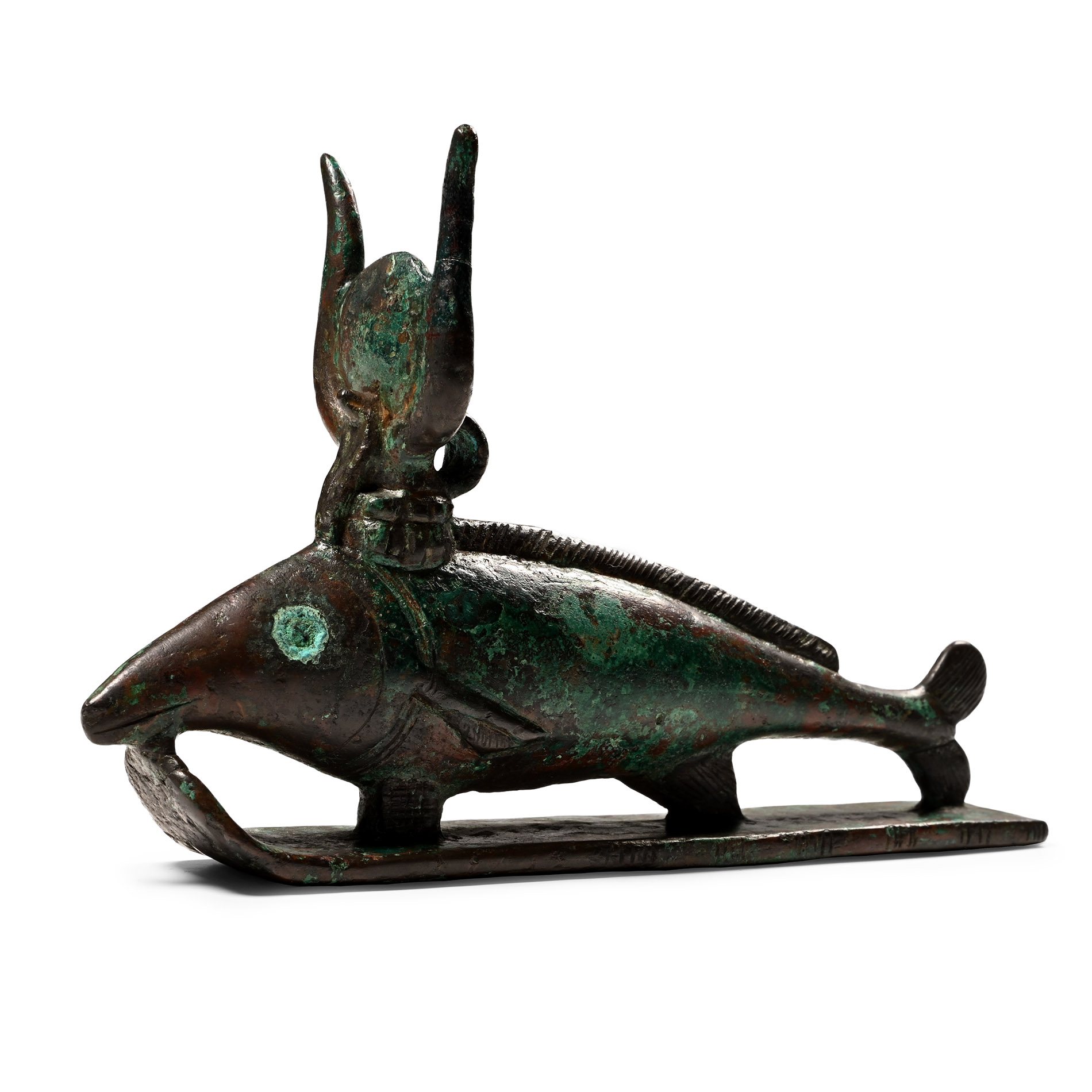
Large Egyptian Bronze Oxyrhynchus Fish of Per-Medjed
LATE PERIOD-PTOLEMAIC PERIOD, 664-30 B.C.
6 3/4 in. (585 grams, 17 cm).
Modelled in the round on a sledge attached by ventral and pectoral fins, forked tail, dorsal ridge, tapering nose; recessed circular eyes with enamel fill; horned sun disc headdress fronted by a uraeus and a suspension loop behind.
ProvenanceAcquired from Gallery Reiner, Paris, 1981.
Private collection, Europe.
Accompanied by a copy of French passport no.150583 dated 29 November 2013.
This lot has been checked against the Interpol Database of stolen works of art and is accompanied by a search certificate number no.12375-226676.
Cf. Kozloff, A.P., Animals in Ancient Art from the Leo Mildenberg Collection, Mainz am Rhein, 1981, fig. 60, for a similar example; Tiribilli, E., The bronze figurines of the Petrie Museum from 2000 BC to AD 400, London, 2018, p.229, for discussion.
FootnotesThe Medjed, a type of elephant-snout fish (Mormyrus kannume), was revered in ancient Egyptian religion, particularly in Per-Medjed, better known by its Greek name, Oxyrhynchus Polis. This version of the name, meaning "city of the sharp-nosed," reflects the fish's distinctive appearance as depicted in Egyptian art. These fish were believed to have consumed the penis of Osiris, the god who was dismembered and scattered by his brother Seth. As sacred creatures, figurines of the Medjed were often adorned with a horned sun-disc headdress worn by the goddesses Hathor and Isis, suggesting a close association with both. Some figurines, like this example, featured suspension loops, allowing them to be worn as pendant amulets.
CONDITIONTimeLine Auctions follows a vetting process to ensure the authenticity and legality of all items, reinforcing our commitment to integrity and responsible trading. Each antiquity, antique, and coin lot undergoes thorough examination by a vetting committee of at least ten external specialists, professional trade association members, scientists, and archaeologists: Our Vetting Process
AUCTIONS:
TimeLine is a leading auction house specialising in antiquities, ancient art, collectables, natural history, coins, medals, and books. Our auctions offer museums, collectors, historians, and enthusiasts the opportunity to acquire unique and historically significant pieces.
LOT 0044
Large Egyptian Bronze Oxyrhynchus Fish of Per-Medjed
Estimate £6,000 - 8,000€6,960 - 9,280 (for guidance only)$8,100 - 10,800 (for guidance only)
-
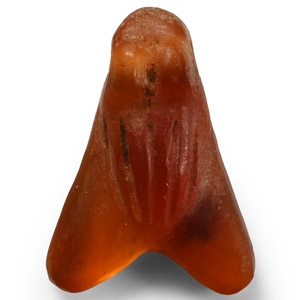
Egyptian Carnelian Fly Amulet
Late Period, 664-332 B.C.Sold for (Inc. bp): £117
Formed as a fly with long triangular wings and domed eyes. 0.42 grams, 12 mm
From an early 20th century collection.
Fly amulets first appeared in burials as early as c. 3200 B.C., but their popularity expanded during the New Kingdom. They were made from various materials such as gold, silver, lapis lazuli, carnelian, amethyst, faience, and bone. Fly amulets were thought to protect against insect bites and to ward off troublesome flying creatures through apotropaic magic. They may also have even been intended to symbolise the fly’s fecundity. Pharaohs would bestow gold fly-shaped pendants as military awards to honour the bravery and fly-like persistence of soldiers in battle. -
.jpg)
Egyptian Quartzite Fragment with Hieroglyphs
New Kingdom, 1550-1069 B.C.Sold for (Inc. bp): £585
Dressed stela or shrine fragment inscribed with three vertical columns of enigmatic hieroglyphs; mounted on a plaque. 320 grams total, 13 cm wide including stand
From an American deceased estate, acquired between 1970-1989. with Bonhams, London, 28 October 2009, no.23. Private collection, Europe.
The second-to-last complete sign in the central register is a semi-hieratic version of the balancing post hieroglyph, suggesting an 18th Dynasty or later New Kingdom date. -
.jpg)
Egyptian Bronze Head of a Pharaoh with Inlaid Eyes
Third Intermediate Period, 21st-22nd Dynasty, circa 1069-900 B.C.Sold for (Inc. bp): £49,400
Hollow-formed mask with integral tripartite wig and mount for a uraeus; impassive facial detailing and applied gold cosmetic lines to eyes, eyebrows, and lateral chin straps of the braided 'false beard'; segment of the wesekh-collar visible between the lappets of the wig; some restoration; mounted on a custom-made stand within a padded wooden display case. 1.2 kg, 22.5 cm high including stand (3.27 kg total, 27 cm including case)
Old French family collection of Monsieur and Madame D., 1960s. Ex Rennes Enchères, Hôtel des Ventes, France, 11 March 2003, no.117 (front-cover) for 150,000.00 euros. Acquired from Mansour Gallery, London W1, UK, in 2013. From the collection of a Kensington gentleman. Private collection, UK. Accompanied by the original Rennes Enchères catalogue. Accompanied by a copy of French passport no.058205 dated 15 April 2003. Accompanied by a copy of Mansour Gallery’s invoice, 2013. Accompanied by previous typed and illustrated collection cataloguing pages. Accompanied by an academic report by Egyptologist Paul Whelan. This lot has been checked against the Interpol Database of stolen works of art and is accompanied by a search certificate number no.12372-225585.
