
Loading, please wait...
_900x900.jpg "Large Egyptian Bronze Osiris with Silver-Inlaid Eyes")
_200x200.jpg "Large Egyptian Bronze Osiris with Silver-Inlaid Eyes")
.jpg "Large Egyptian Bronze Osiris with Silver-Inlaid Eyes")
LOT 0026
Large Egyptian Bronze Osiris with Silver-Inlaid Eyes
LATE PERIOD, 26TH-30TH DYNASTY, 664-332 B.C.
12 1/4 in. (1.15 kg total, 31 cm high including stand).
Modelled mummiform with arms crossed at the chest, holding crook and flail with highlighted features, wearing a plaited false beard and Atef crown mounted on two curved ram's horns, flanked by detailed ostrich feathers and frontal uraeus; natural facial detailing with silver inlaid eyes and large protruding ears; accompanied by a custom-made display stand.
ProvenanceNorman Blankman collection, New York, 1960s.
P.G. collection, New York, USA.
with Art for Eternity, New York.
with Bonhams, London, 6 July 2023, lot 360.
This lot has been checked against the Interpol Database of stolen works of art and is accompanied by search certificate no.11945-210564.
Cf. The Metropolitan Museum, accession number 56.16.2, for a comparable 26th Dynasty example; Museo Stibbert, Florence, statuette inv. no. 11169; Del Francia, P. R., 'Le antichità egizie' in AA. VV., 'Frederick Stibbert, gentiluomo, collezionista e sognatore, Rivista del Museo Stibbert 3, Firenze, 2000, p.90, n.3, pl.20; see Robins, G., Egyptian Shabtis, Shire Egyptology 26, Princes Risborough, 2001, pp.19.
FootnotesOsiris was the foremost of ancient Egyptian funerary deities and lord of the underworld. Many statuettes of the god were offered in temples dedicated in his name, and have also been discovered in other contexts including animal necropoleis and temples dedicated to other gods.
CONDITIONTimeLine Auctions follows a vetting process to ensure the authenticity and legality of all items, reinforcing our commitment to integrity and responsible trading. Each antiquity, antique, and coin lot undergoes thorough examination by a vetting committee of at least ten external specialists, professional trade association members, scientists, and archaeologists: Our Vetting Process
AUCTIONS:
TimeLine is a leading auction house specialising in antiquities, ancient art, collectables, natural history, coins, medals, and books. Our auctions offer museums, collectors, historians, and enthusiasts the opportunity to acquire unique and historically significant pieces.
-
.jpg)
Large Egyptian Bronze Osiris with Silver-Inlaid Eyes
Late Period, 26th-30th Dynasty, 664-332 B.C.Sold for (Inc. bp): £6,500
Modelled mummiform with arms crossed at the chest, holding crook and flail with highlighted features, wearing a plaited false beard and Atef crown mounted on two curved ram's horns, flanked by detailed ostrich feathers and frontal uraeus; natural facial detailing with silver inlaid eyes and large protruding ears; accompanied by a custom-made display stand. 1.15 kg total, 31 cm high including stand
Norman Blankman collection, New York, 1960s. P.G. collection, New York, USA. with Art for Eternity, New York. with Bonhams, London, 6 July 2023, lot 360. This lot has been checked against the Interpol Database of stolen works of art and is accompanied by search certificate no.11945-210564.
Osiris was the foremost of ancient Egyptian funerary deities and lord of the underworld. Many statuettes of the god were offered in temples dedicated in his name, and have also been discovered in other contexts including animal necropoleis and temples dedicated to other gods. -
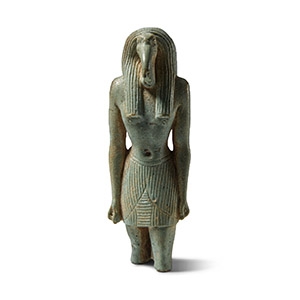
Egyptian Faience Figure of Thoth
26th Dynasty, 664-525 B.C.Estimate: £3,000 - 4,000 (‡+bp*)
Opening Bid: £1,500
In ibis-headed form, plain dorsal pillar, pleated kilt, tripartite wig; old collector's inked accession number 'E.1000' to the reverse; repaired. 44.7 grams, 88 mm high
Ex Roger Liechti collection, Geneva, Switzerland. This lot has been checked against the Interpol Database of stolen works of art and is accompanied by search certificate no.11595-199013.
One of the most prominent of the ancient Egyptian gods, Thoth was associated with writing, magic and wisdom, and was credited with founding a number of branches of knowledge including law, religion and science. He is believed to have been self-created or grown from the seed of Horus from the forehead of Set. As the son of the gods of order and chaos, he was also the god of equilibrium. As such, he was considered a just and infallible judge. Worshipped from the Pre-Dynastic to the Ptolemaic periods, Thoth was one of the longest, continuously worshipped gods from any civilisation. Thoth's Egyptian name was Djehuty (also dhwty) meaning ‘He Who is Like the Ibis’, a sacred bird in ancient Egypt as well as a popular pet associated with wisdom. -
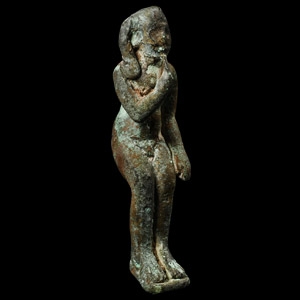
Egyptian Bronze Seated Harpocrates Figure
Late Period, 664-332 B.C.Sold for (Inc. bp): £182
With feet resting on a rectangular base, forefinger on the lips, prominent sidelock of youth. 30.7 grams, 68 mm
Ex Brigantia, York, UK, item no.12040. Private collection of Mr T.H., Norfolk, UK. Accompanied by a previous dealer's certificate of authenticity.
Harpocrates is the Greek rendering of the Egyptian Hor-pa-khered, which translates as 'Horus the Child'. This refers to Horus as the divine infant of Isis and Osiris. Wearing the amulet of Harpocrates could provide the wearer with the same protection that Isis gave to her beloved son.
