
Loading, please wait...
_900x900.jpg "Large Egyptian Blue Faience Taweret Vessel")
_200x200.jpg "Large Egyptian Blue Faience Taweret Vessel")
_900x900.jpg "Large Egyptian Blue Faience Taweret Vessel")
_200x200.jpg "Large Egyptian Blue Faience Taweret Vessel")
_900x900.jpg "Large Egyptian Blue Faience Taweret Vessel")
_200x200.jpg "Large Egyptian Blue Faience Taweret Vessel")
_900x900.jpg "Large Egyptian Blue Faience Taweret Vessel")
_200x200.jpg "Large Egyptian Blue Faience Taweret Vessel")
.jpg "Large Egyptian Blue Faience Taweret Vessel")
.jpg "Large Egyptian Blue Faience Taweret Vessel")
.jpg "Large Egyptian Blue Faience Taweret Vessel")
.jpg "Large Egyptian Blue Faience Taweret Vessel")
LOT 0055
Large Egyptian Blue Faience Taweret Vessel
LATE PERIOD, 26TH DYNASTY, 664-525 B.C.
6 3/4 in. (160 grams total, 17.3 cm including stand).
Composite animal figure with a hippopotamus's head and body, a crocodile's tail, and a human torso with arms, topped with a finely striated tripartite wig; the right hand, positioned beneath the left nipple, encloses a drilled hole connecting to the hollow body; a hole at the top of the head; mounted on a custom-made stand.
ProvenanceEx private French collection, since the early 1990s.
Acquired from Galerie Reiner, rue Bonaparte, Paris.
Artcurial, Paris, 6 November 2013, no.55.
Accompanied by an academic report by Egyptologist Paul Whelan.
Accompanied by a copy of French passport no.150578.
This lot has been checked against the Interpol Database of stolen works of art and is accompanied by search certificate number no.13189-249212.
Cf. Guichard, H. (dir.), Des animaux et des pharaons, le règne animal dans l'Égypte ancienne, Paris, 2014, p. 194, ill. p.
194, no. 165, for a similar vessel in the Louvre (inv. no. E 14232).
The vessel’s shape indicates it was likely used in magical and libationary rituals meant to invoke Taweret’s protective powers during childbirth and maternity. Usually depicted as a female hippopotamus with lion-like arms and legs and a crocodile’s back and tail, Taweret remains one of the most distinctive and recognisable deities in the Egyptian pantheon. Her name comes from the Egyptian word for "great" or "large" (tꜣwꜣrt), emphasising her powerful and protective nature.
CONDITIONTimeLine Auctions follows a vetting process to ensure the authenticity and legality of all items, reinforcing our commitment to integrity and responsible trading. Each antiquity, antique, and coin lot undergoes thorough examination by a vetting committee of at least ten external specialists, professional trade association members, scientists, and archaeologists: Our Vetting Process
AUCTIONS:
TimeLine is a leading auction house specialising in antiquities, ancient art, collectables, natural history, coins, medals, and books. Our auctions offer museums, collectors, historians, and enthusiasts the opportunity to acquire unique and historically significant pieces.
LOT 0055
Large Egyptian Blue Faience Taweret Vessel
Estimate £8,000 - 10,000€9,280 - 11,600 (for guidance only)$10,800 - 13,500 (for guidance only)
-
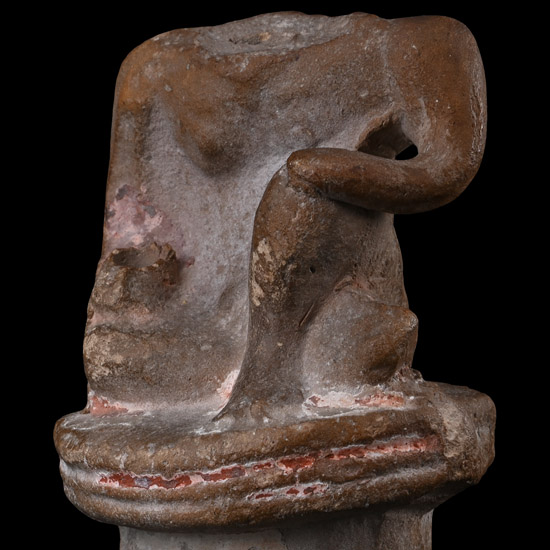
Romano-Egyptian Terracotta Seated Figure
Ptolemaic Period, 332-30 B.C. or laterSold for (Inc. bp): £85
Hollow-formed lid of a jar with anthropomorphic figure crouching with left hand on the knee; right hand hollow to form a socket; head absent. 173 grams, 90 mm
Phillips International Auctioneers & Valuers, Tribal & Antiquities Sale, 25th June 1998, no.15 (part). Property of a West Northamptonshire, UK, gentleman. -
.jpg)
Egyptian Brown Quartzite Figure of the Baboon God Thoth
New Kingdom, circa 1550-1070 B.C.Estimate: £4,000 - 6,000 (‡+bp*)
Opening Bid: £2,222
Carved in a typical pose, sitting on its haunches with its tail curving around the right side, its front paws resting on its knees and protruding beneath its thick furry pelt, with incised detailing, its feet either side of the phallus, the head with bulbous, striated hair on either side, chipped, snout restored; seated on a high shrine-shaped plinth with squared front and rounded back, featuring a cavetto cornice and roll detailing on the upper part. 1.15 kg, 15 cm
From a deceased American estate, 1970-1989. with Bonhams, London, 28 October 2009, no.35. Accompanied by copies of the relevant Bonhams catalogue pages. This lot has been checked against the Interpol Database of stolen works of art and is accompanied by a search certificate number no.12368-226706.
The baboon was an animal manifestation of the god Thoth, the patron deity of Hermopolis Magna, who was revered for his association with knowledge, writing, and healing. -
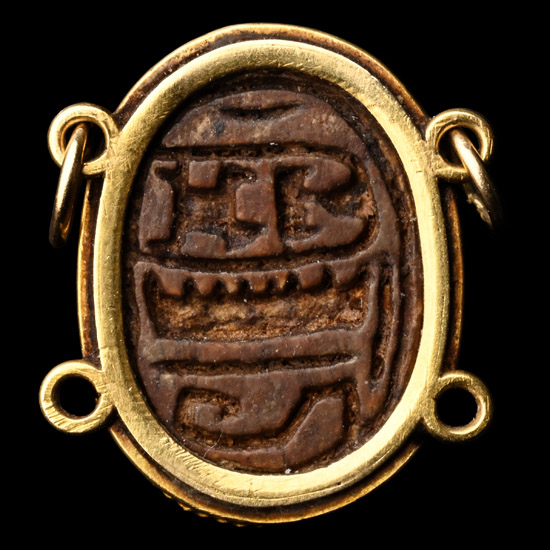
Egyptian Steatite Scarab in Antique Pendant Mount
Late Period, 664-332 B.C. and laterSold for (Inc. bp): £195
The scarab with anatomical detailing on the body, underside with a cartouche for Tuthmoses III and other hieroglyphs; set in a gold filigree mount with four lateral loops. 3.68 grams, 18.3 mm
From the private collection of a European gentleman (1942-2024), formed since the 1970s.
