
Loading, please wait...
_900x900.jpg "Large Egyptian Blue Faience Roundel for Ramesses II")
_200x200.jpg "Large Egyptian Blue Faience Roundel for Ramesses II")
.jpg "Large Egyptian Blue Faience Roundel for Ramesses II")
LOT 0042
Large Egyptian Blue Faience Roundel for Ramesses II
NEW KINGDOM, 19TH DYNASTY, 1295-1186 B.C.
5 1/2 in. (475 grams total, 14 cm including stand).
A fitting or pommel made for King Ramesses II, his throne name (User-Maat-Re Setep-en-Re) inscribed within a cartouche topped by two ostrich feathers framing a solar disc; the cartouche positioned above the hieroglyphic sign nbw, which signifying 'gold' and alluded to the luminous radiance of the royal name; two uraei flanking the cartouche, wearing the White Crown of Upper Egypt and the Red Crown of Lower Egypt, respectively; the throne name roughly translating as 'The justice of Re is powerful, chosen of Re'; a square-shaped socket located at the back for attachment; mounted on a custom-made display stand.
ProvenanceFormerly with G. Janes, Manchester, UK and collection Galerie Nefer.
Previously with Cybele Galerie Librairie Egyptologie, Paris, France.
From an important English collection.
Accompanied by an academic report by Dr Alberto Maria Pollastrini.
Accompanied by a copy of the Cybele invoice.
This lot has been checked against the Interpol Database of stolen works of art and is accompanied by search certificate number no.10740-177442.
'Nefertari regina d'Egitto' An exhibition of 130 objects from the British Museum, the Louvre, the Egyptian Museum of Turin, the Turin Archaeological Museum, and the Royal Library of Turin. In collaboration with the Getty Conservation Institute, 6 October 1994 - 5 June 1995.
LiteratureCf. Alfano, C. (ed.), Nefertari regina d'Egitto. Le Ciminiere, Catania, 27 mar.-30 giu., Catania, 1999, p. 16, for a comparable green faience fitting of Ramesses II (Zurich 3702); Donadoni Roveri, A.M. (ed.), Egyptian Civilization: Religious Beliefs, Turin, 1988, p.150, fig.201, for a similar fitting, inscribed King Ay, found in Queen Nefertari's tomb.
FootnotesThe epithet part of the throne name Setep en Re appears in Ramesses II's royal titulary from Year 2 of his reign. The two rearing cobras, which symbolise the goddesses Nekhbet and Wadjet, also represent the unity of the Two Lands under Ramesses II's rule. A similar green faience fitting bearing Ramesses II's throne name is kept in the Archaeological Collection of Zürich (inv. no. 3702). Similar objects linked to the 18th Dynasty kings Akhenaten and Ay show that such fittings were not limited to the 19th Dynasty. They may even have influenced later designs, as the fitting of King Ay, possibly from a piece of heirloom furniture, was found among the tomb goods of Nefertari, Ramesses II’s “Chief Queen”.
CONDITIONTimeLine Auctions follows a vetting process to ensure the authenticity and legality of all items, reinforcing our commitment to integrity and responsible trading. Each antiquity, antique, and coin lot undergoes thorough examination by a vetting committee of at least ten external specialists, professional trade association members, scientists, and archaeologists: Our Vetting Process
AUCTIONS:
TimeLine is a leading auction house specialising in antiquities, ancient art, collectables, natural history, coins, medals, and books. Our auctions offer museums, collectors, historians, and enthusiasts the opportunity to acquire unique and historically significant pieces.
LOT 0042
Large Egyptian Blue Faience Roundel for Ramesses II
Estimate £10,000 - 14,000€11,600 - 16,240 (for guidance only)$13,500 - 18,900 (for guidance only)
-
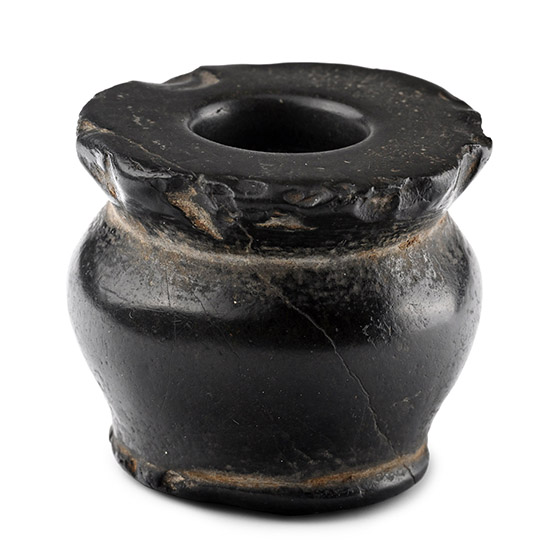
Egyptian Basalt Kohl Pot
16th-11th century B.C.Sold for (Inc. bp): £234
Carved into the shape of a poppy head with flange rim; old inked collector's number to base '1935.438'. 78 grams, 40 mm
From the estate of a deceased American, acquired between 1970-1989. with Bonhams, London, Knightsbridge, 28 October 2009, no.23 [part].
Cf. Aston, B.G., Ancient Egyptian Stone Vessels: Materials and Forms, SAGA 5, Heidelberg, 1994, pp. 87, 148 (Type 164), for similar examples. -
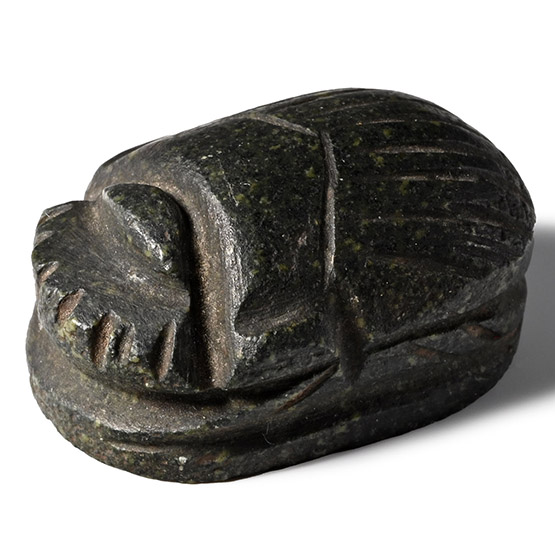
Egyptian Black Hardstone Scarab
Late Period, 664-332 B.C.Sold for (Inc. bp): £234
Dark green hardstone with paler speckles; with a boldly carved head, clypeus, prothorax and elytra, and legs indicated at the sides; plain underside. 17 grams, 29 mm
Ex Irene Newman, Birdham, Chichester, West Sussex, England. with Stride & Son Auctioneers, Chichester, West Sussex, England, 23 April 2015, no.1599 [Part]. Acquired by the present owner at the above sale.
The scarab, which represented the dung beetle, was the most popular amulet in ancient Egypt for approximately two thousand years until the Ptolemaic Period when it gradually fell out of favour. The popularity of scarabs extended beyond the borders of Egypt, and they were also distributed and produced in other regions, such as Phoenicia and Israel. The beetle is named khepri, derived from the verb 'to come into existence', and was considered the embodiment of the creator god Khepri, who was self-engendered. The ancient Egyptians mistakenly believed that the young beetle emerging from the dung ball was the result of an act of self-creation. -
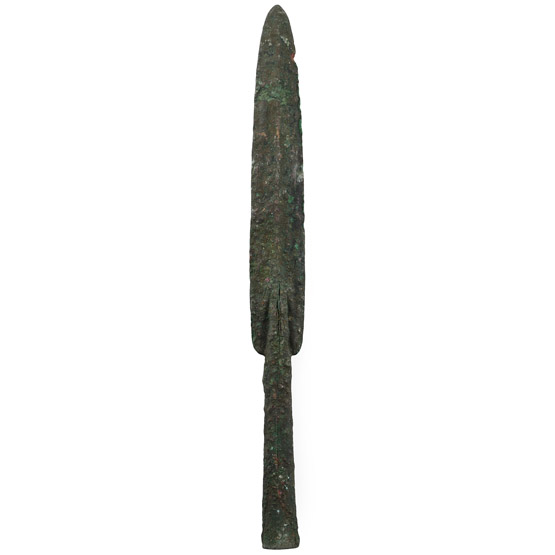
Egyptian Bronze Socketted Spearhead
New Kingdom, 15th-14th century B.C.Sold for (Inc. bp): £338
Foliate blade and tapering, short tubular shaft, marked mid-rib and rounded shoulders. 204 grams, 28 cm
Ex Abelita family collection, 1980s-2000s.
With the introduction of the socketted spearhead in the Middle East in the second half of the 3rd millennium BC, by the middle of the 2nd millennium, socketted spearheads became dominant throughout the ancient East and Egypt, and spearhead design has remained virtually unchanged since then.
