
Loading, please wait...
LOT 0362
Large Diptych of the Mother of God as Hodegetria
EARLY 16TH CENTURY A.D.
19 1/4 x 21 7/8 in. (3.6 kg, 49 x 55.5 cm (opened)).
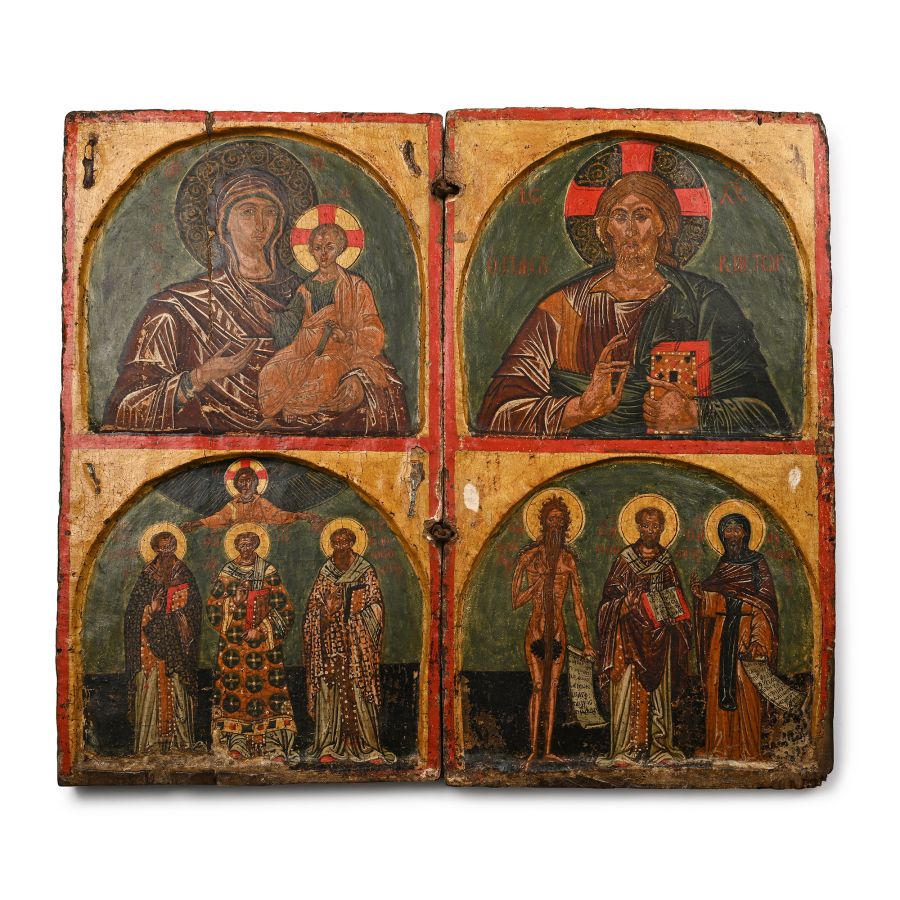
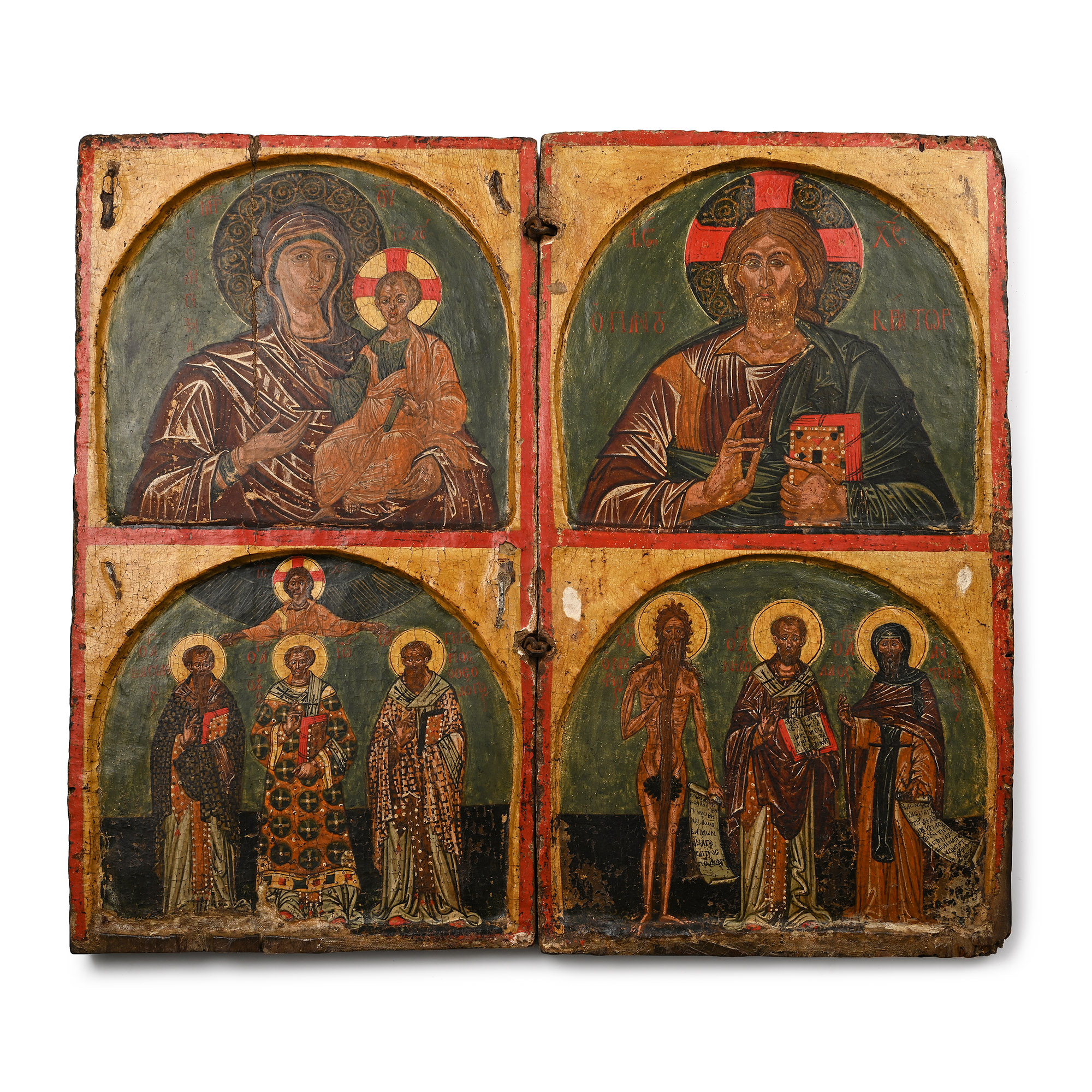
Tempera on two wooden panels executed on a green ground; the upper part of the left panel showing the nimbate Theotokos (Mother of God) with veiled head and mantle, pointing the infant Jesus supported by her left hand, wearing a red-gold maphorion mantle over a dark blue robe with gold cuffs; the infant facing away to left, dressed in blue tunic, wrapped in a red orange shawl, right hand extended towards his mother in a blessing gesture; beside Mary inscriptions in red Greek letters 'ΜΡ' and 'ΘΥ' (Μήτηρ (τοῦ) Θεοῦ = Mother of God), and beside the child the Greek letters 'ΙϹ ΧϹ' (ΙΗϹΟΥϹ ΧΡΙϹΤΟϹ = Jesus Christ); in the lower part of the panel, God emerging as a half-bust from the sky, blessing the three theologians, Saint Basil of Caesarea, Saint John Chrysostom and Saint Gregory the Theologian, all dressed in ecclesiastic high garments, their names written in Greek beside their heads; the upper part of the right panel showing Christ Pantokrator, Lord of the Universe, the right hand in blessing gesture, the left hand holding a Gospel decorated with precious stones, wearing a blue chlamys and red sticharion embroidered with a gold clavus; in the lower part Saints Onuphrius, Saint Nicholas of Myra and Antony the Great of the Desert, the first naked and covered only by a leaf, the second in bishopric garments and the third in monastic garments, their names written in Greek beside their heads; all the haloes are in gold, the ones of Christ marked by a red cross.
ProvenanceAcquired on the European art market.
Private collection, London, UK.
Accompanied by an academic report by Dr Raffaele D'Amato.
This lot has been checked against the Interpol Database of stolen works of art and is accompanied by a search certificate number no.12794-240887.
This lot has been cleared against the Art Loss Register database, and is accompanied by an illustrated lot declaration signed by the Head of the Antiquities Department, Dr Raffaele D'Amato.
Cf. as a prototype for the icons of the Hodegetria and the Pantokrator united in a diptych, see the icon of Korsunskaya Hodegetria, in Kremlin Museum, Byzantium, 13th century A.D.
FootnotesThe diptych is a synthesis of Orthodox belief: from one point of view, it shows the human nature of God, born from the Virgin; from the other the divine nature of Jesus Christ as the supreme Lord of the Universe. The icon skilfully depicts the subjects, with Mary pointing towards the infant Jesus, the faces rendered with dramatically emphasised features and dark tones.
CONDITIONTimeLine Auctions follows a vetting process to ensure the authenticity and legality of all items, reinforcing our commitment to integrity and responsible trading. Each antiquity, antique, and coin lot undergoes thorough examination by a vetting committee of at least ten external specialists, professional trade association members, scientists, and archaeologists: Our Vetting Process
AUCTIONS:
TimeLine is a leading auction house specialising in antiquities, ancient art, collectables, natural history, coins, medals, and books. Our auctions offer museums, collectors, historians, and enthusiasts the opportunity to acquire unique and historically significant pieces.
LOT 0362
Large Diptych of the Mother of God as Hodegetria
Estimate £8,000 - 10,000€9,280 - 11,600 (for guidance only)$10,800 - 13,500 (for guidance only)
-
Silver Button and Brooch Set
20th century A.D.Sold for (Inc. bp): £39
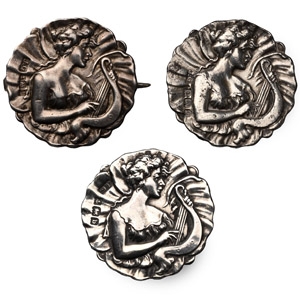
Each a disc with low-relief image of a female playing a harp on a field f radiating billows; two mounted as buttons and one as a badge. 9.21 grams total, 23-26 mm
Acquired on the UK art market. Property of an East Anglia private collector. This lot is accompanied by an illustrated lot declaration signed by the Head of the Antiquities Department, Dr Raffaele D'Amato. -
.jpg)
Life Size Marble Julian Style Bust
18th century A.D.Sold for (Inc. bp): £28,600
Carved in the round, displaying an emperor or noble with thick hair cut in the Julian style and combed forward onto the brow; with finely-modelled features and stern expression; mounted on a custom-made stand. 33 kg total, 68 cm including stand
Acquired on the German art market. European private collection, 1970s-early 2000s. Acquired from the above; thence by descent. Private collection, London, UK. This lot has been checked against the Interpol Database of stolen works of art and is accompanied by a search certificate number no.12791-234562. This lot has been cleared against the Art Loss Register database, and is accompanied by an illustrated lot declaration signed by the Head of the Antiquities Department, Dr Raffaele D'Amato.
The bust is characteristic of the taste that prevailed in France since the Italian wars of Napoleon. The quality of the carving is high and stylistically recalls the school of Antonio Canova. -
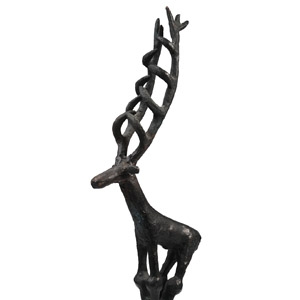
Copy of Ankara Museum's Anatolian Hittite Bronze Stag
20th century A.D.Sold for (Inc. bp): £845
Stylised figure of a standing deer atop a ceremonial standard, elongated head with annulet eyes, tall antlers; mounted on a custom-made display stand. 2.23 kg total, 45 cm high including stand
Acquired on the UK art market, early 2000s. This lot is accompanied by an illustrated lot declaration signed by the Head of the Antiquities Department, Dr Raffaele D'Amato.
