
Loading, please wait...
_900x900.jpg "Large Cypriot Buff Ware Storage Bowl")
_200x200.jpg "Large Cypriot Buff Ware Storage Bowl")
.jpg "Large Cypriot Buff Ware Storage Bowl")
LOT 0543
Large Cypriot Buff Ware Storage Bowl
IRON AGE, CYPRO-GEOMETRIC, CIRCA 950-850 B.C.
8 in. (2.3 kg, 20.5 cm high).
Drum-shaped in profile with carination above the foot, rolled rim to the mouth; chipped. [No Reserve]
ProvenanceFrom a collection acquired on the UK art market from various auction houses and collections mostly before 2000.
From an important Cambridgeshire estate; thence by descent.
This lot is accompanied by an illustrated lot declaration signed by the Head of the Antiquities Department, Dr Raffaele D’Amato.
TimeLine Auctions follows a vetting process to ensure the authenticity and legality of all items, reinforcing our commitment to integrity and responsible trading. Each antiquity, antique, and coin lot undergoes thorough examination by a vetting committee of at least ten external specialists, professional trade association members, scientists, and archaeologists: Our Vetting Process
AUCTIONS:
TimeLine is a leading auction house specialising in antiquities, ancient art, collectables, natural history, coins, medals, and books. Our auctions offer museums, collectors, historians, and enthusiasts the opportunity to acquire unique and historically significant pieces.
-
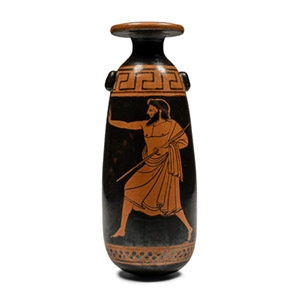
Greek Terracotta Attic Red-Figure Alabastron
Circa 500 B.C.Sold for (Inc. bp): £6,500
Ovoid shape with short neck and expanded flat rim, lugs on the sides; painted with daily life scenes: one side with an older man holding a crozier, dressed in chiton and himation, the other side with a younger bearded man holding a short staff, dressed in a similar way; meander pattern above and a dotted band below; some restoration. 125 grams, 13.6 cm
with Hirsch Auction, 23 September 2006, no.666. Accompanied by an academic report by Dr Raffaele D’Amato. This lot has been checked against the Interpol Database of stolen works of art and is accompanied by search certificate number no.12463-228723. Accompanied by thermoluminescence analysis report no.06280606 by Laboratory Kotalla. This lot has been cleared against the Art Loss Register database, and is accompanied by an illustrated lot declaration signed by the Head of the Antiquities Department, Dr Raffaele D’Amato.
The men depicted on this vessel are each holding an elegant walking stick appropriate to Athenian citizens. They both seem to be in a drunken rage, and seemingly have just left a drinking party: the consequences of immoderate drinking were a favourite subject for vessel decorations. -
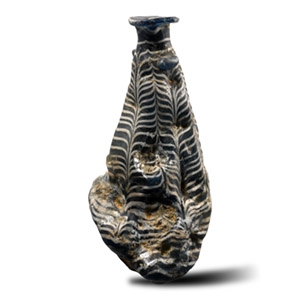
Greek Melted Core-Formed Glass Alabastron
4th-3rd century B.C.Sold for (Inc. bp): £715
With fusiform body, slender neck and broad flange rim, decorated with white and blue marvered feathering and spiralling trails; deformed, remains of attachment point for handle. 46.9 grams, 10.5 cm
Mr F.D. collection, acquired on the European art market, 1975 to present. This lot is accompanied by an illustrated lot declaration signed by the Head of the Antiquities Department, Dr Raffaele D’Amato.
The design of this vessel was applied in blue and white bands: it belongs to the Hellenistic vases that were core-formed, pre-blown. According to some scholars the feather pattern was not used before the 4th century B.C. -
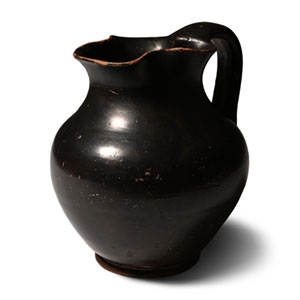
Greek Black-Glazed Trefoil Oinochoe
5th-4th century B.C.Sold for (Inc. bp): £624
With pinched three-lobe mouth and strap handle, old collector's label 'N3521' to underside. 332 grams, 14.8 cm
with Galerie Gilgamesh, prior 2003. Accompanied by a copy of an Art Loss Register certificate no.S00075441. This lot is accompanied by an illustrated lot declaration signed by the Head of the Antiquities Department, Dr Raffaele D’Amato.
