
Loading, please wait...
LOT 0242
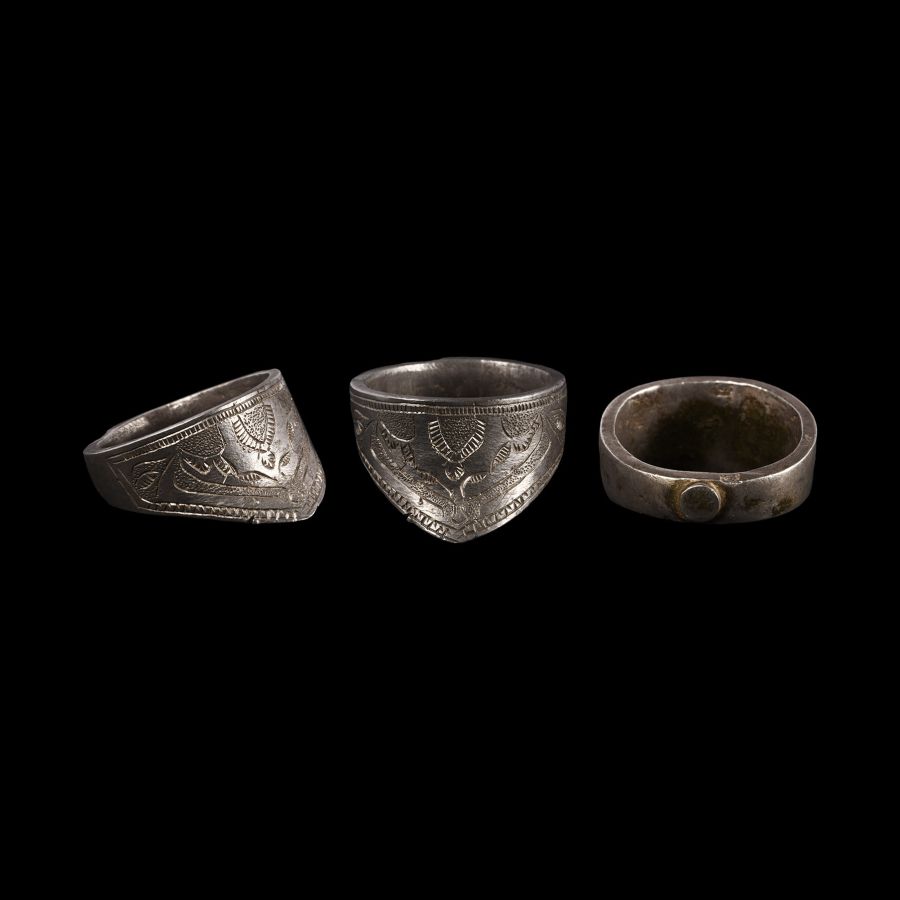
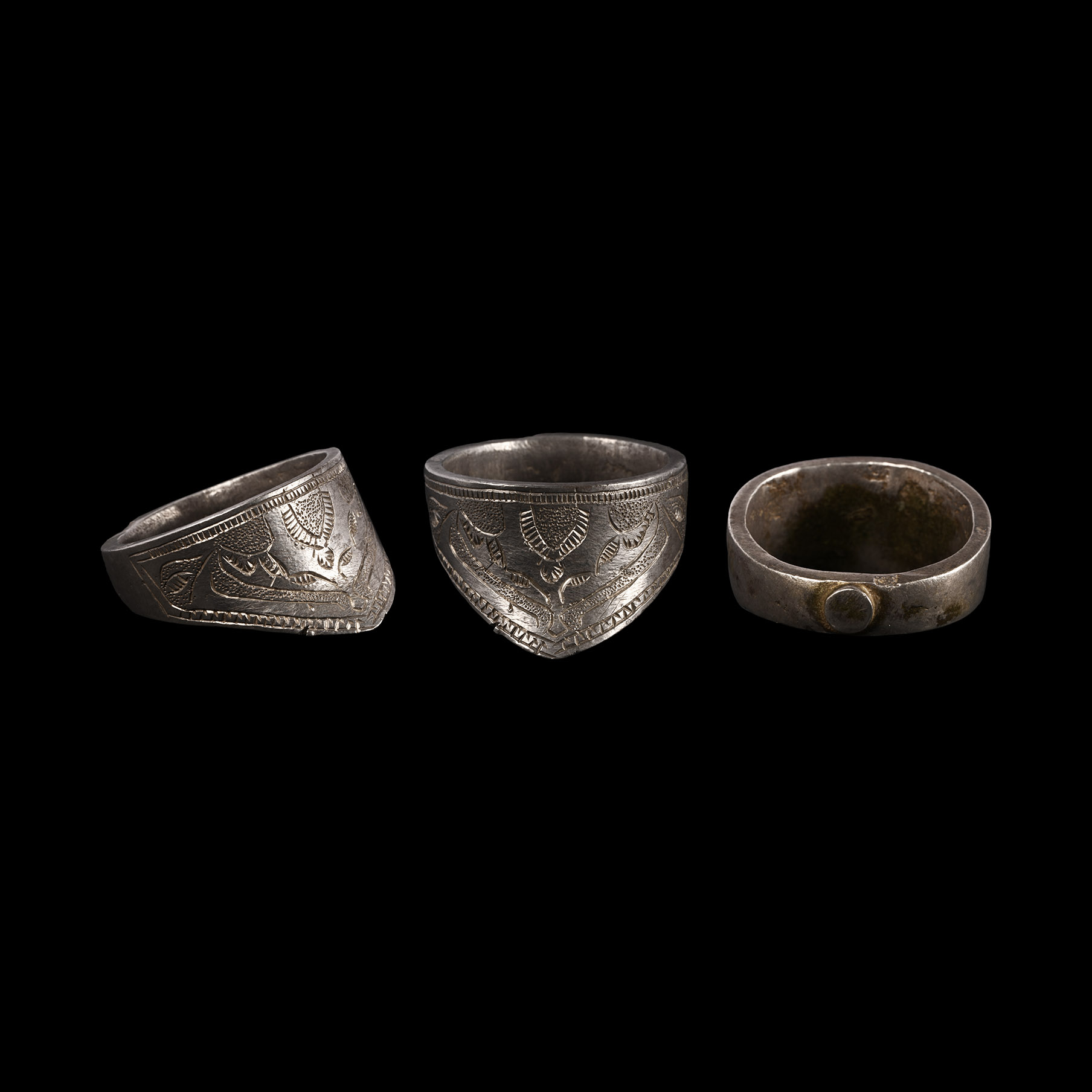
Large Byzantine Silver Archer's Ring
14TH-15TH CENTURY A.D.
1 3/8 in. (22.61 grams, 34.77 mm overall, 25.16 mm internal diameter).
A substantial silver archer's ring comprising a hoop with reserved triangular ornament on the edges and triangular plaque with foliage motifs, raised central panel with frond motif.
ProvenanceAcquire in the 1990s.
Ex Cambridgeshire, UK, collection.
Cf. Bikic, V., ‘Beyond the Jewellery: Archer’s Rings in the Medieval Balkans (14th-15th centuries)’ in Bosselmann-Ruickbie, A. (ed.), New Research on Late Byzantine Goldsmiths’ Works (13th-15th Centuries), Mainz, 2019, figs. 5, 6, 7.
FootnotesArcher rings in Late Byzantium and the medieval Balkans were connected with the employment of the powerful composite bow, but very often, in 14th century, they were rank symbol for aristocratic noblemen. Archaeological findings of archers’ rings originate mainly from fortified towns, including mining centres. Many were made in bone, simple in design and undecorated. In contrast, the ones made in bronze and silver were usually decorated in rather uniform style, consisting of floral motifs on the head, mostly tulip and foliage, and linear motifs around the edges. This decoration combined Turkish, Central European and Eastern Roman traditional patterns.
CONDITIONTimeLine Auctions follows a vetting process to ensure the authenticity and legality of all items, reinforcing our commitment to integrity and responsible trading. Each antiquity, antique, and coin lot undergoes thorough examination by a vetting committee of at least ten external specialists, professional trade association members, scientists, and archaeologists: Our Vetting Process
AUCTIONS:
TimeLine is a leading auction house specialising in antiquities, ancient art, collectables, natural history, coins, medals, and books. Our auctions offer museums, collectors, historians, and enthusiasts the opportunity to acquire unique and historically significant pieces.
-
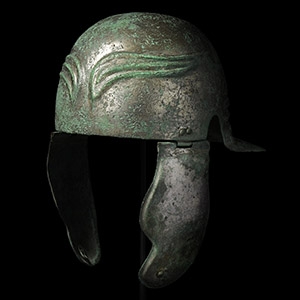
Roman Legionary Helmet with Wings of Jupiter
Late 1st century B.C.-early 1st century A.D.Sold for (Inc. bp): £52,000
A tinned sheet-bronze legionary helmet of Imperial Gallic Type A with deep rounded bowl, simple C-shaped cut-outs for the ears, integral flared neck-guard extending some way along the sides, corrugated ribs to the occipital area at the rear and corrugated 'wings' or eyebrows (Russel-Robinson's Type E) above the brow; small stud the rear of the neck-guard attaching suspension loops to the underside; hinged bracket at each temple for a deeply curved cheek-guard with gently flared rim, bearing a loop to the inner face to accept an vinculum fastening strap; accompanied by a custom-made display stand. 2.38 kg total, 29 cm high (41 cm including stand)
typologically important helmet of the utmost rarity, excellent state of preservation.
From a West Coast, USA, arms and armour family collection; thence by descent. Accompanied by an academic report by Dr Raffaele D'Amato. This lot has been checked against the Interpol Database of stolen works of art and is accompanied by search certificate number no.11585-199847.
This important and well-preserved helmet (Cassis) belongs to a small and rare group of helmets of the Weisenau type (modern term). The development of this helmet formed the main category of legionary helmets in 1st and 2nd centuries A.D. This early category was characterised by a very high hemispherical calotte and a slightly sloping, narrow neck guard. They were fitted with a pair of prominent curved eyebrows (symbolising the wings of Jupiter’s thunderbolts) flanking two rivetted bosses. -
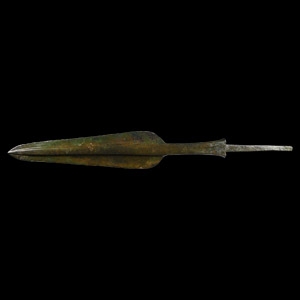
Amlash Type Spearhead
13th-11th century B.C.Sold for (Inc. bp): £234
A bronze tanged spearhead with heavily ridged and tapered blade with short collared shaft and square section tapered tang of recangular section. 436 grams, 40 cm
Acquired 1980-2015. Ex Abelita family collection.
The weapon belongs to the type 1 of the spearhead classification by Khorasani, mainly from Marlik or Amlash areas. Similar pieces have been dated by Stutzinger to 1200-1100 B.C. -
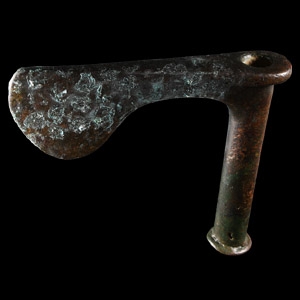
Western Asiatic 'Crescentic' Axehead
1st millennium B.C.Estimate: £200 - 300 (+bp*)
Opening Bid: £100
A bronze axehead with slender tubular socket, horizontal upper cheek and curved lower one, scooped profile to blade with convex cutting edge. 330 grams, 12.5 cm
Acquired 1980-2015. Ex Abelita family collection.
