
Loading, please wait...
LOT 1445
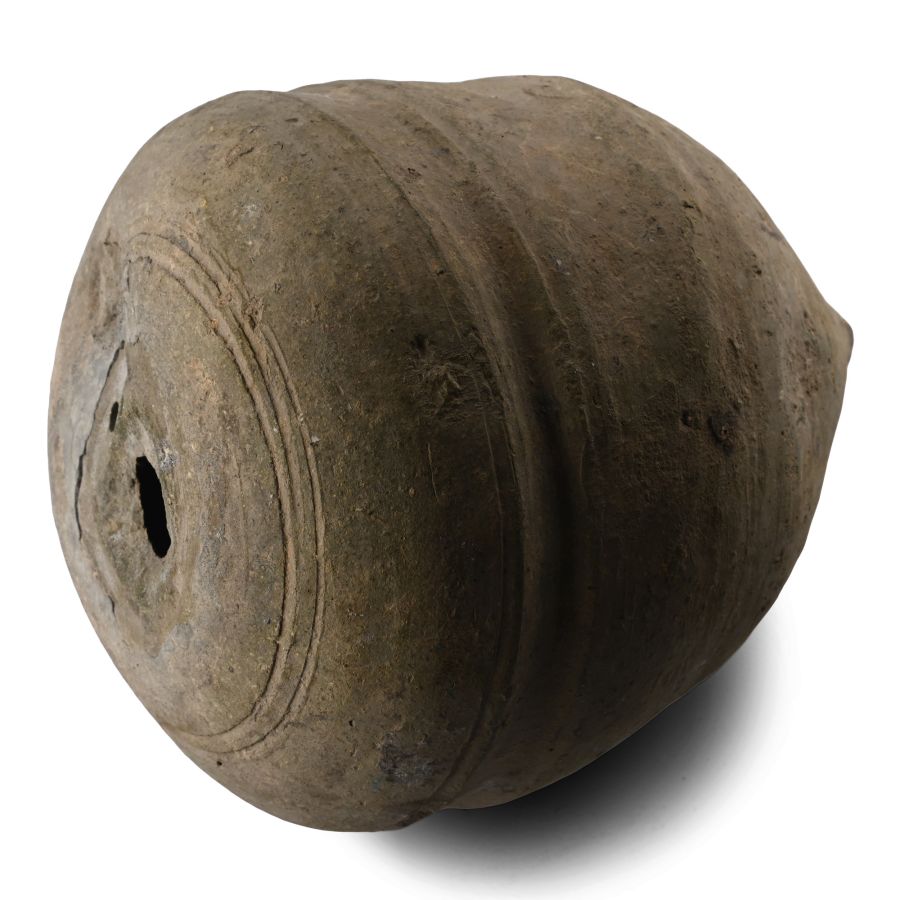
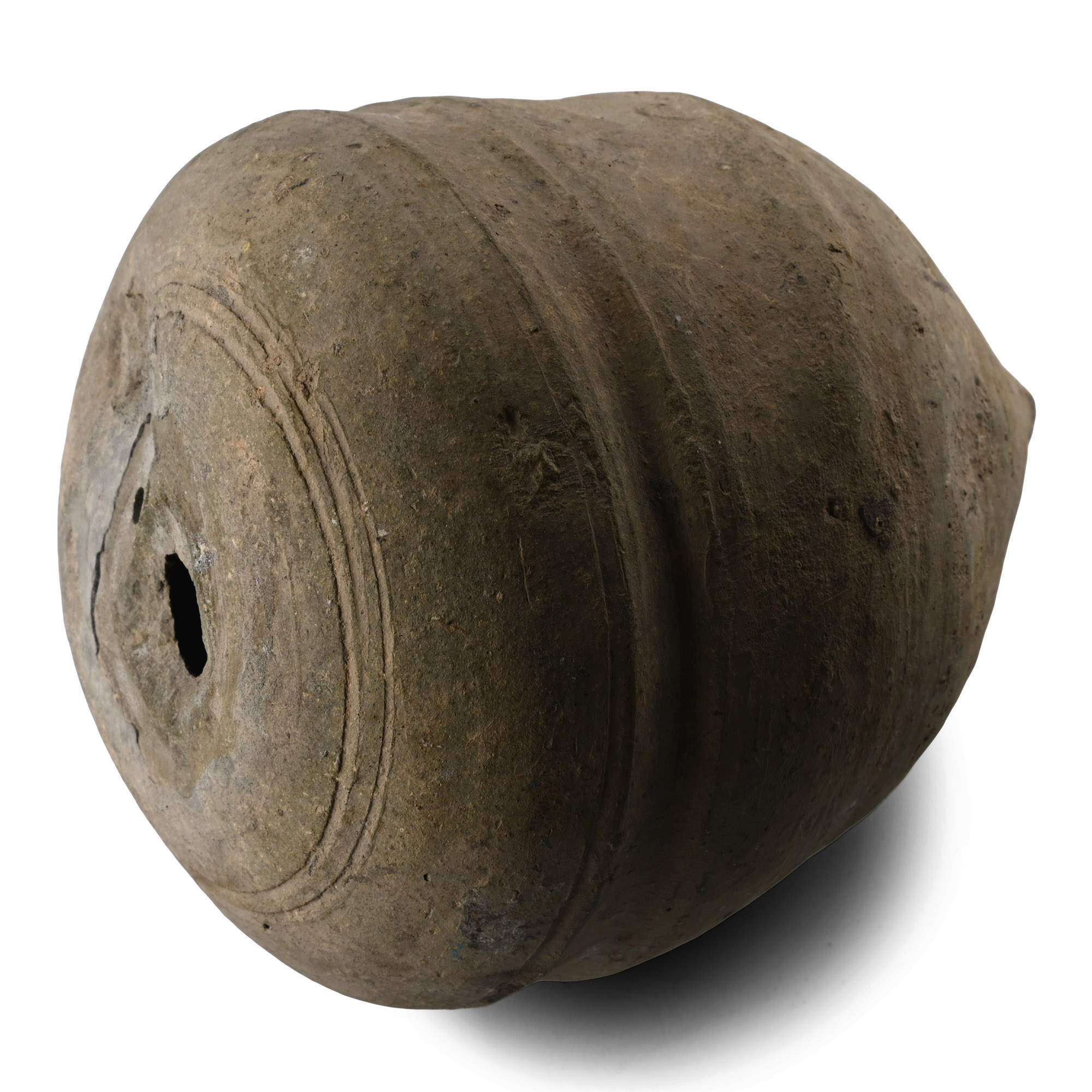
Large Byzantine 'Greek Fire' Ceramic Fire Bomb or Hand Grenade with TL Test
9TH-11TH CENTURY A.D.
6 1/8 in. (1.59 kg, 15.5 cm).
Cylindrical body with pointed tip, deep circumferential groove beneath the shoulder; intended to be filled with explosive liquid and a wick, and used as a hand grenade. [No Reserve]
ProvenanceFrom an important specialist collection, London, UK, 1990s onwards.
Accompanied by an original thermoluminescence analysis report by Oxford Authentication with sample no.P125g16.
Accompanied by an academic paper by military specialist Dr Raffaele D'Amato, dated 15 July 2019 and titled 'Eastern Roman Empire - Greek Fire Bomb or Hand Grenade (μεσαίον kακάβιον) 9th-11th century AD'.
This lot is accompanied by an illustrated lot declaration signed by the Head of the Antiquities Department, Dr Raffaele D'Amato.
Cf. Arendt, W. I., Granaten des 13-14. Jahrhunderts, die an der Wolga gefunden sind, Zeitschrift fur Historische Waffen-und Kostumkunde, 11 (1926-8), p.42; cf. Arendt, W., Die Spharisch-konischen Gefäße aus Gebranntem Ton, ibid; cf. Ayalon, D., Gunpowder and Firearms in the Mamluk Kingdom, London, 1956, p.16.
FootnotesApart from the use of siphons or manual flame-throwers called cheirosiphona, special corps of Roman soldiers employed terracotta grenades, in the form of small jars, abundantly evidenced in archaeological excavations. They were called μεσαία kακαβιά or κυτροκακάβια where the former had a bulbous shape and the latter a more cylindrical form.
CONDITIONTimeLine Auctions follows a vetting process to ensure the authenticity and legality of all items, reinforcing our commitment to integrity and responsible trading. Each antiquity, antique, and coin lot undergoes thorough examination by a vetting committee of at least ten external specialists, professional trade association members, scientists, and archaeologists: Our Vetting Process
AUCTIONS:
TimeLine is a leading auction house specialising in antiquities, ancient art, collectables, natural history, coins, medals, and books. Our auctions offer museums, collectors, historians, and enthusiasts the opportunity to acquire unique and historically significant pieces.
LOT 1445
Large Byzantine 'Greek Fire' Ceramic Fire Bomb or Hand Grenade with TL Test
Sold for (Inc. bp): £143
-
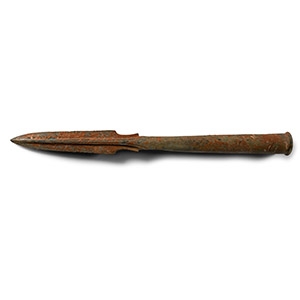
Chinese Zhou Bronze Socketted Spearhead
Zhou Dynasty, 1046-256 B.C.Estimate: £500 - 700 (‡+bp*)
Opening Bid: £278
With thick midrib, leaf-shaped blade with lateral spurs, deep tubular socket with fastening hole for the attachment to the wooden shaft. 250 grams, 32 cm
Acquired in the mid 1980s-1990s. Private collection, Switzerland, thence by descent. Private collection, since the late 1990s. This lot is accompanied by an illustrated lot declaration signed by the Head of the Antiquities Department, Dr Raffaele D’Amato. This lot is accompanied by an illustrated lot declaration signed by the Head of the Antiquities Department, Dr Raffaele D'Amato. -
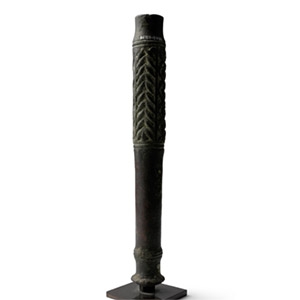
Mesopotamian 'Chrysler Museum' Bronze Macehead with Incised Decoration
Early 2nd millennium B.C.Estimate: £1,000 - 1,400 (+bp*)
Opening Bid: £500
Tubular in plan with low-relief braided panel and undulating lines; scooped profile at each end and securing collar; mounted on a custom-made stand. 647 grams total, 25.6 cm including stand
Ex Chrysler Museum of Art, Virginia, accession no.NP.68.62.M. with ArtAncient, 2010. Private collection, London, UK. This lot is accompanied by an illustrated lot declaration signed by the Head of the Antiquities Department, Dr Raffaele D'Amato. -
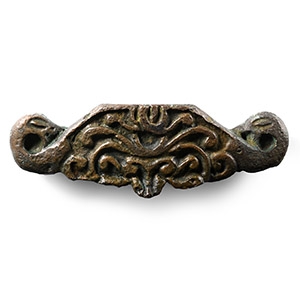
Viking Age Bronze Lower Sword Guard with Dragons
11th-13th century A.D.Estimate: £1,200 - 1,700 (+bp*)
Opening Bid: £400
Sloping shoulders and transverse slot to the upper face, lateral beast-head terminals; panel of palmette ornament to each broad face with tendrils, dentilled lower edge; Baltic Curonian type. 124 grams, 10 cm
From the private family collection of a lady, UK; acquired in Germany mid 20th century. Accompanied by an academic report by Dr Raffaele D'Amato. This lot has been checked against the Interpol Database of stolen works of art and is accompanied by a search certificate number no.12727-236128. This lot is accompanied by an illustrated lot declaration signed by the Head of the Antiquities Department, Dr Raffaele D'Amato.
The cross guard finds good parallels with Baltic swords used by Prussian, Curonian, Estonian and Lithuanian pagan warriors; see a clear parallel in Tomsons, 2012, fig.2,7 but especially fig. 3. The Curonian Type T swords were thoroughly examined by Tomsons and he was able to date the type to the 11th to 13th centuries.
