
Loading, please wait...
LOT 0255
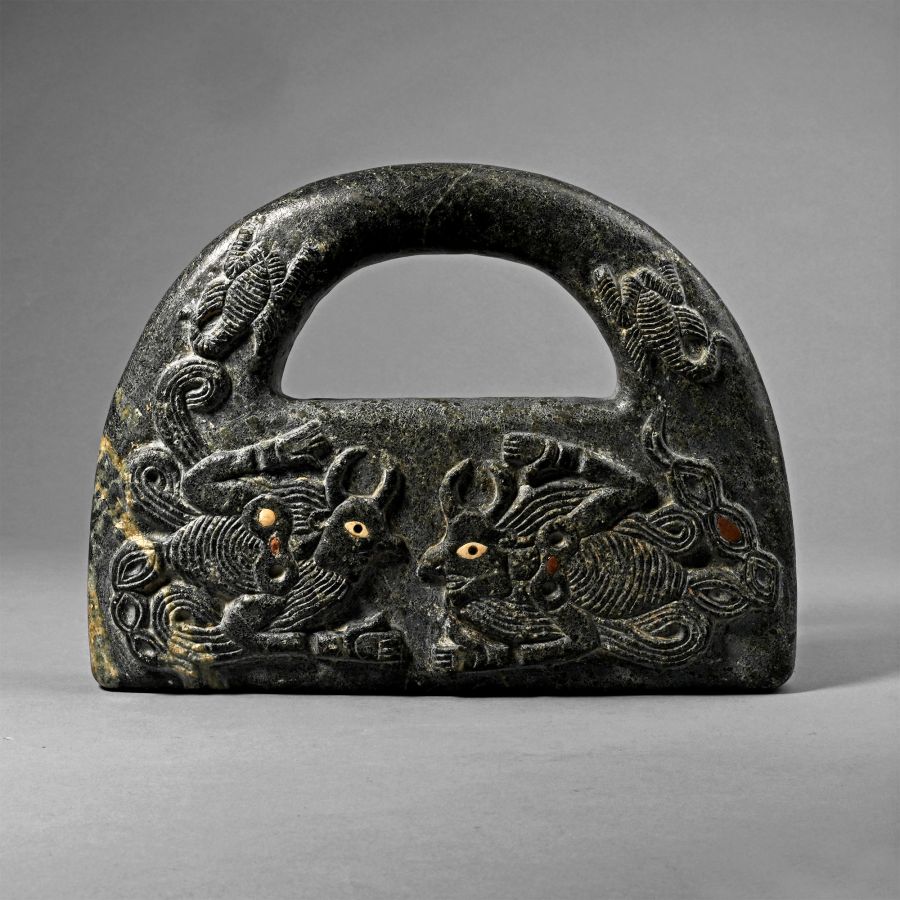
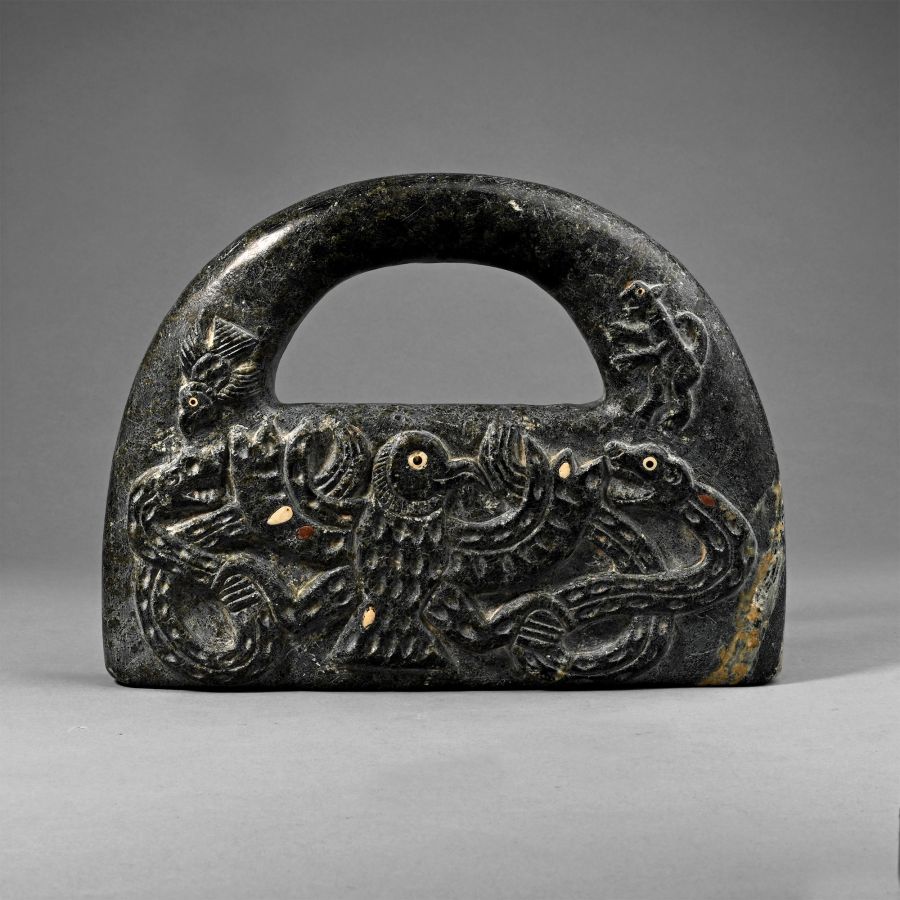
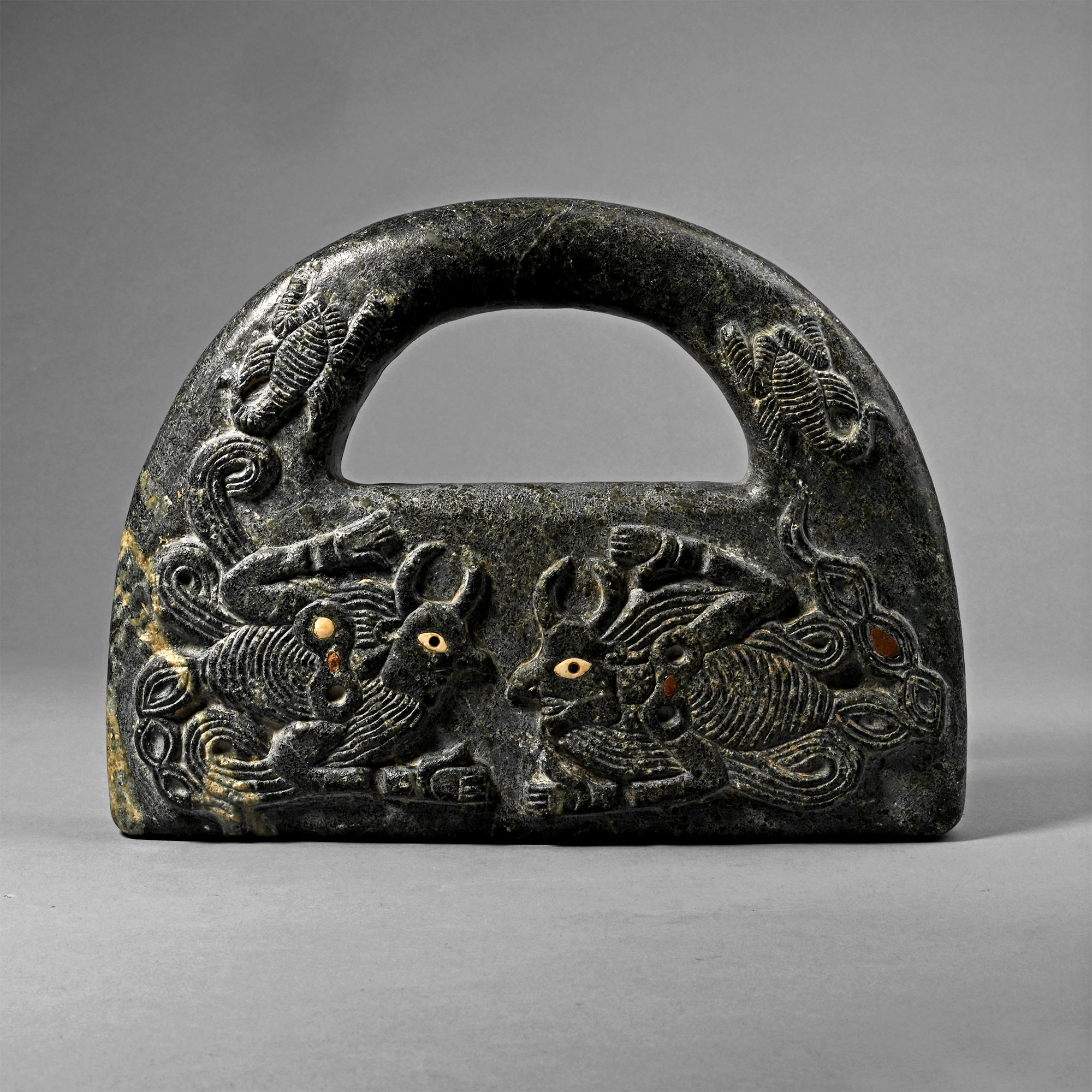
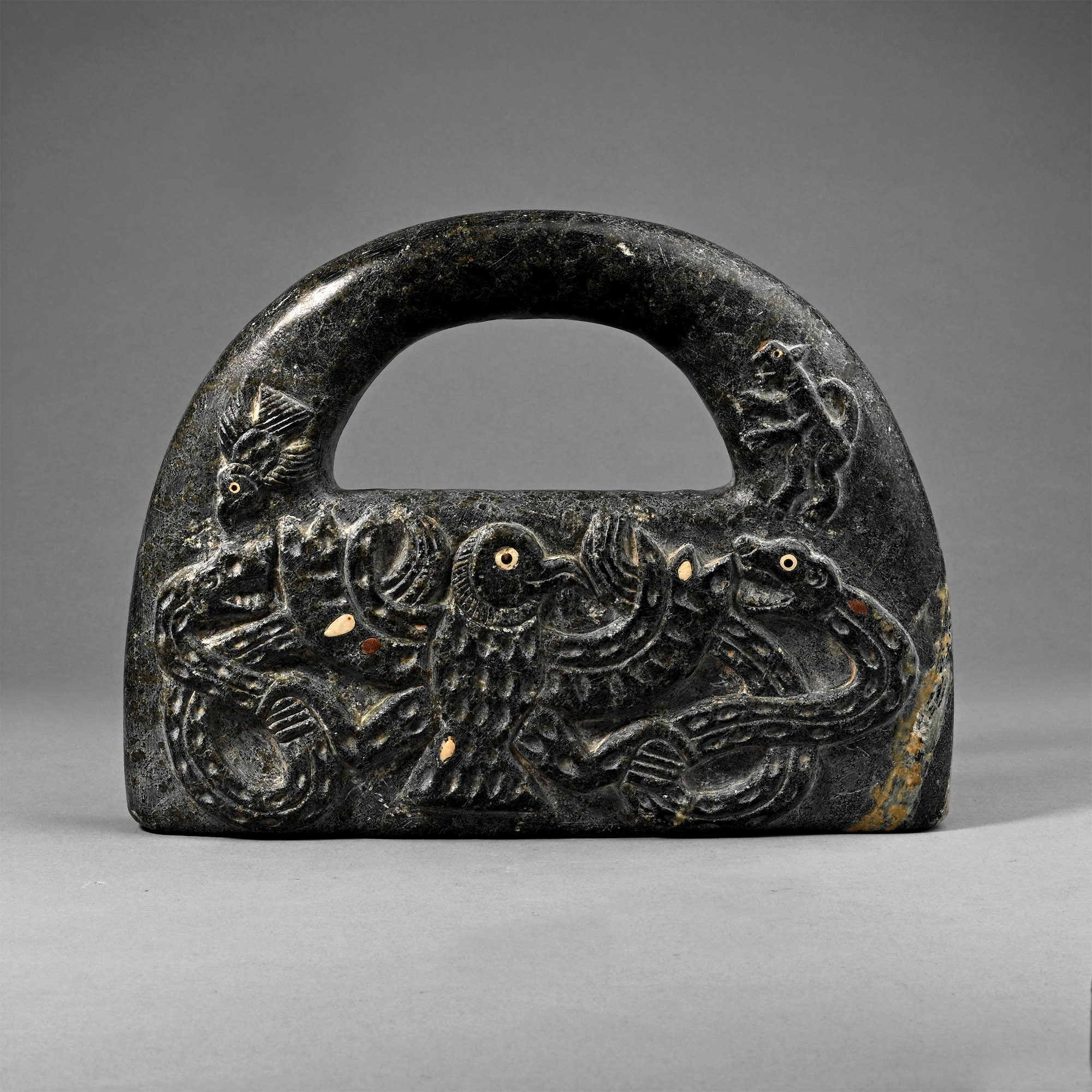
Large Bactrian Black Chlorite 'Hand Bag' Ceremonial Weight
3RD MILLENNIUM B.C.
10 3/8 in. (3.81 kg, 26.2 cm).
D-shaped in profile with a round-section loop and incuse sockets to accept inlay in contrasting colours (mostly absent); obverse with a reserved scene of two opposed human-headed scorpions with ribbed detailing advancing below two smaller scorpions placed perpendicular to them; reverse with a median eagle with wings extended and feather detailing, flanked by rearing serpents and other animals.
ProvenanceAcquired before 1983.
Ex London gallery, 1990s.
Private collection, London, UK.
This lot has been checked against the Interpol Database of stolen works of art and is accompanied by search certificate number no.13285-253383.
Cf. Various, 7000 Years of Iranian Art, Exhibition catalogue, Smithsonian Institute, 1964, p.54 & p.118, illustration no.11.
CONDITIONTimeLine Auctions follows a vetting process to ensure the authenticity and legality of all items, reinforcing our commitment to integrity and responsible trading. Each antiquity, antique, and coin lot undergoes thorough examination by a vetting committee of at least ten external specialists, professional trade association members, scientists, and archaeologists: Our Vetting Process
AUCTIONS:
TimeLine is a leading auction house specialising in antiquities, ancient art, collectables, natural history, coins, medals, and books. Our auctions offer museums, collectors, historians, and enthusiasts the opportunity to acquire unique and historically significant pieces.
LOT 0255
Large Bactrian Black Chlorite 'Hand Bag' Ceremonial Weight
Estimate £15,000 - 20,000€17,400 - 23,200 (for guidance only)$20,250 - 27,000 (for guidance only)
-
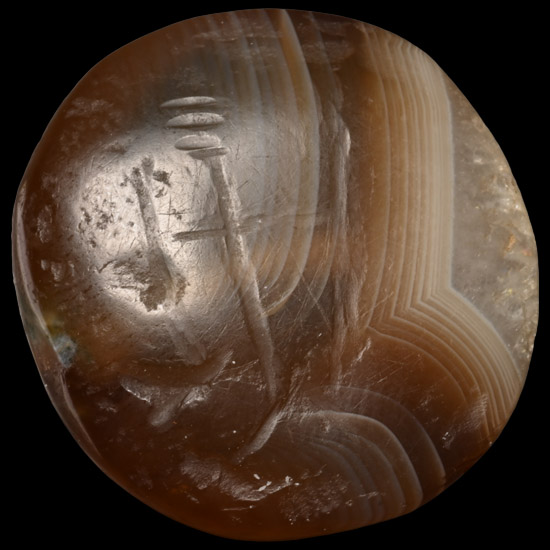
Large Sasanian Banded Agate Stamp Seal
Circa 4th-5th century A.D.Sold for (Inc. bp): £33
Plano-convex in section with lightly incised standing figure with sword and shield in his outstretched hands. 13.21 grams, 27.07 mm
From the private collection of a European gentleman (1942-2024), formed since the 1970s. -
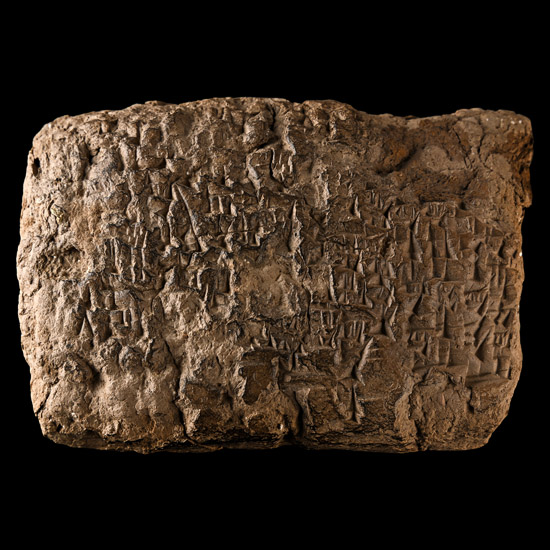
Old Babylonian Terracotta Cuneiform Tablet of a Poem
Early 2nd millennium B.C.Estimate: £3,000 - 4,000 (+bp*)
Opening Bid: £1,400
Pillow-shaped tablet with a Sumerian hymn to Sin-idinam, king of Larsa (1849-1843 BC), reading: '5-6 (the gods) granted him to exercise, in a sublime manner, kingship and the priestly office. 7-8 They made him sit upon a seat whose foundation is firm, a radiant throne ... 9-10 Once he had firmly secured the crown and the sublime radiance upon his head. 11 Sin, the firstborn son of Enlil, 12 bestowed upon him a sublime name. 13 Utu, the great judge of the universe, 14 caused law and justice to be established for him]. 15 The praise
Specialised collection of cuneiform texts, the property of a London gentleman and housed in London before 1992. Thence by descent to family members. Examined by Professor Wilfrid George Lambert FBA (1926-2011), historian, archaeologist, and specialist in Assyriology and Near Eastern archaeology, in the late 1980s and early 1990s. This small collection is exceptional for the variety of types, including some very rare and well-preserved examples. Accompanied by a translation by M. Guichard. This lot has been checked against the Interpol Database of stolen works of art and is accompanied by search certificate number no.13269-253330.
Old Babylonian tablets were found in regular excavations from Khafaje and Kish, although, even today, the main body came from dealers. A definite date can be assigned to them only based on internal evidence. The scripts of the tablets vary a good deal: some tablets are written in archaic cursive, others in younger cursive, still others mix archaic and younger sign forms. -
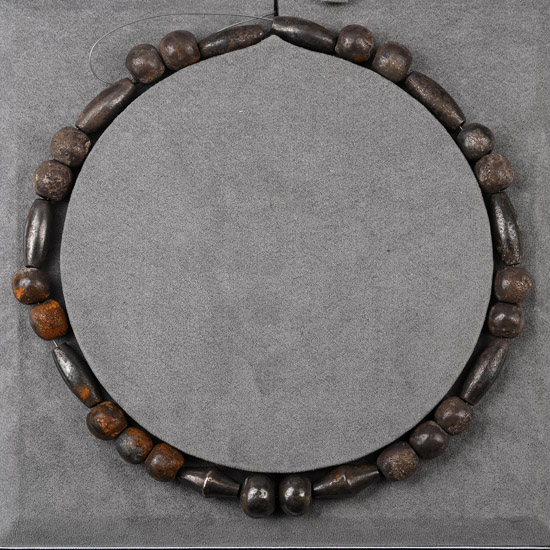
Mesopotamian Heavy Silver Bead Necklace
3rd-early 2nd millennium B.C.Estimate: £5,000 - 7,000 (+bp*)
Opening Bid: £2,500
Restrung and comprising mainly spherical, elongated ovals, oblates, and biconical shapes; accompanied by a custom-made lined display box. 224 grams, 56 cm
Numismatic and Ancient Art Gallery AG, Ancient Art of the Mediterranean World, No 8, no.5, c.1982. Taisei Gallery, Gold & Silver Auction, Part II, Ancient to Renaissance, 5 November 1992, The Conrad Salon, The Waldorf-Astoria, New York, no.39. Private collection, London. This lot has been checked against the Interpol Database of stolen works of art and is accompanied by search certificate number no.13265-253358.
The Sumerian word for silver is kú-babbar, which means ‘white metal’. Silver was mined from ores that contained significant amounts of other metals and impurities and therefore requires a great deal of further processing before it can be used. It was considered sacred and immutable, and an extremely high-status material, used for royal jewellery.
