
Loading, please wait...
_900x900.jpg "Large Bactrian Bifacial Stone Stamp Seal with Serpent and Ibex")
_200x200.jpg "Large Bactrian Bifacial Stone Stamp Seal with Serpent and Ibex")
_900x900.jpg "Large Bactrian Bifacial Stone Stamp Seal with Serpent and Ibex")
_200x200.jpg "Large Bactrian Bifacial Stone Stamp Seal with Serpent and Ibex")
_900x900.jpg "Large Bactrian Bifacial Stone Stamp Seal with Serpent and Ibex")
_200x200.jpg "Large Bactrian Bifacial Stone Stamp Seal with Serpent and Ibex")
_900x900.jpg "Large Bactrian Bifacial Stone Stamp Seal with Serpent and Ibex")
_200x200.jpg "Large Bactrian Bifacial Stone Stamp Seal with Serpent and Ibex")
.jpg "Large Bactrian Bifacial Stone Stamp Seal with Serpent and Ibex")
.jpg "Large Bactrian Bifacial Stone Stamp Seal with Serpent and Ibex")
.jpg "Large Bactrian Bifacial Stone Stamp Seal with Serpent and Ibex")
.jpg "Large Bactrian Bifacial Stone Stamp Seal with Serpent and Ibex")
LOT 0259
Large Bactrian Bifacial Stone Stamp Seal with Serpent and Ibex
CIRCA 2000 B.C.
2 in. (55 grams, 51 mm).
Carved chlorite bifacial seal with incuse image to each broad face: coiled serpent-body with facing beast-head; profile beast with forelegs folded beneath the body, long neck curved to the rear and head turned, holding a frond in the mouth and with another before the chest.
ProvenanceCollected from 1969-1999.
From the collection of the late Mr S.M., London, UK.
Cf. Aruz, J., Art of the First Cities. The Third Millennium B.C. from the Mediterranean to the Indus, New York, 2003, item 235, for beast imagery.
CONDITIONTimeLine Auctions follows a vetting process to ensure the authenticity and legality of all items, reinforcing our commitment to integrity and responsible trading. Each antiquity, antique, and coin lot undergoes thorough examination by a vetting committee of at least ten external specialists, professional trade association members, scientists, and archaeologists: Our Vetting Process
AUCTIONS:
TimeLine is a leading auction house specialising in antiquities, ancient art, collectables, natural history, coins, medals, and books. Our auctions offer museums, collectors, historians, and enthusiasts the opportunity to acquire unique and historically significant pieces.
LOT 0259
Large Bactrian Bifacial Stone Stamp Seal with Serpent and Ibex
Sold for (Inc. bp): £546
-
.jpg)
Large Bactrian Stone Stamp Seal with Lamassu
Circa 2000 B.C.Estimate: £1,200 - 1,700 (+bp*)
Opening Bid: £600
Plano-convex in section with broad face, incuse profile image of a lamassu (winged bull with a human head) with pellets and objects in the field. 70 grams, 59 mm
Collected from 1969-1999. From the collection of the late Mr S.M., London, UK. -
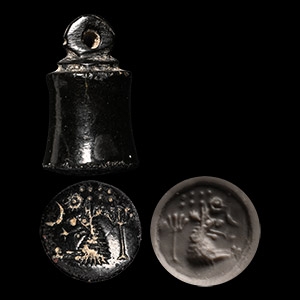
Urartu Black Stone Stamp Seal with Horse Head
2nd millennium B.C.Sold for (Inc. bp): £390
Bell-shaped seal with ribbed suspension loop, incuse design including pellets, a frond and a horse's head; supplied with a museum-quality impression. 4.07 grams, 21 mm
Collected from 1969-1999. From the collection of the late Mr S.M., London, UK. -

Western Asiatic Haematite Cylinder Seal with Presentation Scene and Inscription
Circa 2nd millennium B.C.Sold for (Inc. bp): £1,170
With frieze depicting a seated figure holding up a vessel in one extended hand, star and crescent above; before him, a facing figure in fringed robe and another in flounced robe with hands raised; two columns of cuneiform text; supplied with a museum-quality impression. 2.23 grams, 17 mm
From an important London, UK, collection, 1970-1990. Examined by Professor Wilfrid George Lambert FBA (1926-2011), historian, archaeologist, and specialist in Assyriology and Near Eastern archaeology, in the late 1980s and early 1990s.
