
Loading, please wait...
LOT 1483
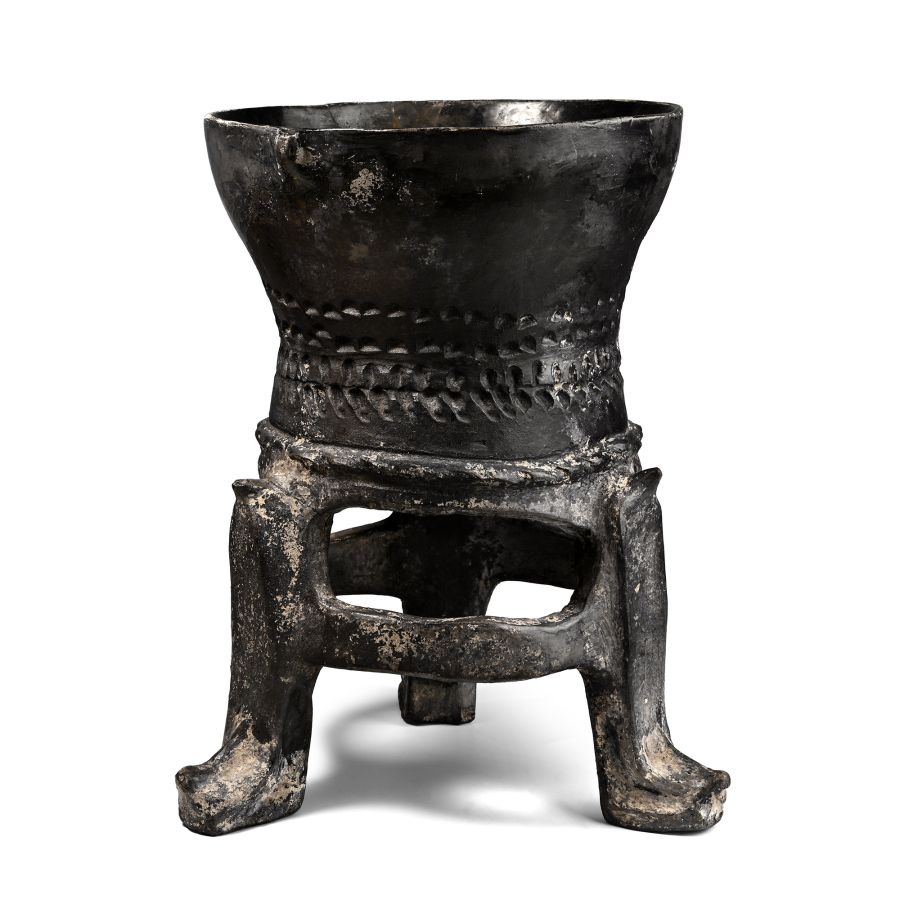
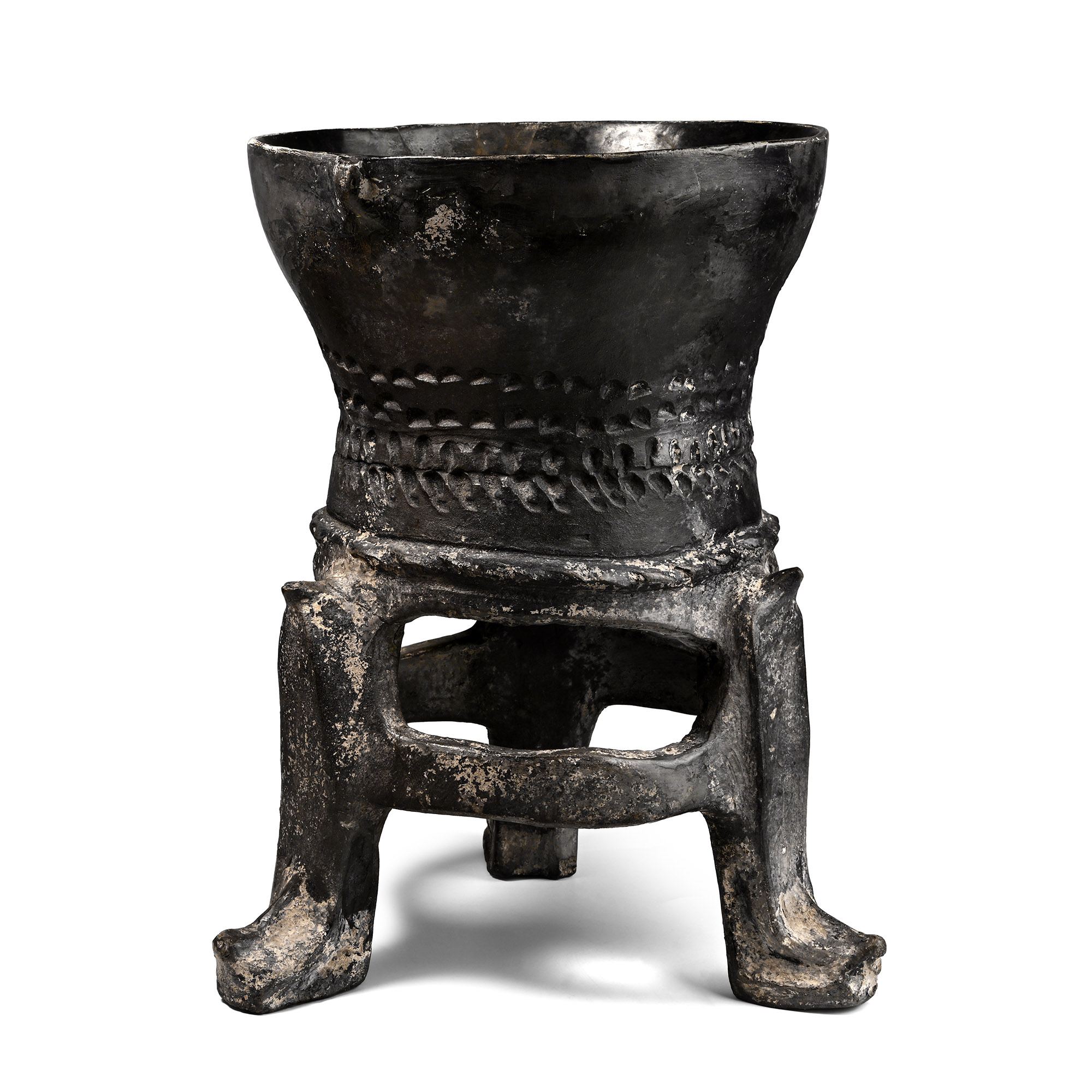
Large Azerbaijan Hasanlu Tepe Pottery Vessel
CIRCA 1000-700 B.C.
14 in. (5.28 kg, 35.5 cm).
Comprising a broad bell-shaped bowl with flat rim attached by a thick trunk with four rows of angled impressions to a tripod base with sturdy curved legs with inner supporting ring and keeled finials.
Provenancewith Mahboubian Gallery, London, UK, 1974.
Private collection, London, UK.
TimeLine Auctions follows a vetting process to ensure the authenticity and legality of all items, reinforcing our commitment to integrity and responsible trading. Each antiquity, antique, and coin lot undergoes thorough examination by a vetting committee of at least ten external specialists, professional trade association members, scientists, and archaeologists: Our Vetting Process
AUCTIONS:
TimeLine is a leading auction house specialising in antiquities, ancient art, collectables, natural history, coins, medals, and books. Our auctions offer museums, collectors, historians, and enthusiasts the opportunity to acquire unique and historically significant pieces.
-
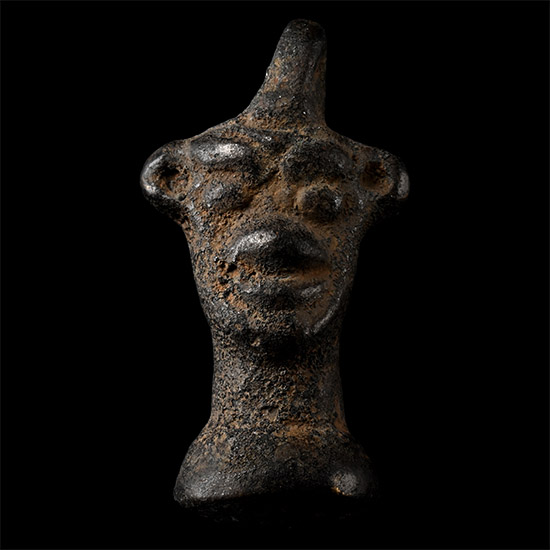
Assyrian Double-Faced Pendant Depicting Pazuzu, King of Wind Demons
8th-6th century B.C.Estimate: £500 - 700 (+bp*)
Opening Bid: £250
Carved in the round with flared base, addorsed faces of the demon with suspension lug above. 50.24 grams, 44 mm
UK private collection before 2000. Acquired on the UK art market. Private collection, London, UK.
The figure described as the 'King of Wind Demons' is commonly identified with Pazuzu, a well-known demon in Assyrian and Babylonian tradition. Despite his fearsome appearance, often shown with a canine face, bulging eyes, a scaly body, and wings, Pazuzu was not simply a malevolent force. He was understood as the ruler of the winds, particularly the hot, destructive winds from the desert, but was also invoked for protection. Most notably, Pazuzu was believed to ward off the demon Lamashtu, who threatened pregnant women and infants. Small amulets and pendants bearing his image were therefore worn or placed in domestic spaces as protective devices. Objects such as this pendant belong to that world of everyday belief, where the boundary between danger and protection was fluid, and where even a demon could serve an apotropaic role. -

Western Asiatic Cylinder Seal with Geometric Design
3rd-2nd millennium B.C.Estimate: £300 - 400 (+bp*)
Opening Bid: £150
With incuse geometric design of hatching and vesica shapes; accompanied by a museum-quality impression. 5.38 grams, 26 mm
UK private collection before 2000. Acquired on the UK art market. Private collection, London, UK. -
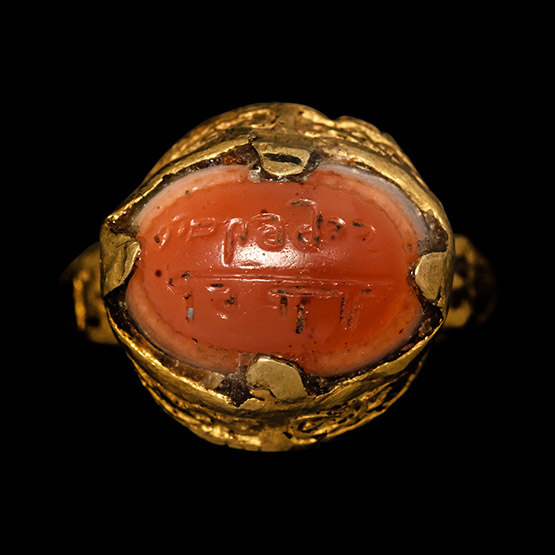
Western Asiatic Gold Ring with Inscribed Sardonyx Gemstone
10th-12th century A.D.Sold for (Inc. bp): £2,340
With stepped shoulders supporting a cell bezel with a claw setting. 7.33 grams, 27.65 mm overall, 13.76 x 14.32 mm internal diameter (approximate size British E 1/2, USA 2 1/2, Europe 3, Japan 3)
Private collection, acquired on the German art market in 1993; thence by descent. This lot has been checked against the Interpol Database of stolen works of art and is accompanied by search certificate number no.13183-249300.
Rings from the 9th-13th centuries represent a variety of artistic achievements; the techniques were elaborate, and the rings show rich decoration. The rings were set with cabochons, table-cut oval or rectangular stones such as turquoise, rubies, garnets or other precious stones. The Arabic inscription, engraved with early Kufic characters, contains the expression “AL__LLH”, which could be interpreted as “il-la-lah”, i.e. “For/to Allah”.
