
Loading, please wait...
_900x900.jpg "Large Anglo-Saxon Gilt Bronze Mount")
_200x200.jpg "Large Anglo-Saxon Gilt Bronze Mount")
.jpg "Large Anglo-Saxon Gilt Bronze Mount")
LOT 1413
Large Anglo-Saxon Gilt Bronze Mount
CIRCA 6TH CENTURY A.D.
3/4 - 1 1/2 in. (17 grams total, 20-37 mm).
Two adjoining pieces broadly rectangular in plan with a slight taper, two parallel rectangular recesses with guilloche in relief; remains of lugs to two edges. [2, No Reserve]
ProvenanceFound Berkshire, UK.
CONDITIONTimeLine Auctions follows a vetting process to ensure the authenticity and legality of all items, reinforcing our commitment to integrity and responsible trading. Each antiquity, antique, and coin lot undergoes thorough examination by a vetting committee of at least ten external specialists, professional trade association members, scientists, and archaeologists: Our Vetting Process
AUCTIONS:
TimeLine is a leading auction house specialising in antiquities, ancient art, collectables, natural history, coins, medals, and books. Our auctions offer museums, collectors, historians, and enthusiasts the opportunity to acquire unique and historically significant pieces.
-
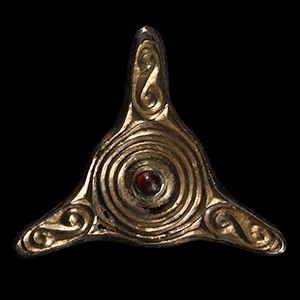
Saxon Age Silver-Gilt Trefoil Brooch with Central Garnet
6th-8th century A.D.Sold for (Inc. bp): £780
Plaque with concentric raised rings and central glass cabochon, three radiating arms each with an S-scroll motif; catch and pin-lug to the reverse. 10.79 grams, 59 mm
From the collection of a North American gentleman, formed in the 1990s.
The brooch is reminiscent of the Anglo-Scandinavian 'trefoil' type but lacks the customary detailing of that type. Its slender proportions and use of S-scrolled tendrils are more readily associated with the Irish metalworking tradition. -
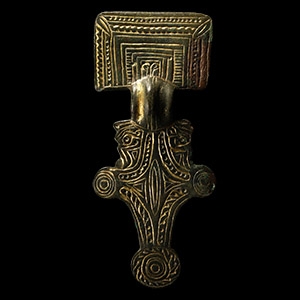
Anglo-Saxon Gilt Bronze Great Square-Headed Brooch
6th century A.D.Sold for (Inc. bp): £1,690
Of Hines's Group XX with square headplate bearing concentric bands of billets, undulating lines and punched points, with vesica motifs to the upper corners; thick shallow bow with central rib, isosceles triangle footplate with horse-head lappets and flanking lobes with concentric rings, ropework bands and central vesica, disc finial with ropework border; pin-lugs to the reverse and broad catch. 136 grams, 13.5 cm
Found near Grimsby, Humberside, UK, circa 2010.
The brooch shows a restrained use of low-relief detailing confined to largely geometric features other than the horse-heads at the shoulders and the single facing mask on the headplate above the junction with the bow. The bow itself is very thick and displays a prominent median rib with just a suggestion of outer ribs. The mineral deposits on the reverse bear the imprint of the textile to which the brooch was attached. -
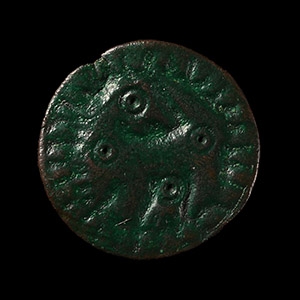
Anglo-Saxon Nummular Disc Brooch
6th-9th century A.D.Sold for (Inc. bp): £72
Displaying a stylised regardant beast standing within a raised geometric border, punched ring-and-dot eye and detailing; remains of pin lug and catchplate to reverse. 6.19 grams, 28 mm
Acquired on the UK market, 1990s. Property of a retired academic.
