
Loading, please wait...
LOT 1800
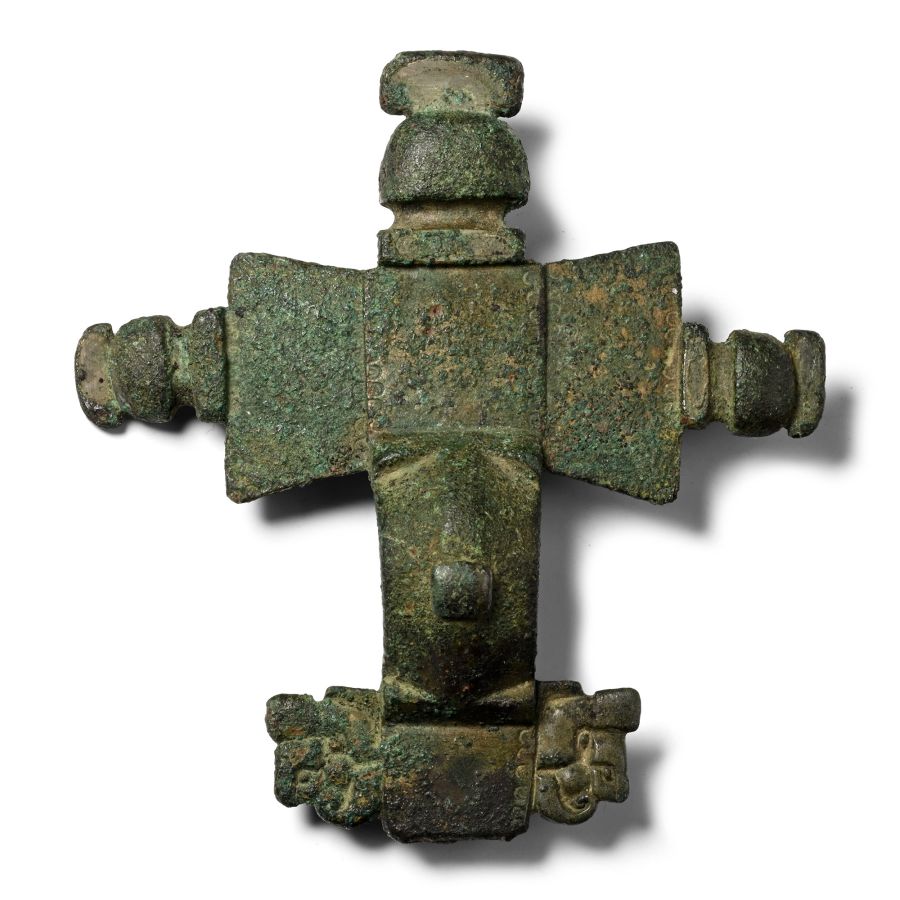
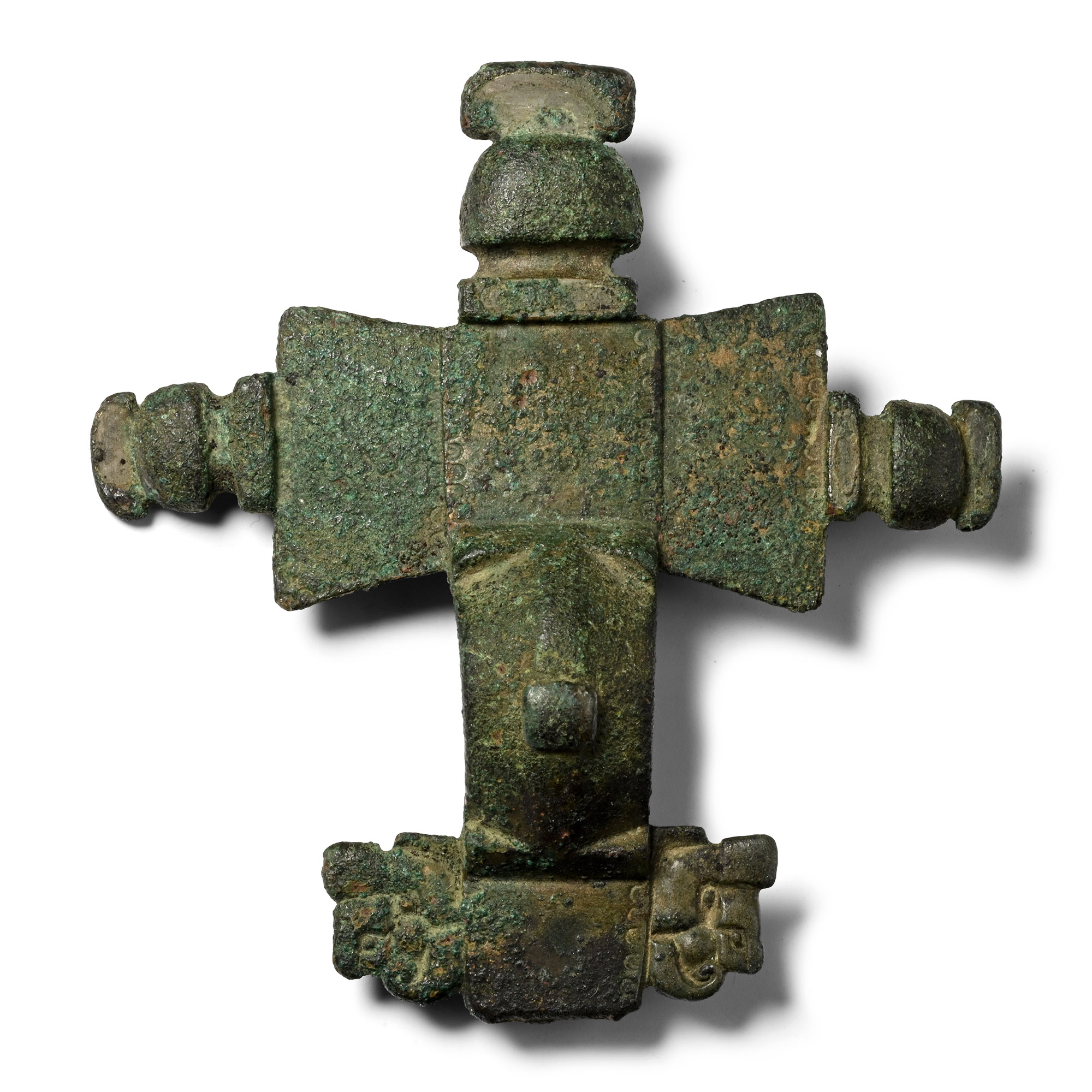
Large Anglo-Saxon Cruciform Brooch Section
CIRCA 6TH CENTURY A.D.
3 1/8 in. (54.3 grams, 81 mm).
Comprising the rectangular headplate from a cruciform brooch (Group IV(dii)) with raised central panel bearing horseshoe stamps on the lateral edges, trapezoidal wings and three integrally-cast waisted lugs each with a D-shaped panel to the outer edge; deep bow of curved section with central square-section knop and spandrels at each end; portion of footplate with lateral lappets each formed as a Style I profile bird-head; portion of catch to reverse and ferrous mass marking the remains of the iron pin. [No Reserve]
ProvenanceFrom the private collection of the late collection of Mr M., Waterlooville, Hampshire, UK, formed from the late 1980s to early 1990s.
LiteratureCf. West, S. A Corpus of Anglo-Saxon Finds From Suffolk, East Anglian Archaeology 84, Ipswich, 1998, fig.151 (7).
CONDITIONTimeLine Auctions follows a vetting process to ensure the authenticity and legality of all items, reinforcing our commitment to integrity and responsible trading. Each antiquity, antique, and coin lot undergoes thorough examination by a vetting committee of at least ten external specialists, professional trade association members, scientists, and archaeologists: Our Vetting Process
AUCTIONS:
TimeLine is a leading auction house specialising in antiquities, ancient art, collectables, natural history, coins, medals, and books. Our auctions offer museums, collectors, historians, and enthusiasts the opportunity to acquire unique and historically significant pieces.
-
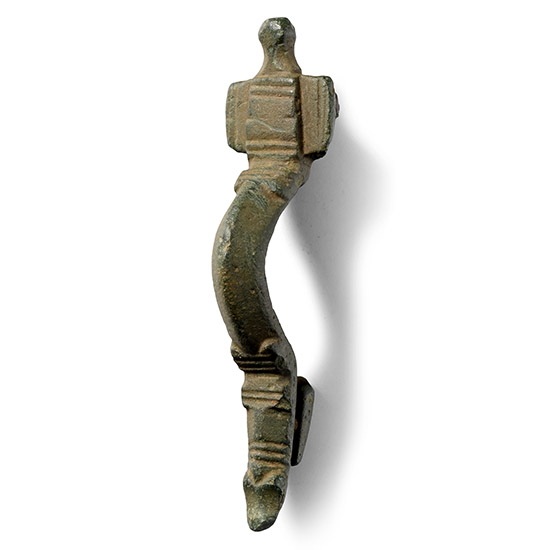
Anglo-Saxon Zoomorphic Cruciform Brooch
Late 5th century A.D.Sold for (Inc. bp): £59
The headplate with a raised trapezoidal panel with rectangular wings decorated with grooves, a full-round knob projecting from the end of the central panel, a keeled bow and an animal head foot; a catchplate and pin-lugs on the reverse. 16.8 grams, 64 mm
Found Uttlesford, Essex, UK. Accompanied by a copy of the British Museum's Portable Antiquities Scheme (PAS) report no.SF-0D30CE. -
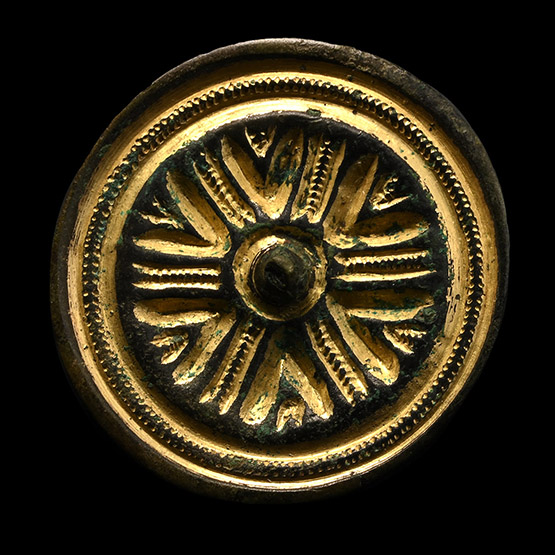
Large Anglo-Saxon Gilt Bronze Saucer Brooch
Late 5th-6th century A.D.Sold for (Inc. bp): £754
Discoid in plan with raised rim and inner ridge decorated with notches, six radiating arms with notch detailing and interstitial chevrons; central knop rivetted from reverse; remains of catch to reverse. 20.4 grams, 37 mm
Found Seaham, Co Durham, UK. Property of a Durham private collector.
The saucer brooch was one of the commonest types of brooches used by Anglo-Saxon women, usually occurring in matched pairs on the chest. This typology extends in time from the 5th to the late 6th century, especially diffused south of the Humber and East of the Severn, with a concentration in the south Midlands and Upper Thames Valley. -
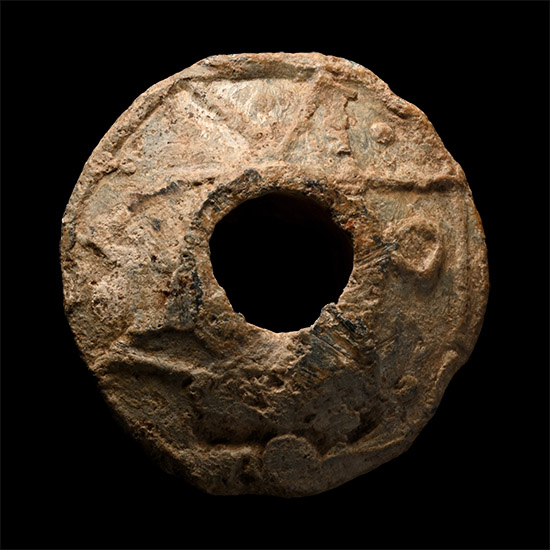
Post Saxon Decorated Lead Spindle Whorl with Runic Letter
Circa 1200 A.D.Sold for (Inc. bp): £7
Biconical in form, with flat top and bottom surfaces, central perforation measuring 9.2 mm; both surfaces decorated with raised motifs including a non-standard rune shape (but similar to the Hægel rune). 29.1 grams, 28 mm
Found near Grimsby, North East Lincolnshire, UK. Accompanied by a copy of the British Museum's Portable Antiquities Scheme (PAS) report no.LIN-5C4312.
The raised design resembles some Anglo-Saxon runes: for example, the Hægel rune with a pellet, Yr rune and others. Perhaps the motifs were designed by someone who had seen runes in a text somewhere.
